

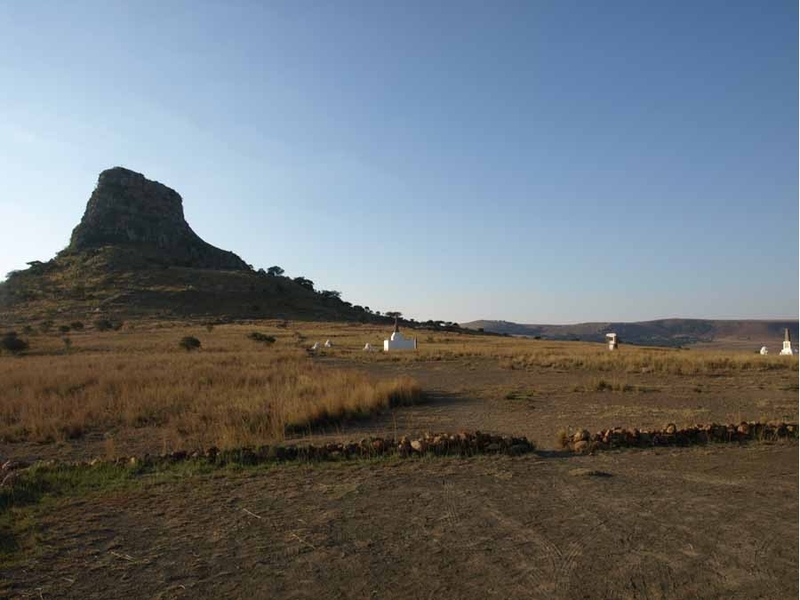
Michael Caine got it right, - it was epic stuff. Thousands of Zulus, pouring up the conical hill met by the heavily armed Brits who were about to get their comeuppance, against some Africans with simple spears.
David won. Goliath lost. Little white cairns mark the spots where the British soldiers were buried in fives and sixes. There are 269 of them in all, simple whitewashed monuments  marking where the remains of 1,329 soldiers are scattered over a wide section of the plain. It is only by surveying them that you can see exactly how ridiculously far away from their camp the English staged their stand.
Rob Gerrard relives the battle every day with a passion that comes from a lifetime studying British military history. His booming Ampleforth accent paints the scene, baking heat, lush long grass which allowed the Zulu warriors to creep up unnoticed, and the fear of the red-shirted squaddies who were far from home.
The Zulus carried spears and clubs; the British were armed with modern rifles and two heavy guns. The Zulu commander, Ntshingwayo, used a masterly deception plan to lure Lord Chelmsford, the British commander, and 3,000 troops away from their main camp and send them on a wild goose chase across the plains. Then Ntshingwayo opened a massive attack on the weakened British force left in the camp. Of 1,774 invading troops in the camp, only 55 survived.
More officers died at Isandlwana than at Waterloo - 52 versus 48 respectively. And Rob Gerrard reckons there were 1,000 Irish among the 1,700 dead. All of the infantry were Irish, he says. Scattered through the Churches of Ireland are monuments to the guys who died far from home on the plain of Isandlwana - the monument to Neville Coghill in Castlehaven Church of Ireland is a good example.
Gerrard names the other Irish officers, Anthony Durnford from Dublin, who retreated uphill and has a stand point named in his honour, Major Reynolds, the surgeon, and Colour Sergeant Bourne, who died just as World War II was coming to an end.
And James Rorke, the Down man after whom Rorke’s Drift was named. There he had a trading post where he sold supplies to people crossing the river while his wife supplied unspecified favours to travellers.
 James Rorke arrived there sometime before 1849 and shot himself in a drunken stupor in 1875 when he realised his supply of gin had not arrived. Four years later his homestead was defended by a heavily armed group of British against poorly armed Zulu reserves. It was less a battle than a turkey shoot. The strange thing is that the Zulus won two major battles against the overwhelmingly superiorly armed British. Why? “Arrogance,” says Gerrard.
There are 126 battlefields in total in this region, from the days when Europe came to steal the spoils of Africa. Gerrard knows them all. Boer against Zulu is commemorated at the side of the Blood River; the Anglo-Zulu war at Isandlwana and Rorke’s drift, and there are the various battle sites of the Boer war, when the English and Dutch fought over somebody else’s land.
Spion Kop is a godforsaken hill that was so famous Liverpool’s football supporters’ terrace was named in its honour. And at Talana you get the best museum of the area, commemorating all the wars.
At Talana the Royal Irish and Dublin Fusiliers took the hill from the Boers, then while pursuing Boers got captured themselves in one of the most farcical episodes of Irish military history.
The Fusiliers got a gate to Stephen’s Green named in their honour and Talana was commemorated in a famous Dublin street ballad at the time:
"Dicey took a lad named Walsh; Dooley got McGurk.
"Gilligan turned in Fahey's boy - for his father he used to work.
They had marched to fight the English - but Irish were all they could see - that's how the 'English fought the Dutch' at the Battle of Dundee."
Not all the wars were as merry. The Zulu victors at Isandlwana had no memorial to their dead there until the 120th anniversary of the battle in 1999.
In the meantime the English and the Boers competed with each other to put up gaudy monuments to their heroes and the  politicians and military personnel all came through to lay wreaths and celebrate their fallen heroes. More Zulus died here than invaders.
Surveying the monuments, you would be forgiven for thinking it was the Zulus who had invaded England, not the other way 'round.
Now, belatedly, there is a Zulu monument at Rorke’s drift too: a series of shields laid on the ground and a Umphafa tree, the sacred tree where the spirits of the ancestors can be found.
Isandlwana is an out of the way place, and just under the rock from where Ntshingwayo watched the battle, Pat Stubbs runs the Isandlwana lodge. She came from Florida in 1996 hoping to find an opportunity to invest in a bush camp in Botswana but ended up here instead.
Building of the Lodge became the “second Battle of Isandlwana,” according to Pat, because supplies and building materials had to be hauled a long distance to the site. There was no road, no water and no electricity but she did it in the end. She feels the spirit of 1879 never went away. “When something dramatic happens, the impact hangs over the landscape.”
Peace now reigns. In the dark of the morning the birds call like dying men and the outline of the hill rises against the African sky. Armies and nations recover from the epic events of history. Battlefields never do.
• Discover Africa offers self-drive holidays in KwaZulu Natal which focus on the Isandlwana and other battlefields, as well as spa and activity stops. For further information visit 67 Middle Abbey Street, Dublin 1, Tel 01–8720128, email info@discoverafrica.ie or log onto www.discoverafrica.ie.
• Isandlwana Lodge is a two hour drive from Durban. For further information Tel +2711 537 4620 or +27 34 271 8301/4/5, email lodge@isandlwana.co.za or visit www.isandlwana.co.za.
• Rob Gerrard, FRGS, conducts battlefield tours of Isandlwana and Rorke’s Drift on a daily basis. Tours of other Anglo Zulu and Anglo Boer War sites, including Talana, can be booked in advance. To book Tel. +2711 537 4620, email lodge@isandlwana.co.za or visit www.isandlwana.co.za.
Eoghan Corry
RTÉ is not responsible for content on external websites.
