


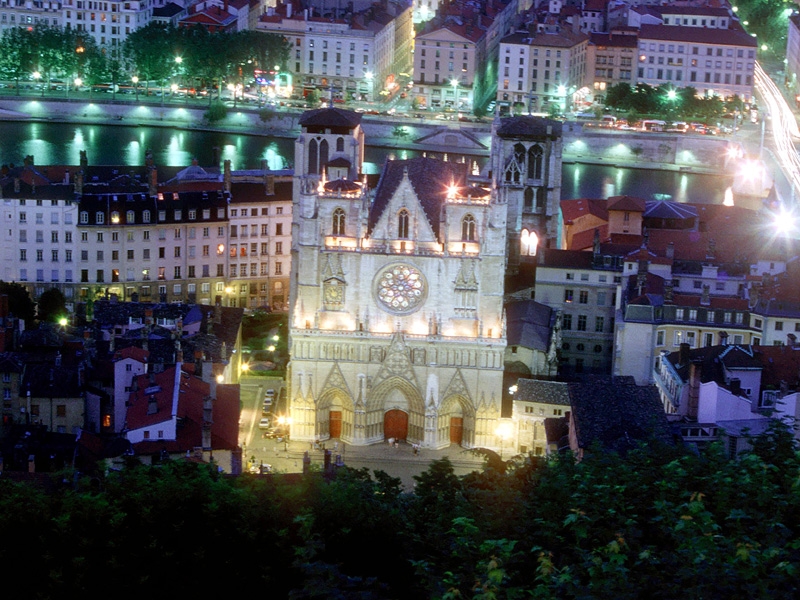
One city, two great rivers. The River Saône seems reluctant to join the Rhône at first. It flows through the French plains, ignoring Mont Blanc thrust into the skyline a long way away, it comes within a short walk of its sister river and then seems to change its mind. Eventually, reluctantly, it loses its name and takes the plunge.
The resulting long finger-like peninsula lies in between the rivers as the striking location which became the heart of France’s second city. Paris has its left bank, Lyon has its right bank.
It is on the right bank of the Saône where the heart of the city is found. Vieux Lyon is probably the finest surviving architectural complex anywhere from the Renaissance period.
Decayed, shabby and in danger of collapse in the 1980s it has been restored through a series of tax incentives and inventive social housing schemes, which means that the beautiful courtyards of Old Lyon are accessible during daylight hours.
It is like the renaissance breathes again in these little streets and pokey alleyways. Bicycles and bakeries are to be found in the quaint courtyards with pink hued towers and balconies sprung straight from 'Romeo and Juliet'.
 Workmen in the alleys are carefully re-cobbling the streets. And, most delicious of all, the smell of the city’s distinctive cuisine floods the peninsula every lunch time and again in the evening. The aromas from the local restaurants, and the bouchons, waft upwards to the white marbled basilica, which looks down approvingly on the action below. You can stand on the hilltop and look towards the Alps, look at the parallel river-motion and tell yourself that this is a sacred place.
It all goes back to 'Lugh Lámh Fhada', the Celtic superhero who gave his name to the month of August, 'Lughnasa' and the Brian Friel play. Back in the days when they played hurling on the banks of the Rhône, the place was called Lugh-Dun. When the Romans rolled over the district and set up home, the name evolved to Lugdunum until it became today’s Lyon. By the first century AD there were 50,000 people living here – it was the original French metropolis and the capital of France when Paris was still in short pants.
The grandeur of the city lingers most strikingly in the hill top basilica. Giant murals commemorate the great events in local, French and church history – including the martyrdom of France’s first Christians in 177AD.
Blandin is a popular girl’s name here, named for one of the martyrs who was gored by a bull, after the lion who was supposed to maul her, had a religious experience and changed his mind.
 The city’s cathedral lies on the riverbank beside the old town, reflecting centuries during which the real power lay with the archbishops. They offered a refuge for the Pope in times of stress and hosted ecumenical councils to be held there in 1245 and again in 1274.
At Lyons they almost got the Catholic and orthodox churches to reunite and decided on the white smoke method of electing popes we still use today. And, irony of ironies, at this beautiful river confluence they invented purgatory.
The third river of Lyon, as the locals delight in telling you, is the delicious red stuff that flows annually from the limestone escarpments of the Côte du Beaujolaise, home of one of the most widely drunk wines in the world.
Beaujolais is a marketing triumph of the late 20th century. The fashionable and trendy cannot get enough of this product of the Gamay grape, its medium red colour, its relatively light body and its fruity, refreshing taste. It is virtually the only red wine which is best served chilled.
The grapes are harvested in September, the crop announced with great fanfare in Belleville and delivered to the shelves within months. Half of the wine is drunk nouveau. There is no better way of spending a day than among the wineries of the surrounding countryside, there they will show you the process and explain the lore of the Beaujeu area.
Ten villages in the North reputedly produce the best Beaujolais, classified as 'Grands Crus', notably Moulin-à-Vent and Fleurie.
At Chateau de Pizay there is a four star hotel and spa in the heart of the vineyards, with its own vineyard and cellar serving Morgon, Brouilly and Régnié Crus.
 In St Jean d’Ardières you can discover the 'Rendez-vous de Bobosse' local products and wine tasting. They will tell you these Beaujolais-villages have more colour and body and are considered to be superior in quality. The tasting is a religious experience in itself. If the right bank was where purgatory was invented, this is indeed heaven.
• Eoghan Corry flew to Lyon with Air France which offers connections to Lyon through Paris' Charles de Gaulle airport. Aer Lingus fly to Lyon. Ryanair fly to nearby Grenoble. Lyon is two hours from Paris by TGV (Train à Grande Vitesse aka the French Fast Train).
• For further information visit www.rhonealpes-tourisme.fr
Eoghan Corry
RTÉ is not responsible for the content of external websites.
