


Malaysia's dance of the seven veils has been a joy to behold.
In the late 1970s and early 1980s it revealed its beach destinations to Ireland's growing band of holiday hunters, Penang and half a dozen others, whose white sand and palm lined beaches fill our brochures.
Then we got interested in the exotic jungles of Sabah and Sarawak, the Borneo provinces – as far from peninsular Malaysia as Poland is from us. Nearly 15,000 Irish people a year now travel to Malaysia. But the one that was most familiar, the stopover destination of Kuala Lumpur, has been overlooked for what it is.
Kuala Lumpur barely featured on maps, never mind travel maps, until the 19th century.
When Melaka was a famous destination, Kuala Lumpur was a river swamp, prone to flooding. The last ten years has seen the rise of a new type of tourist destination, the Asian citybreak.
The Asian citybreak was a creation of the stopover requirements of Aussie-bound airlines, but it has now got a life of its own, with Singapore, Hong Kong, Dubai, Bangkok and Bombay featuring alongside Kuala Lumpur.
KL, as they call it, wanted to be top of the market. They built the signature attractions - the KL tower and the Petronas Towers which are two of the tallest structures in the world, and tourists like an icon.
The KL tower comes complete with spectacular views, the revolving restaurant that creates at least one 'where's my handbag gone' incident every evening (it's usually on the window sill at the other side of the room by the time you have finished the post-dinner Tiger beer).
The Towers visit brings you to the viewing deck on the 38th floor between them, giving the viewer a unique feeling of being suspended above with KL spreadeagled below.
This is a strange place to have such a built environment. The place is still true to its marshy heritage, and still floods in monsoon season. The rivers are, by necessity, filled with concrete culverts and drains. The two rivers that gave the city its name are now almost peripheral to the landscape, but they remind us all of their existence every rainy season.
Sungai Gombak (previously known as Sungai Lumpur, which means muddy river) and Sungai Klang (Klang River) were used to derive the name Kuala Lumpur which literally means 'muddy estuary'.
The swamp is buried under a city whose frenzied activity belies by the heat. Market stalls mix with massive shopping centres.
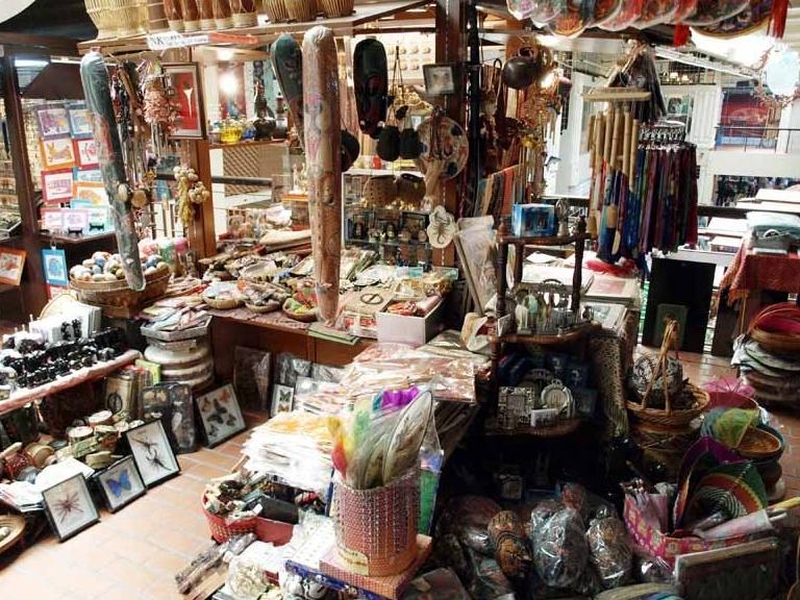
The gadgets and computer centre is an attraction in itself. Chinatown, with its fake Rolexes and pirate DVDs, is best visited in the dark, when the air is filled with bargains and with tourists being persuaded to pay five times the going price for everything. Everything needs to be argued, even the top end malls expect you to haggle, about 20% below the going rate. In Chinatown offer him one sixth of the price and endure the insults. It is worth it in the end.
This is not Malacca or Singapore, and therefore has a special charm of its own. In fact Kuala Lumpur has a point to prove exactly because of Singapore. The buildings must be higher, the cosmopolitanism must be more cosmopolitan, the attractions must be more attractive, the traffic more chaotic and the food must be tastier.
The charm of the city is that it is a stopping off point, not just for tourists, but for every aspect of Asian culture, every aspect of the world. It applies to its religion, its culture and most famously to its food.
The Malaysian side cafes are like pubs in rural Ireland, full of character and eccentricities in their own right, staffed and patronised by characters and eccentrics. The conversations are long and unhurried, and the local delicacies are served with pride.
The slow-cooked works of art served up by the amazing chef John Locke in Precious restaurant in Chinatown look too handsome to eat, but you will be glad when you do.
Go to a spot beside the Petronas Towers for an Indian meal that will knock you out. Even the hotel breakfasts are uniquely Malaysian in an increasingly homogenised foodie world. There are several thousand more restaurants in the city, serving regional specialties from all over Malaysia.
Each has its signature dishes, but what is on the plate is only part of the action. If you go to the top floor of the central market you still see what would pass as a food hall anywhere else, but here is a temple to the art of dining, fast food treated like slow food should be, ordinary families celebrating the indulgence of their taste buds in the humid noon. Even if your plate is empty, stay and watch.
• Eoghan Corry flew to Kuala Lumpur with Air Malaysia and stayed at Berjaya Times Square Hotel & Convention Centre Kuala Lumpur. 019 200 9500
• Bukit Nanas Forest Reserve can be reached on the monorail. A guided walk takes you through the ancient forest.
• The National Museum along the Mahameru Highway offers various types of collection such as artifacts and paintings collected throughout the country.
• The Islamic Arts Museum houses more than seven thousand artifacts as well as an exceptional library of Islamic-art books is located at Jalan Lembah Perdana next to the National Mosque.
• The premier performing arts venue is the Petronas Philharmonic Hall, check locally for concerts, you can't miss it at the base of the Petronas Towers.
• Petronas Art Gallery centre for fine art is situated in Kuala Lumpur City Centre
• There are excursions to the Batu Caves, a limestone hill in the Gombak district, north of Kuala Lumpur, which has a series of caves and cave temples.
• Bukit Bintang Shopping Area, LOT 10, Bukit Bintang Shopping Complex, Star Hill Gallery, KL Plaza and Petaling Street market offer shopping opportunities.
