

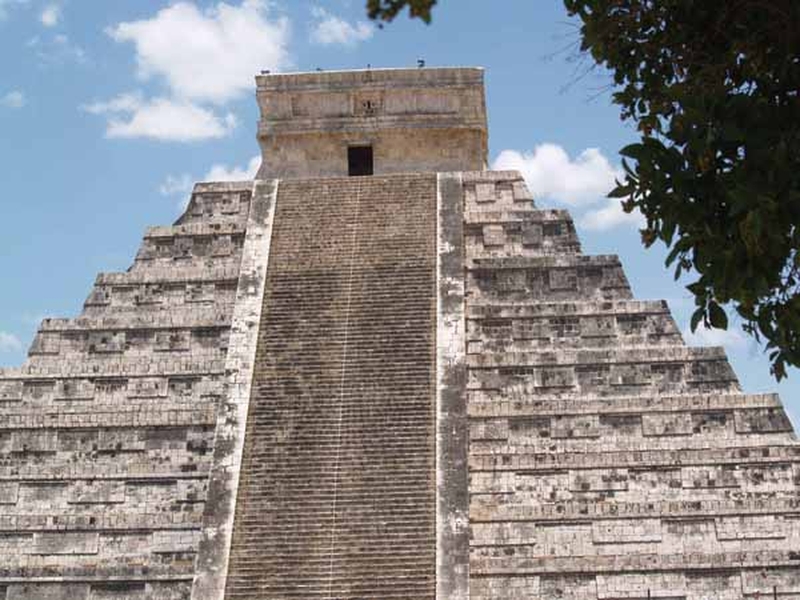
One of the world’s iconic buildings is about to perform. The guide claps his hands on front of the Kukulcán pyramid at Chichén Itzá on Mexico's Yucatan peninsula. Clap, clap, clap go the guide's hands.
'Aka, aka, aka' answers the pyramid. 'That is the sound of the quetzal, the sacred bird of the Mayans, and still the national bird of Guatemala,' he says.
Luis Chay is a Mayan who has been guiding for 20 years. There is an element of pride in showing off the great city that the Mayans have left behind, and the fabulous acoustics of the temples and the ball courts.
'People say the Mayans went away,' he says. 'We are still here.'
Mel Gibson has already proved the point. His new movie Apocalypta, is going to catapult the Mayans and their prophecies in to the heart of human culture. The date 2012 is for some a mantra for the end of the world, for others including Luis Chai just a version of what happened when fundamentalist Christians began to worry about the end of the second millennium.
It is also crucial to Mexico's plan to become the fourth largest tourist destination in the world by 2008. Chichén Itzá is growing by the year into a temple much larger than the block we see on our day trip from Cancun.
It was at one stage the leader in the campaign for the new wonders of the world, having failed to make the first list 2,000 years ago. It is now in fourth place and highly likely to make it to the end. Chichén Itzá, or Chicken Pizza to those comedians who make the charter journey from Ireland, is the jewel in the crown of historic Mexico, before Mel Gibson and long after he is gone.
Funny how Chichén Itzá, the epitome of all that is cultural, has become an addendum of Cancun, the man-made resort designed to drag American tourists southwards in the 1970s.
It is in a separate state and is a long day tour away, but they flock down from Cancun at an average of 5,000 visitors a day. The trip includes a rest stop in a Mayan village on the way down, lunch at one of the dozens of local eateries which have sprung up to net the dollars, and for some, a swim in a cenote, one of the local pools formed by sinkholes in limestone formations.
One of these pools gave Chichén Itzá its name, the chi (mouths) of chen (wells) of Itzá and the original villagers used the water for agriculture from about 500ad. Their clusters of buildings are swallowed up by the forests and ignored on the shorter tours even the more interesting ones, like the observatory El Caracol (The Snail).
Human sacrifice, the bit the tourists like to hear about, came later between 800 and 1100ad, including the champion of the ball court, the one who had managed to send the ball through a stone hoop with his ancient Mayan caman. He was ceremoniously decapitated and sent to glory with the Gods after his feat.
The highlight of the Chichén Itzá year is the equinox when 50,000 people gather to watch the equivalent of a light show, where the sun lights the 91 stairs of the pyramid in turn until it reaches the snake¹s head at the bottom.
Then it is back to worship the modern light shows at the lively nightspots at the end of Cancun lagoon.
There is no direct charter to Cancun this summer. Many holiday companies run excursions to Cancun through Paris & Madrid.
Ireland Exotic Travel International Ltd specialises in catering for Irish visitors, Plaza La Mansión Costa Blanca, Local B 4-5, Blvd. Kukulkan Km.8.5, Cancún Q. Roo 77500 Tel:(52) 998 883 4188- Fax:(52) 998883 4364 - exoticmexico@gmail.com
See also www.questbeyond.com www.questbeyond.com Quest Beyond Ltd, Ballindinas, Barntown, Co Wexford, Ireland info@questbeyond.com
Archaeological tours out of Cancuninclude Chichén Itzá from US$45. Jungle tour from US$55. Dolphin encounter from US$59. Snorkel tour from US$40. Xcaret eco park US$467. Scuba diving from US$50. Fishing tour from US$99. ATV our from US$45. Horseback from US$55. Bullfight from US$35. Caribbean carnival from US$65. Pirates tour (evening dinner on ancient galleon replica) from US$70. www.amomexico.com http://www.amomexico.com +52 998 898 3135 gerencia@amomexico.com
