


When you position yourself out in the middle of the Atlantic, as the nine islands in the Azores archipelago have done, it is as if the whole of creation comes by to gape.
Whales, dolphins, migratory birds, sailors, pirates and aviators have all passed through. Seamlessly, these people moved from being the edge of the medieval world to the centre of the world of navigation. Now they are fighting for a place on the tourism map, that their location at the heart of nature’s wonderland, richly deserves.
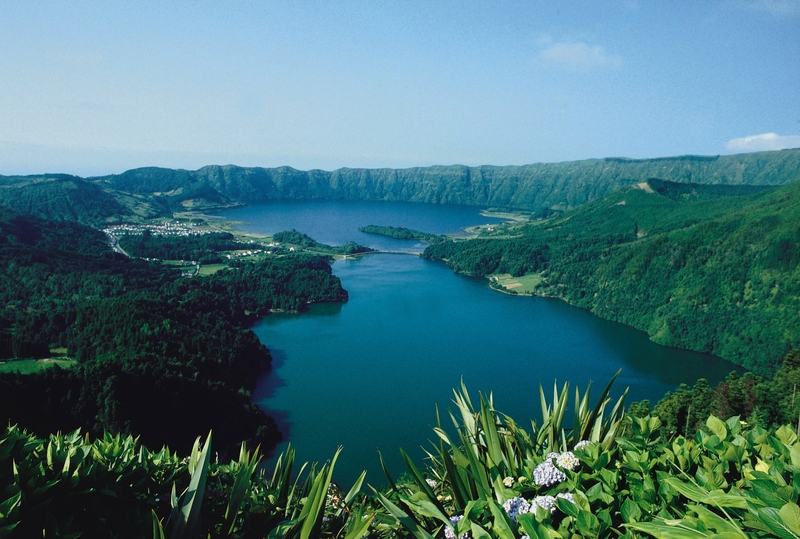
The first view of San Miguel is from the charter plane window, multitudinous red roofs atop whitewashed houses, shades of Tom Jones green, a lake (Lagoa das Fumas), plopped methodically behind a hill, high cliffs and streaks of river run and a fringe of white foam to show where the sea ends and the paradise begins.
In the patches of farm-fenced field, cattle wander as speckles. The hotels built to harvest the tourists betray their presence with blue patch swimming pools.
San Miguel, the mammy Azore, is on the same latitude as Lisbon and perched in the Gulf Stream, so temperatures go from a year round average of 14 degrees to 28 in summer. Sea temperatures vary between 16 and 22.
That isn’t as warm as we have been used to in the other Atlantic archipelago islands, the Canaries and Madeira. But it offers more than beach, which is why the Azores has been picked by Sunway and Atlantic holidays as the new summer destination for 2007. This is a green botanic idyll, a cooler Madeira farther out in the Atlantic and a lot more prone to the vicissitudes of the ocean than we might have expected. It rains, it blows, it shines, and it carves out the landscape.
Think West of Ireland for that stunning landscape. Think Sicily with Etna smoking for that feeling of being on an Atlantean anvil. Think of childhood holidays on empty sandy beaches and the distinctive Portuguese aura of Madeira with even quieter resorts. Think of boat trips out to the heart of the great Atlantic in quest of whale pictures, fast paddling turtles, and fishermen harvesting squid. Think of exotic flowers filling the corners of every vista and steaming cauldrons of boiling water, plumes of smoke and the smell of sulphur. Think of small bars with cavernous dance floors with pulsating reggae played by Cape Verde musicians. Think of quiet roadside bars where beer costs 90 cent. Then you have begun to sample the Azores sensation.
What is on show? Whales, birds, flowers and Fenomeno Vulcanico, the geysers and springs that dot the island and remind us of how they came about in the first place. Parts of the island are 30 million years old, other parts only 50,000.
Around the town of Fumas, in the valleys above Ribiera Grande, and in various other pockets you can see the caldeiras, smoking potholes where hell seems to seethe. In some of them they will bake your stew for an evening meal: the famous Cozido das Furnas, Flann O’Brien might fancy that the meal should be washed down with 'a drop of the crater'.
In the Vale das Furnas, a lush garden at the bottom of a huge volcanic crater, the warm water bubbles in brooks. In Parque Terra Nostra, exotic tropical plants live side by side with those from colder climates.
Around a corner and you halt to let a farmer bring his cows back for milking. Around another and you come to a tea plantation, the only ones in Europe. They also grow the only pineapples in Europe. Wild garlic flowers speckle the hedgerows, azaleas and other exotica roam like kings of the shrubbery.
The entire island is a botanic garden, with 60 indigenous species; cedar, scotch heather, heath, sheepberry and 'pau branco', daphne and tamujo. Unlike Madeira there are real beaches here.
Prices range from €700 for a four-star in May to about €1,600 for a five-star in August - prices more in line with Sicily than the Algarve.
You can see why the sailors who made those old maps were fazed by the Azores. They sailed through at a time of many volcanic eruptions, so they put fire-breathing dragons and the symbols of hellfire on the western extremes of their maps. It must have looked as if the world was coming to the edge here, so going further would have required a spirit of adventure.
The key to the Azores is that spirit of adventure. It will never be the Canaries, and we can be grateful for that. The landscape will always perform, because it is one of the most versatile on the planet. The streaming pools and puffing whales are worth a visit. But the real Azores is best found with hiking boots and a bit of time to wander slowly through one of the most beautiful landscapes on the planet.
This is not the end of the world after all, but perhaps the beginning of a love affair for Irish holidaymakers.
For more information www.visitportugal.com and www.visitazores.org
San Miguel tourist office in Ponta Delgada Tel +351 296 284569 info.turismo@drt.raa.pt
Sunway commences a weekly charter service direct from Dublin to the Azores in May.
Sata airlines operates the Sunway charter and operates flights between the islands. www.sata.pt +351 707 227282 booking@sata.pt
