


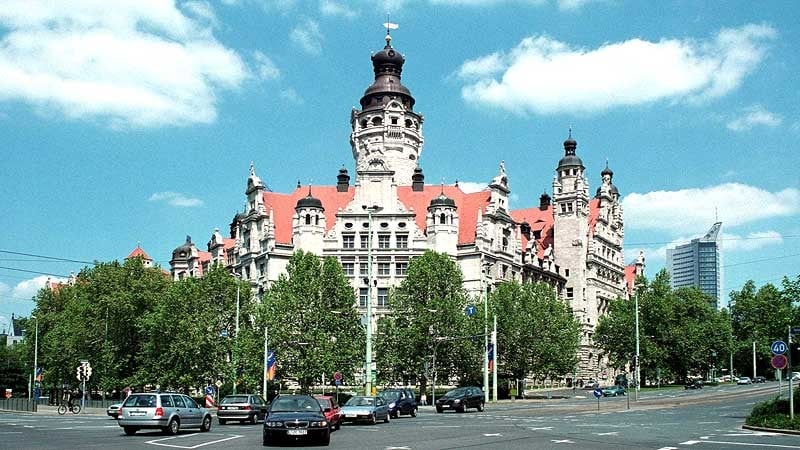
When they picked the venues for the 2006 World Cup, German authorities needed one city in the former East Germany outside of the capital Berlin. With an eye to history, they chose Leipzig. Not because of its football team, which is lost in the recesses of the lower leagues, but because they want to rekindle interest in a storied and beautiful city whose commanding position on two intersecting trade routes made it one of Europe's wealthiest medieval capitals.
The trouble was, the recent past had not been as kind to Leipzig. One-quarter of Leipzig was destroyed in the last years of World War II, but it was no more drastically bombed in WWII than others, especially local rival Dresden.
Having ended up under American occupation, Leipzig was traded to the Russians at Potsdam and went into a tailspin of decline. The legacy of that trade-off can be seen in the suburbs of the city: abandoned industrial complexes, social realist housing and dilapidated flats. So they commissioned a local artist to drape a great football canvas creation on front of the worst examples so visitors wouldn't have to look at the eyesore.
These smiling former East Germans are nothing if not pragmatic. Having hauled themselves out of the post-traumatic disorder of the 1990s, they are now looking to new tourist markets to showcase their unique combination of picture postcard village life and an outstanding modern story of strength in the face of adversity.
For 17 years investment has poured into Leipzig, restoring and rebuilding and transforming it back to some of its medieval splendour. First stop nowadays for most visitors is the shiny new airport, but Leipzig's glory is the railway station through which visitors of yesteryear arrived.
Leipzig is still the centre of many railway lines, and its main railway station is one of the most impressive passenger stations in Europe. Part of it has been transformed into a shopping centre, diminishing the monumental scale but bringing much more activity to the building.
Historic landmarks that were restored after World War II include the Old Town Hall, the Old Commercial Exchange, the old residential and market squares, Auerbach's Cellar, and the 13th-century Church of St Thomas.
The skyline of the modern city now includes the university tower (a waitress carries your schnapps to the top where you view the city) and new hotels and commercial and residential buildings.
Within the city, former woodlands along the riverbanks have been partly converted to parks and a breathing space where the former beauty of the city can be appreciated. So modern, yet ancient at the same time. Close your eyes and you might hear Faust announcing his latest magical illusion.
Medieval Leipzig must have been an exciting place, as travellers, merchants, musicians and magicians called round to the two annual markets - at Easter and at Michaelmas (both were raised in 1497 to the rank of imperial fairs).
Leipzig's importance meant it was host to three battles during the Thirty Years' War: in particular the Battle of Leipzig (or Battle of the Nations) in October 1813 in the Napoleonic Wars.
Leipzig had become the foremost German commercial centre by about 1700, with a network of roads converging on the town. For 27 years, Johann Sebastian Bach was cantor at St Thomas's Church (Thomaskirche), and is buried in the altar room.
In Leipzig he wrote hundreds of cantatas, numerous motets, the Magnificat, and the St John and St Matthew Passions. In the Bose House, the Bach research centre next door, there is also the Bach Museum.
In 1839 the first German railroad was opened between Leipzig and Dresden. Trading also created the famous covered shopping arcades, most of which developed out of inner courtyards.
Leipzig was the centre of the book business and was Germany's most important banking centre and stock exchange. But since the 1940s it has watched helplessly as Frankfurt stole its clothes.
For most visitors, the recent history of how the city won its soul back from the devil is more interesting than Faust. The fall of the Berlin Wall came about because of cracks which began to show in Leipzig's Church of St Nicholas (Nikolaikirche), where the local Pastor Fuhrer led prayers for peace every Monday to growing crowds.
Almost everyone in the town will tell you their personal experience of how, in October 1989, it led the charge to freedom. Peaceful but massive demonstrations by citizens of the city in October 1989 were to shake the foundations of the Berlin Wall. They speak of fear, the fear of what the soldiers were to do, and the joy in realising that in the end, a dark age had passed.
* Lufthansa flies connections to Leipzig through Frankfurt daily. Leipzib can also be reached by fast train direct from Frankfurt airport.
