


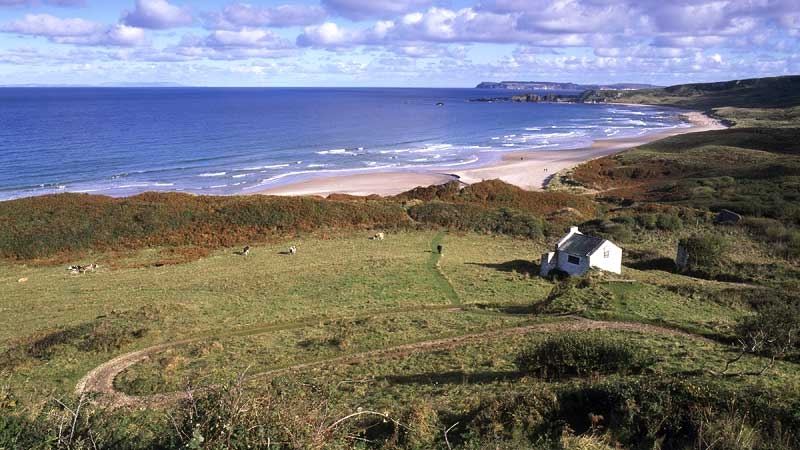
Why is it with islands that small is always more beautiful? The comfort of being able to hear the sea humming from every angle sends us southwards across the world in search of islands of the palm fringed variety or northwards in search of something more rugged and seabird-songed.
Fortunately we don’t have to go far. Ireland and Scotland have some of the most beautiful small islands in the world. The L-shaped Rathlin sits between Scotland and Ireland, almost unsure in which of two of the beautiful seascapes it wishes to participate. In the end it opts for a little bit of both and a little contribution of its own. Rugged beauty with shrubbery.
For a wind-and-sea battered island, Rathlin does great foliage. As you wander the roads the sea peeps, laughs and twinkles at you through gaps in the trees. Around another turn there is a shimmering lake, surrounded by baby lakes. A loud and boisterous brook streams down behind the school house.
The bits of this landscape which don’t have foliage give way instead to heather. There is one section where you walk along a ridge of colour-bending bracken, sea to the right and left of you, the most spectacular view of the Mull of Kintyre and Antrim’s Fair head ahead of you and the sound of sea and seagulls in your ears.
Ballycastle ferry
You reach Rathlin by ferry from Ballycastle. Twice in summer and once in winter the ferry plies its trade, carrying trailer-loads of topsoil and red post vans to and fro. Just collect your map at Ballycastle ferry port, pay your GB£9/€13.50 for a return ticket and off you go. Leave the car behind. Visitors are not supposed to bring cars, (you need a permit for a car on the island) and there has been an ongoing problem with the dumping of mainland vehicles.
Rathlin figures on the very first maps of Ireland but evidence of the stories in history is sparse. Bruce’s castle (if it was built by him at all) is just a pile of stones. The Vikings loved Rathlin so much they chose it for the very first of their 'shock and awe' raids in 795. Francis Drake came to massacre the family of Sorley Boy McDonnell here in 1575. The screams are still recalled in folklore.
Marconi, or at least his assistant, created a gentler sound when he sent the world’s first wireless message here from Ballycastle in 1891. A century later the sound was of gas exhaling from Richard Branson’s balloon when he arrived unexpectedly.
Branson has given his name to the local hostel, which seems appropriate. The 18th century manor house has been restored as a B&B and there is another guesthouse in Church Bay. Most people come for day trips, which probably don't do the island justice.
Lighthouses dominate the seascape. Three of them are positioned at strategic places to prevent shipping mishaps, and form ideal destination points for walks along the narrow roads.
Main attractions
Walking and bird watching are the main attractions. There is a bird observation post near the West Lighthouse which is open between April and August, and they come to watch guillemots, fulmars, kittiwakes, Manx shearwaters, razorbills and puffins.
A World War II wreck at the mouth of the bay is a starting point for a large number of divers who come by. Colonies of grey and common seal can be seen at Mill Bay at the walk to the south lighthouse.
The island is four miles by three miles long, is never wider than a mile, 3,500 acres and a succession of small mirror lakes. The angle of the L faces towards Antrim, and it is here the 100 or so inhabitants, all Catholic with one Protestant family, are huddled around the single pub, two churches, two shops, school and craft shop with a small selection of Rathlin-made handicrafts.
Church Bay, as it is known, is just a staging point for three walks into some of the most beautiful heather-lined walkways you will find anywhere. It is around the three lighthouses that you can share the landscape of Rathlin’s high-end, jugged 450-feet cliffs facing towards Scotland from where Robbie Bruce famously came to shelter in a sea cave and met a determined spider. The spider didn’t give in and Bruce decided he wouldn’t either, so he went back for a rematch with the English at Bannockburn.
You can’t get into the cave from land. Which sort of makes sense when you think of it. Every visitor to Rathlin comes home with a little more determination than when they arrived.
