


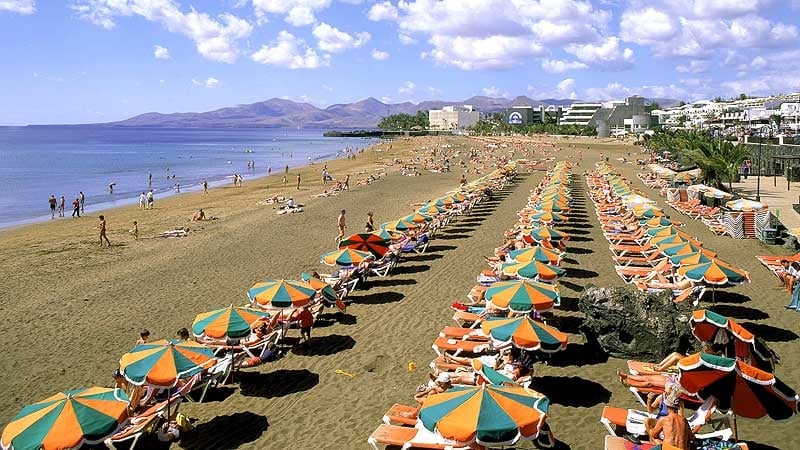
Lanzarote is still Ireland's favourite winter sun destination and a large summer sun contingent also takes the four-hour flight southwards.
And strangely, in the midst of the sun rush, both it and Tenerife have much to offer the solace-seeker.
Holidaymakers gravitate towards the same sunspots, Puerto del Carmen and Los Pocillos. The resorts here had a name for being boisterous in the 1980s but have calmed down considerably. It was Michael Palin who coined the phrase Lanzagrotty for the high-rise developments along the coast.
The coastal strip is fun, but most tourists are unaware of the greater island beyond. The inland colonial towns have a Moorish feel, left undisturbed by the hubbub of the passing tourist boom.
Occasionally in the open landscape, to the side of the road are reminders that, holiday island or no, people still have their lives to live. Crops grow on the rocky fields and animals watch the traffic go by.
In Puerto De La Cruz you will find the Hotel Botanico, five-star recluse of the Hola magazine set: an occasional stopping place for Michael Jackson and an escape for King Juan Carlos from the reign in Spain.
Keep an eye on the chandelier in the main hall. If furniture could speak, all of the Botanico's would have lots to tell, but it is this chandelier which has the hairiest tale of all. Two years ago a Russian visitor, plied with vodka and bravado, leaped from an upstairs landing in a Yeltsinesque frenzy to swing off the cut-glass chandelier. In testing its pendulous qualities he almost brought the whole thing to a glassy end.
The gardens are worth a visit in themselves, while the hotel offers that rarity; a heated salt water swimming pool. Of the recent refurbishment, the glory is the Oriental restaurant, exquisitely decorated in woodcuts worthy of Bangkok.
From here there is a burgeoning industry in tours by off-road vehicles, driven by Englishmen with tales to tell who commute between the winter season in Lanzarote, and hill walking options in peaceful hills that might be Connemara with perpetual blue skies. In the still air, turn around a ridge of volcanic rock and you might be on another continent from the swinging nightlife and sunbed mania of the south.
The distant clang of a cow's bell, or the bleating of a goat, carries for miles in the still air.
While Tenerife's volcano, Teide, is in graceful retirement, Lanzarote's volcano still earns its keep. In Timinfaya national park you can visit El Diablo, the crater restaurant, to have your burgers cooked by genuine hell-fire. Guides stoke up the black smoking rock to show you the sulphuric embers and do fire tricks for busloads of tourists up from the Playa. To each side of the road, wastelands of black rock extend as far as the eye can see, beautiful and stark and dead, a useful back-drop for any Redemptorist's mission sermon. They are relics of eruptions in 1730-36 and again in 1824.
Africa is only 60 miles away, a slice of Spain shining bright beside the dark continent. Canary Island history is a painful story of colonialists and indigenous population, just 300 who lived in the north of the island when Jean de Bethencourt conquered it for the Castilians in 1402. In Arrecife, the old stone Castillo de San Jose guards the harbour, while the art collection inside pays homage to local protégé Cesar Manrique.
Back on the coastline in Costa Teguise, an 18-hole golf course offers a shaley round without demanding championship winning skills. The "fishing villages" of the brochures don't always check out (if you want a real Spanish fishing village, try Castletownbere), but Playa Blanca has a feeling that a fishermen might still stop by, if only to visit the cousin's sangria-stall.
Escape is surprisingly easy. Papagayo offer relatively unswamped bays within miles of Playa Blanco. Refuges further north include Haria, the valley of the ten thousand palms with its spectacular volcanic tubes, Cueva de los Verdes and Jameos del Agua.
The small marina coffee-shops have a relaxed feel, there are real people there who can tell you what it was like before the tourist influx and take time to chat.
Costa Teguise's pale sandy beach contrasts with the others of the island (the colour-preferences of Canary volcanoes never cease to amaze: the nearly adjoining beaches of Playa de Las Americas and Los Cristianos have completely different sand).
