

Jamaica has been making rum since 1749, so it doesn't take much imagination to visualise sailors, pirates and musketeers downing the delicious fruit of the sugar cane.
Rum, as we know nowadays, tastes better from a cocktail glass on a beach filled with white, white sand, with a Caribbean sunset to help it slide down better.
That is what Jamaica means for most people nowadays. A lot of Jamaican holidays are all inclusive, but there is much to see and beautiful restaurants to sample around the compound. You needn't leave the hotel but that would be a shame because there is so much to see.
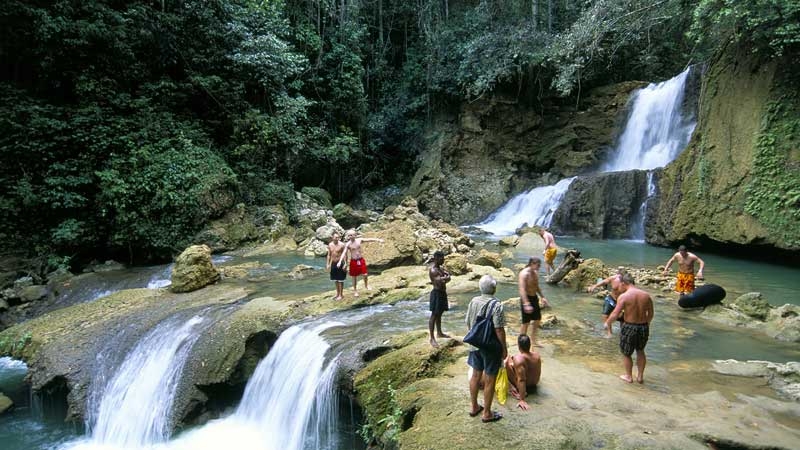
The best attraction is natural. Be prepared to get very wet - you walk up the streams of cascading water (about 600ft) to Dunn's River Falls.
And beaches. Negril boasts one of the longest beaches you will see in a resort, all seven miles of it. It gets crowded here in summer. But never fear. Just a little way along the coast, one will find 'the real Jamaica' with fishing villages like Treasure Beach, Port Antonio and Oracabessa providing quieter retreats.
You can take a Jeep Safari excursion which goes round all the back roads and to the place where Bob Marley was born. There is a museum and mausoleum dedicated to the great man himself at Nine Miles.
The two main tourist resorts are Negril and Montego Bay, Jamaica's second city known to one and all as Mo' Bay.
A major port for the sugar and banana industries during the 18th and 19th centuries (with a few buildings surviving from this period), the town centre is chaotic and built up but still keeps the laid back atmosphere which makes Jamaica famous somewhere in the middle of it all.
Ochos Rios is famous for its shopping more than its beach, because so many cruise ships come to call.
There is duty-free shopping galore in various plazas including one modelled on the Taj Mahal in India. Large hotels stock everything from Swiss watches to designer clothes, craft markets; roadside stalls supply a variety of souvenirs, handicrafts, clothing and accessories.
Kingston, the capital, has elegant, old colonial houses against the stunning backdrop of the Blue Mountains.
Jamaica gained a reputation for violence about ten years ago but things have improved beyond recognition. There certainly are no-go areas in Kingston, but most Jamaicans are overwhelmingly friendly and fun-loving.
Go, if you can, in late April, May or early December. Taking into account both the weather and the prices, these are the best times.
To improve your chances of a trouble-free holiday, book a package. The Caribbean is not as geared up to independent travel as Europe or the United States.
Most traffic is concentrated in three resorts, Montego Bay is Jamaica's tourist heart and second largest town after Kingston. Gloucester Avenue is a buzzing two-mile strip lined with touristy shops, restaurants, discos, bars, hotels and apartments as well as fine beaches. A word of warning: a few of the hotels are close to the international airport.
Negril was the magnet for the hippies and flower-children of the 1970s and still has the laid-back atmosphere. It straggles along the coast for around nine miles. Most of the hotels are on the seaward side of the main road. The beach stretches in a sandy crescent for five miles to the north with another sandy stretch at Bloody Bay beyond.
Ocho Rios is a bustling town with mostly hotel-type accommodation, covering the full range of ratings. It caters extensively to the cruise-ship trade, which floods in from the docks on an almost daily basis to neatly polished, "tourist-friendly" amenities. You can chose from a variety of live shows almost every night including a barbecue pirate's night.
Most Irish go for weddings and honeymoons but access is good and prices are terrific at the moment. And there is a cricket world cup coming up next year.
