

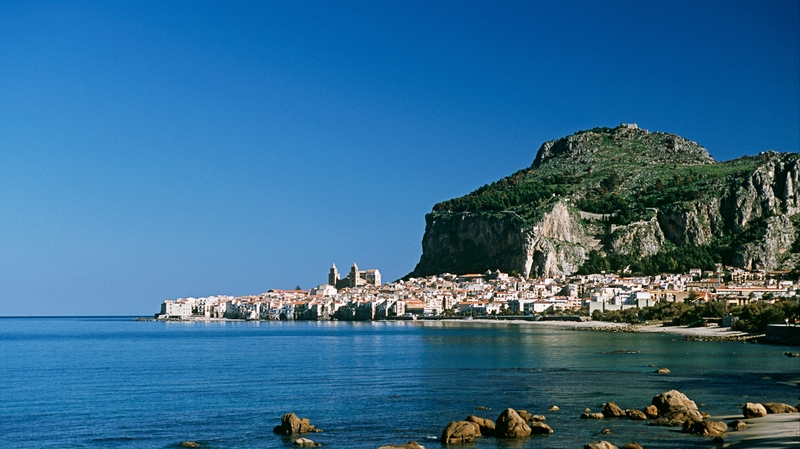
The volcano is the best show on Sicily, a Mediterranean island where showmanship is a way of life. Mount Etna looms over the citrus and olive groves like a shy prima donna. Her head is usually in the clouds. Her flanks of black lava serve as a reminder of her pre-eminence over all of life in the birthplace of the Mafia and other dark legends.
Every time that Etna splutters forth another stream of black-gravy magna, the villagers in the mountains shrug their shoulders nonchalantly and carry on life as they have for millennia. The residents of one village were in danger of being overrun for three weeks in 1992. They stayed put, confident that the problem would be solved and the mountain would spare their homes.
Sicilians like to reassure you. They will tell you that Etna is a slow volcano, not a top-blower like Mount St Helen’s, with a place in her hot heart for the Sicilians who cling to her flanks.
Sometimes, it must be admitted, optimism has to succumb to geology. One remarkable scene: a house buried under a flow just beside the Nicolosi road. While neighbours escaped, this one was destroyed by a 1983 eruption. Further downhill, one of a pair of houses was destroyed while its neighbour escaped. A third lost its garden as the lava went by at an arm’s length.
Marco di Bella has grown up to love this mountain. Over lunch at the restaurant Terraza del Etna, he will tell you about the sulphuric gastronomics of the mountain. In 1983 customers continued to eat here as they watched the molten lava creep past, secured by an earthen dike. When the lava cooled the vista to the south was gone forever, obscured by a black ridge of rock.
So was the road, and the competition. The restaurant next door, La Contoniera, was flattened by fire and rebuilt at a level 20 metres above its previous location. Around here, contours are as relevant as last week’s football results.
The communities who return after each great eruption participate in an elaborate and ancient ceremonial of fire and rebirth. It takes 100 years for the first plants to colonise the cooked lava, and centuries more for the species to thrive: Etna Broom, Etna Violet, Holy Pulvino thorn, and acitulidda.
Long before the plants come the hucksters. Their shops and stalls can be found in two little clusters near the summit, peddlers of postcards, videotape, ashtrays snatched in a mould from the molten lava minerals, and clusters of crystals baked in the 700c cauldron.
The summit, where four craters keep the heat on, can be reached by gondola – a relatively expensive €33 for a journey that takes 20 minutes of chairlift, a jeep ride and a walking tour with a guide, two and a half hours in all. How a private company ended up owning the rights to the gondola ride to the summit is anybody’s guess.
At the top you can look in and smell the sulphur. Crater Centrale has been smouldering for 8,000 years. The northeast crater was born in 1911, the southeast in 1968. Boccanuova, new mouth, was born in 1994.
The legacy of all that turmoil is that beautiful towns are built on hilltops, keeping away invaders (and tourists) who suffer from vertigo. Each hilltop feels like a frontier. Each village watches its back for treachery. Cue the Godfather music.
You can approach Taormina by corkscrew road or chairlift, depending on your sense of adventure. The views are most spectacular from its celebrated Greek theatre. Other Mediterranean theatres point east to the sunrise.
Taormina’s earliest residents directed its prayers to Etna. Life has imitated art ever since. Among those who have come to worship are the high priests of celluloid and literature. In July the film festival is staged here and the glitterati of Italy converge to sit on the benches. Woody Allen stopped in to shoot the Mighty Aphrodite there. The church where Michael got married in the Godfather sits a little lower on the hillside in Forza di Agro. DH Lawrence and Guy de Maupassant are celebrated travellers here. The Etna-Taormina poetry prize was once famous.
“Here we have the grandfathers of all the grapes” Mario Monforte, Hotel manager of the Hellenia Hotel, declares. The wines of the island can vary from valley to valley, farm to farm. They are cheap, rarely exported except to mix with better-known descendants, and surprising.
At his hotel under Mount Etna, he will happily bring you for a tour through the menu for the day: baked anchovies with mint, sedanini with wreckfish sauce, and spatolafish rolls with salmoriglio sauce. He will also bring you through the kitchen to meet the craftsmen who created it.
Sicilian food is like no other, different from the Italian mainland, and has a variety of vegetables, olives, pistachio nuts, garlic, fruits, honey and wine.
Over 2,000 years right in the heart of the Mediterranean world the preparation of food became the greatest Sicilian art of all.
· Sunway Holidays list five hotels in Taormina and six in the nearby beach resort of Giardini Naxos. See your travel agent, book online at www.sunway.ie or phone Sunway on 01-2886828
