


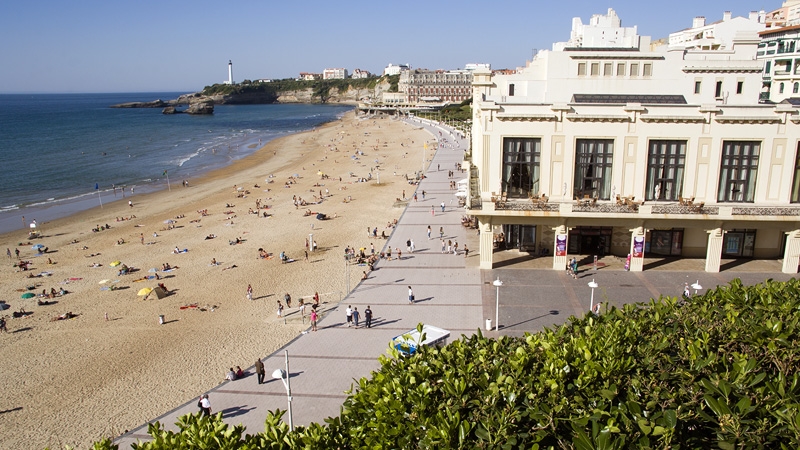
South west France, close to the Spanish border has been opened up by a new Ryanair route from Dublin. The town, spectacularly situated on cliffs over two large beaches, has been a favourite getaway for Parisians since the days of Napoleon III, and has lost none of its old grandeur.
A lot of the attractions are outdoors and accessed freely, as the old port, the Virgin on the rock and the lighthouse. The Virgin stays on guard on a rocky promontory alongside a promenade runs between the sandy beaches of the Grand Plage, facing northwest, and the Côte des Basques.
The sense of grandeur can be found everywhere, especially in the large buildings dominating the seafront. Once a small fishing village, Biarritz was made fashionable after 1854 by Napoleon III and his Spanish empress, Eugénie. Biarritz began to call itself ‘the queen of resorts and the resort of kings’ and Europe’s crowned heads of the 19th century began to hang out there in wintertime. It was here in 1867 that the Spanish military commander and premier Leopoldo O’Donnell, descendant of Red Hugh, died.
There is an array of family attractions for when the weather is cooler or wetter, the Musee de la Mer, the musee Asiatica, and the petit train which passes all the main attractions in Biarritz.
The glistening grandeur of the golden age is even more apparent a few kilometres south at St Jean de Luz, where the pelota courts of the Basque village mark out the boundaries of a new cultural heritage.
Excursions opt for the mountain market towns of Pau, Oloron-Sainte-Marie, and Saint-Jean-Pied-de-Port.
Saint-Jean-Pied-de-Port is the archetypal Pyrenean village. The old Bishop’s Prison has been turned into a small but extremely evocative museum dedicated to the hundreds of thousands of pilgrims who passed this way on the way to Santiago de Compastelo.
The pilgrims wore the trophies of their journey on their hat, carried a long stick and trundled along half shod roads into the mountains. In a way, it better represents the sprit of tourism in the age of low cost air fares than the sight of Eugénie’s palatial hotel on the seafront.
