



Journalist Victoria Brunton sits down with Dublin designer Mark McNulty about his latest work, blurring the lines between ancient Irish and Japanese designs.
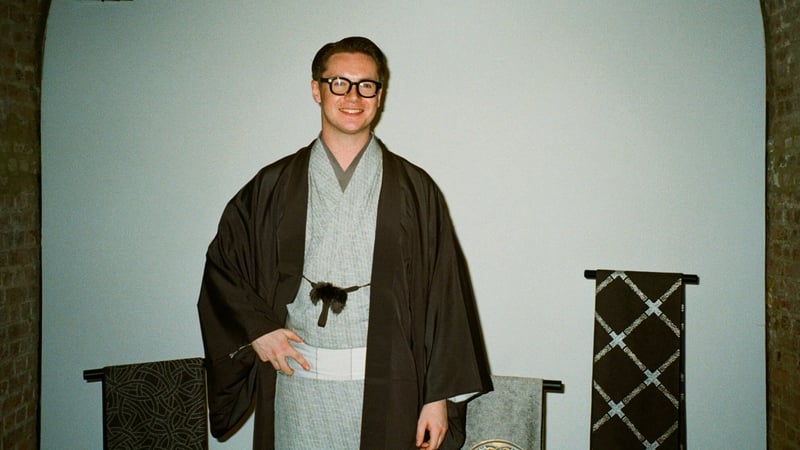
I meet Mark McNulty during London Craft Week at the RSA, where he arrives dressed entirely in kimono.
Not styled like one, not inspired by one, but wearing an actual hand-tailored and hand-dyed kimono, worn with the ease of somebody for whom it has become part of everyday life – which, as it happens, checks out.
"I probably have close to 30 kimono at this stage… I wear one every day. Actually, I think when I come back to Tokyo the week after next, there's going to be a new one waiting for me," he laughs.
Mark, originally from Dublin, now works for a renowned Tokyo-based kimono house, Ginza Motoji. Founded in 1979, the institution is recognised for championing traditional kimono craftsmanship and the artisans behind it. But how did he get there?
"I studied textiles in NCAD," he tells me. "I loved fashion always, but I didn’t necessarily want to study fashion. I was a lot more into the fabric itself."
Originally, the plan for McNulty was Paris – maybe working at Dior or Schiaparelli, specialising in embroidery and moulage. "Especially couture," he adds. "But then I went to Japan on holiday, when I was in NCAD, and I really enjoyed it."
Quickly, he realised two weeks wasn’t long enough – returning for a full year shortly after, whilst most of his friends and fellow students were also taking a year out or studying abroad.
Once there, McNulty taught English during the day, immersing himself in the culture completely outside of work. "Every day after work and every day off, I spent researching; going to kimono shops, looking at brands, going to libraries and art museums."
After that year, McNulty returned back to Ireland – graduating from NCAD with a degree in Textiles, Art and Artefact. "After graduating I said, you know what, Paris will always be there. I’ll go back to Japan again and see what’s going on."
Over seven years later, he’s still there.
What piqued McNulty’s interest in the Kimono was not solely aesthetic, but the entire process. "I love stuff made by hand," he says. "And nowadays, most fashion isn’t made by hand."
An appreciation that eventually led him to discover Ginza Motoji. "Every kimono I saw that I really liked was from Ginza Motoji," he explains. "So one day I found the website, and I just sent them an email. My mum always used to say, 'Just knock on the door anywhere you want to work.’And it worked! They let me in."
Last year, one of the artisans working with Ginza Motoji, Hiroki Asano of Kyoto weaving house Shokuraku Asano, approached Mark – he had become fascinated by Celtic patterns and their relationship to obi - the traditional sash worn with kimono.
"He said Celtic patterns had caught his eye," Mark explains. "And he thought they suited the narrow, continuous form of the obi."
"I heard that, and I just said, ‘Okay, we’ll have a holiday!’"
What followed was a whirlwind journey across our little island: Dublin, Newgrange, Clonmacnoise, Galway, Inis Meáin, Donegal, Belfast and back again – "about a thousand kilometres in five or six days," McNulty acknowledges. "I don’t drive, so I didn’t realise what I’d done to my poor boss."
I was curious about what struck the Japanese designers most about our landscape.
"We’d be driving, and they’d point at a castle and ask how old it was," McNulty answered. "You’d Google it, and it would say the 700s. They just couldn’t believe it."
"Another thing they always said was the sky was so wide," he recalls. "Because there’s no mountains, just a purple-grey ceiling of clouds."
That classic, dreary ‘grey’ sky most Irish natives would admit to loathing, would eventually become central to the collection itself.
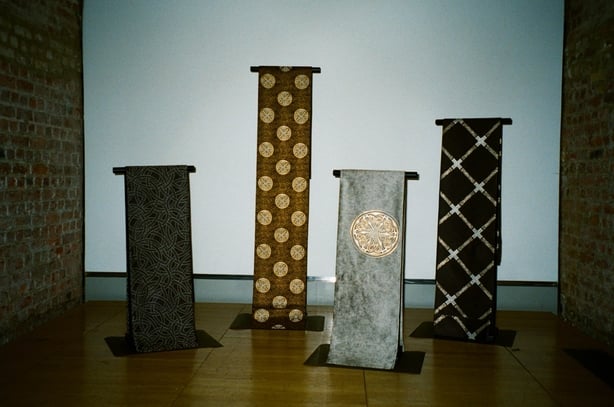
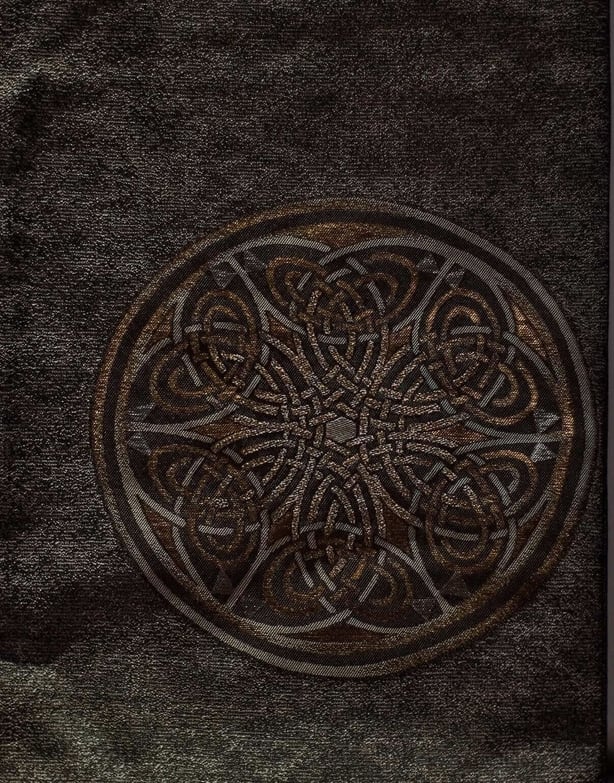
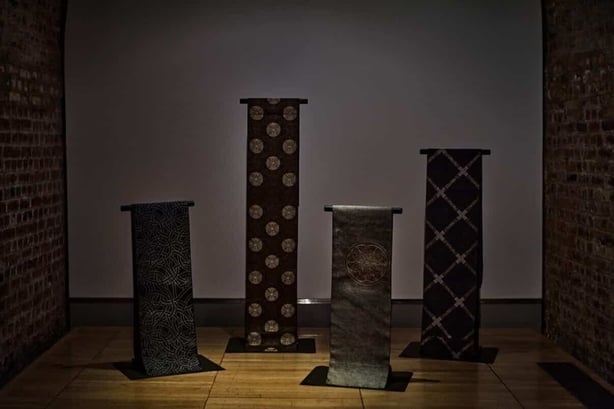
One obi, inspired by circular Celtic motifs from the Book of Kells, is spun from a weave specially coloured in a never-before crafted tone pulled directly from the stone and skies the group encountered.
Another references the Book of Durrow through interlacing crosses and circular forms. Gold threads are intentionally dulled and twisted with grey silk to give the work what McNulty calls "that bit of age".
"They look gorgeous and brand new," he says, "but they have this ancientness as well."
The way each piece is designed is so restrained – nothing feels overtly literal or costume-like, every detail is filtered carefully through true craftsmanship.
"You do the design, and then you take away, take away, take away," McNulty elaborates. "That way you end up with the most beautiful elements of the piece."
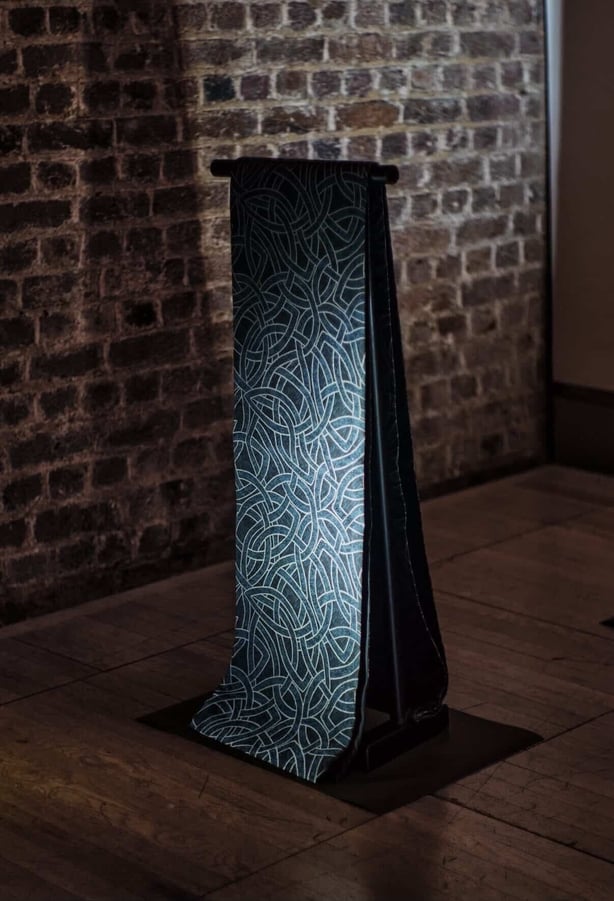
In a third obi, Celtic motifs dissolve into woven texture; a nod to Herringbone references Donegal tweed – inspired by a visit to Molloy & Sons – without replicating it directly. The palette remains almost entirely within silver greys, blacks and muted blues, resulting in an almost illusionary effect.
As an Irish person who followed his passions all the way to Tokyo, now fulfilling his life’s ambition, I assumed watching traditional Irish motifs interpreted through Japanese craftsmanship was an extremely special moment for McNulty.
"It’s a real privilege," he says. "If you come to the shop and see the work that goes into these kimono, it’s just so much work. For someone to come to Ireland, do all the research, and then put all that brain power into making such a beautiful obi…"
He pauses for a moment to reflect before continuing.
"I mean, there are people now in Tokyo walking around wearing patterns from the Book of Kells. That’s really incredible, I think."
To me, this project is about more than national pride – it’s about Irish craft refracted through another island culture equally committed to preservation, ritual and textile history, and McNulty has facilitated that.
As he approaches a decade in Japan, wears a Kimono daily and speaks Japanese fluently, I was curious to know McNulty’s views on the similarities and differences between both of the places he calls home.
"The line is very blurred for me now," he says, laughing. "I forget what’s Irish and what’s Japanese."
"Japanese people have tea ceremony," he says. "And Irish people are the exact same. You come into my house, you sit on the couch and the kettle’s on."
To end our conversation, I ask if there is a Japanese word he particularly loves the meaning of – perhaps something missing from our language. He thinks for a moment before choosing ‘kigokochi’.
"It roughly translates to how something you wear makes you feel, but it’s not just physical," he explains. "It’s how something makes you feel mentally as well. Powerful, or at ease."
He gestures lightly to the kimono he is wearing – hand-dyed, hand-cut and tailored entirely by hand.
"You buy something because it looks beautiful," he says. "But when you wear it, that’s when you understand."
The views expressed here are those of the author and do not represent or reflect the views of RTÉ
