


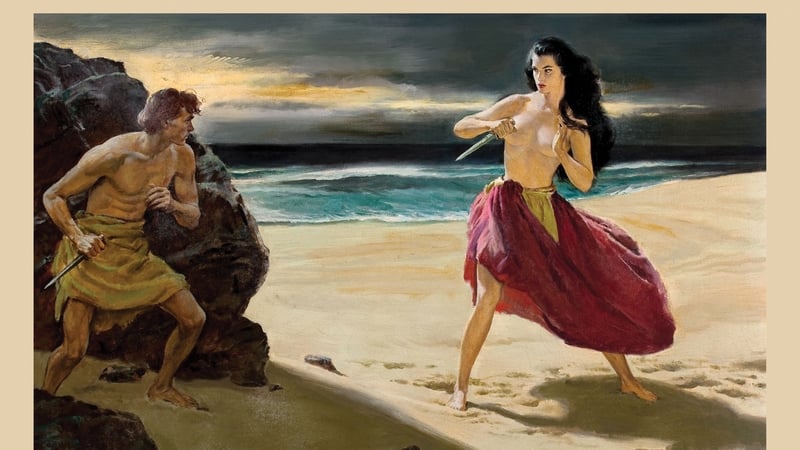

Sailor, plunderer, mercenary, wife: Grace O’Malley contained a multitude. As a slew of projects in her name unfurl, Kate Demolder discovers why the world has aligned itself with Ireland’s nearly-forgotten queen.
News landed in the Irish historical world with a bang: A new film, set to bring the story of one of Ireland’s unsung heroes, is coming to the big screen.
Kirsten Sheridan––the Oscar-nominated writer who wrote several episodes of Say Nothing, was an executive producer on Lockerbie: A Search for Truth, and also happens to be the daughter of renowned filmmaker, Jim––has optioned Grace O’Malley: The Biography of Ireland’s Pirate Queen by biographer Anne Chambers, with production set for sometime this year.
The film joins a slate of other O’Malley-related contributions to the world, including an ARTE documentary, a hotel built in her name, a new storytelling show and Ireland’s first-ever Grace O’Malley Festival, held on the very shores she once guarded.
The reason behind the wave of modern appreciation for Ireland's pirate queen? "It’s because she is real," Dea Birkett, joint founder of the Grace O’Malley Festival, insists with a conviction one imagines Grace might have applauded.
"I think all Irish people, in particular women, are fed up with the green goddesses with red hair, curvy bodies and spells being held up as the ideal. Grace, by contrast, was cunning and awkward and gutsy… and is someone far more inspiring than a gorgeous, impossible goddess."
Indeed, in an era where women rarely had a life beyond their home, O’Malley defied expectations to become a scourge of Ireland's west coast, not dissimilar to the way that Black Beard was the scourge of the Spanish Main.
While other women were duty-bound to their husbands' whims, and often without free will, O’Malley took on the role of any number of then-male-dominated positions: sailor, captain, plunderer, mercenary, rebel, pirate.
"She is, without doubt, a woman of today," Birkett continues. "She was feisty, wild, difficult and wonderful… and incredibly relevant to all women fighting similarly today."
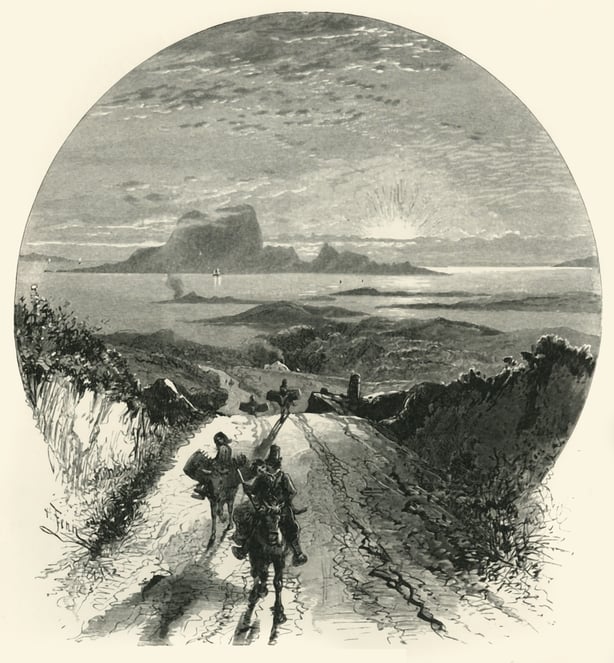
According to the Women’s Museum of Ireland, O’Malley - also known under a slew of monikers: Gráinne O’Máille, Bald Grace Granuaile, or the Pirate Queen - was born around 1530, most likely off the west coast of Ireland, and possibly near Clew Bay.
Her father was the leader of a great seafaring clan which ruled the waves near Achill Island for some 300 years, collecting taxes from all who passed through. Grace, herself, was known to be so fearsome and revered as a leader that she inherited her father’s position upon his death over her older brother, and as leader, expanded her power through marriage and came to rule large swathes of land across Connacht.
Perhaps most unusual about her story, however, is the fact that she only became a figure of note by chance, as Chambers found reference to her in English state records in the mid-70s. Chambers subsequently published a biography in 1979, which is now in its 11th edition.
"Airbrushed out of history is how I suppose you might say it," smiles Mary Fergus, the manager at the Granuaile Centre in Louisburgh. "She was not mentioned at all until Anne Chambers began investigating. To think we almost didn’t know her. I suppose, at one stage, people might have thought that her story was folklore… But Anne has the documentation to prove that her story wasn’t fictitious, that she did exist, and that she is a formidable woman at that."
Although the English were expanding into Ireland throughout her reign, Grace had mainly been left to her own devices. That was until geopolitical issues heightened, when Grace responded by aligning more closely with other Irish Lords who were in open rebellion against English conquest.
She soon came to command three galleys, 20 ships, and some 200 men. So fierce was her reputation that an English Lord once referred to her as a "nurse of all rebellions in this province for 40 years."
"She was quite feared and respected," Fergal agrees. "There’s a story of her turning up with an army of 200 men to a merchant’s group in Galway, and that she was the leader of them all, not her husband. It really is quite remarkable to think."
The voyage for which Grace is best known was to London, where she confronted Queen Elizabeth I about the kidnapping of her two sons and half-brother. She famously requested an audience with the monarch and refused to bow to her due to their presumed equal stature, but was quickly reprimanded when guards found a knife hidden in Grace’s dress.
To turn things around, she negotiated with the Queen in Latin, the sole language they shared. She managed to secure the release of her family members and even a promise from the Queen to have a controversial English Lord step down from his position, but the Queen had a request of her own: that Grace no longer support the Irish rebellion.
Elizabeth eventually reneged on her side of the bargain, and before long, the Pirate Queen was fighting again. "Women at the minute, are fighting for their freedom like never before," Birkett continues. "And Grace is exactly the woman to gather around right now, because that’s exactly what she did. She fought for herself, her family, her land… the same thing that millions of women around the world are doing at this very moment. At a time when we’re faced with overbearing political dictators, that can’t help but resonate."
Grace most likely died of natural causes at Rockfleet Castle around 1603, leaving behind a legacy that continued to inspire her compatriots for generations. (A detailed, ornate plaque near her suspected crypt in the Abbey has the O'Malley motto Terra Marique Potens, Latin for "powerful by land and sea.")
Today, she is perhaps honoured by the castles that depict her legacy - Rockfleet Castle, Kildavnet Castle, and Clare Island Castle, also known as Granuaile’s Castles/Towers - as well as a mural of a new kind; The Grace Hotel in Westport.
"There’s a whole history of Grace here in Westport House," Siobhán O’Sullivan, Director of Marketing & Sales at the hotel says. "The family that used to own the estate were direct descendants of her, and her former castle was on the foundations of Westport House." (The hotel restaurant, named the Black Sheep, also exists to honour her legacy, as does the Gráinne Ale beer festival held annually.)
"She was a force of nature, a rebel, and we’re looking to bring the same spirit of power here. Men always seem to get the hero’s treatment, but women never really did. Now that St Brigid is getting her flowers, Grace should too. And with all that’s going on about her, that’s only going to get bigger and bigger."
Echoing the need for Grace’s personal brand push is Birkett. "It’s great that Brigit is being celebrated," she says. "But she’s a saint… I don’t know any woman who wants to be a saint. Grace, by contrast, is real."
2030 will see Grace’s would-be 500th birthday, with renewed interest in her story bolstering further festivities. Just last year, the Mayo town of Newport unveiled a statue in her honour, and a restoration of Rockfleet has continued to attract visitors.
Brands of whiskey and gin named after the clan chieftain are now on sale in about 30 countries, interactive exhibitions are being held in her name, and the O’Malley Clan Association, which is in its 70th year, are on the precipice of finding further O’Malley descendants through its Finding Grace project. However, Birkett, her fiercest defender, insists that more should be done to herald our almost forgotten queen.
"I think we should pick a day and celebrate her annually," she says. "To celebrate the real women in the past, present and future." When pressed on what date she might choose, Birkett concludes with: "Maybe the September Equinox? When the world is changing, and darkness is coming in, that’s when we need Grace the most, to carry us through the long, dark winter."
The inaugural Grace O'Malley Festival takes place on Achill Island from May 22–24, 2026. Produced by Circus250, the festival features the aerial outdoor show Grace – The Story of a Pirate Queen, plus live music, storytelling, and heritage events in the Mayo region.
