



50 years after one of Ireland's most significant collections of costumes and textiles was destroyed in a fire, with just one precious object spared, a new exhibition in the Ulster Museum celebrates the painstaking work of restoring that archive. Fashion historian Laura Fitzachary reports from the opening last weekend.
Where does one even begin when faced with the loss of a near-complete collection? This must have been the question when news reached the employees of Malone House in South Belfast on 11 November 1976.
A staff memo circulated on the day of the fire listed the profound amount of damage done, including "10,000 or so items destroyed, along with their records".
"The specimens lost included one of the best collections of linen damask in the world, a rare Elizabethan embroidered jacket, a costume collection with items of nearly every year from the 1770s to the 1970s, and a very good collection of 18th century dress, Irish, English and continental lace, Irish and foreign embroidery including 17th century embroidery, and fans, toys, dolls, needlework tools, fashion plates, photograph albums, foreign costume and all costume accessories."
How had such a collection come to be destroyed? More unfortunate still, it turned out to be collateral damage in the broader carnage of The Troubles.
Malone House, the former headquarters of the National Trust in Northern Ireland, was located in a public country park called Barnett Demesne on the outskirts of Belfast.
The Ulster Museum held the top floor and was comprised of eight rooms for storage areas and a textile conservation workshop. Adding insult to injury, the costume and textile collection had only finally gained a well-fitted home and was in the last stages of becoming completely accessible.
Curator Elizabeth McCrum recalled that "despite the usual security precautions at the entrance of Malone House, gunmen gained entry and planted two bombs, one on the ground floor and one on the first floor…"
While everyone in the building at the time was safely evacuated, she noted, "the costume and textile collection on the second floor collapsed on top of the fire, and quickly perished."
It was McCrum who was faced with the gargantuan task of assessing what, if anything, had survived, and how it could be rebuilt.
Rebuilding the collection
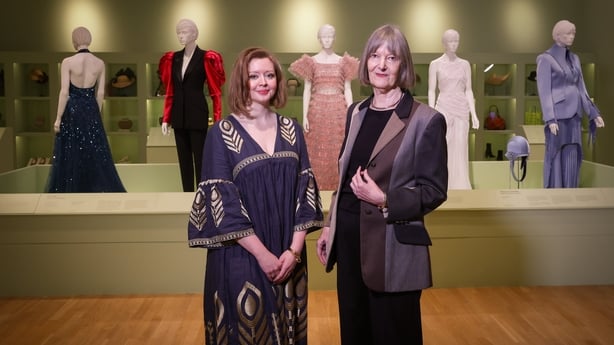
McCrum's first port of call was the auction houses such as Christie’s and Sotheby’s. Present at the launch, she noted how wonderful it was to see the development of where her work began to today, 50 years later.
Through the very few images found in the museum’s archive, visitors to ‘Ashes to Fashion’ gain a tiny glimpse into what the collection once was, not to mention conservation practices of yore when live models wore archived garments for photographing - prohibited practice today.
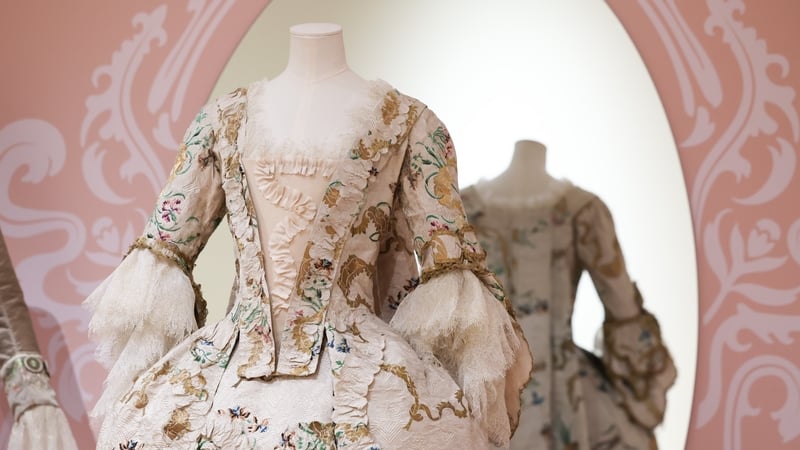
As you move through the space, you are met with the earliest items in the collection, including the sole survivor of the fire of 1976 – the Lennox Quilt.
Created by Belfast native Martha Lennox in 1712, the Irish linen quilt with embroidery silks from France was entirely hand-stitched and was presumably passed down through her family following her death in 1729.
It had only been acquired in 1975, and instead of being stored with the rest of the collection, the new acquisition was displayed in the entrance hall of the Ulster Museum in March 1976. This ultimately saved the piece, and it became ‘Object One’ when the decision was made to rebuild what was lost.
Through five decades, curators McCrum, Elise Taylor, and now Charlotte McReynolds have painstakingly built back up a collection through procurements and, as recently as 2023, major donations.
A generous public gift was presented to the Ulster Museum from Lanto Synge in 2023 of his entire needlework collection, some 250 works. This included 18th-century stool covers and an incredibly rare English stumpwork casket dating to around 1660, which replaces a stumpwork object once part of the original collection.
The exhibition consists of 140 items in all, supported by an incredible team of curatorial assistants, conservation experts and designers, to name but a few roles. When asked about how it feels to see 50 years of work come to fruition off the back of McCrum in the 1970s, curator Charlotte McReynolds said, "I’m the lucky one – I get to build off of all her hard work".
Detailing how McCrum rebuilt the collection, McReynolds added, "but then in 1984, nearly 10 years after the fire, she successfully instituted a policy that we still get to follow to this day, of acquiring a new designer and also high street fashion for the collection every single year", calling the practice a "privilege".
"I follow my instinct and I look for pieces that have a strong design element, strong storytelling or pieces that we simply do not have examples of as well and largely it works out!"
Continuing the legacy
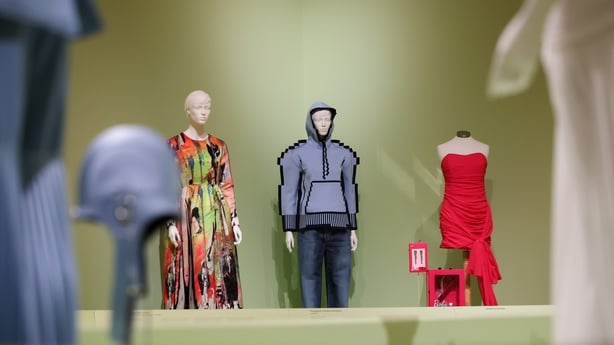
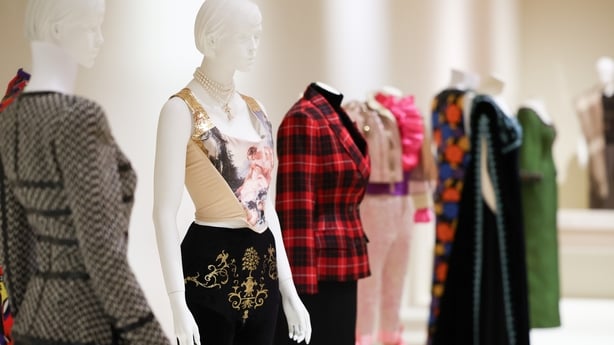
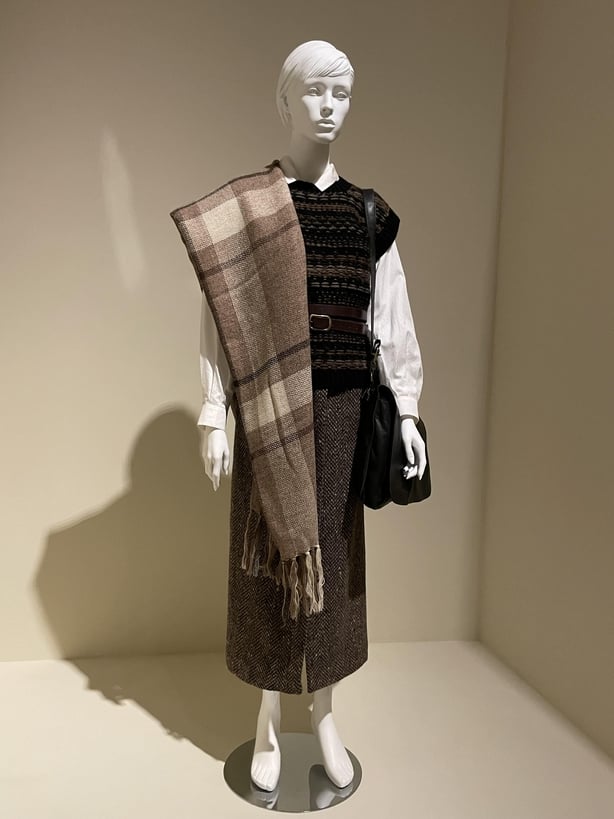
Alongside pieces from Carolina Hererra, Christian Dior, Alexander McQueen, Rodarte, Robert Wun, Paul Poiret and Chanel, that policy implemented in 1984 saw Ulster Museum begin to actively acquire contemporary fashion.
One of the first designers to help was Paul Costelloe, who specially put together three complete outfits from his A/W 1984 collection for the museum, one of which you can see at ‘Ashes to Fashion’ made of wool, Donegal tweed, cotton and leather.
From their earliest acquisitions to one of their most recent, the exhibition also includes a large collection of accessories (including an embroidered pandemic mask by Jenny King), a piece by Glass by Butler’s Jennifer Hackett and a knit dress and cape by Dublin native Oran Aurelio.
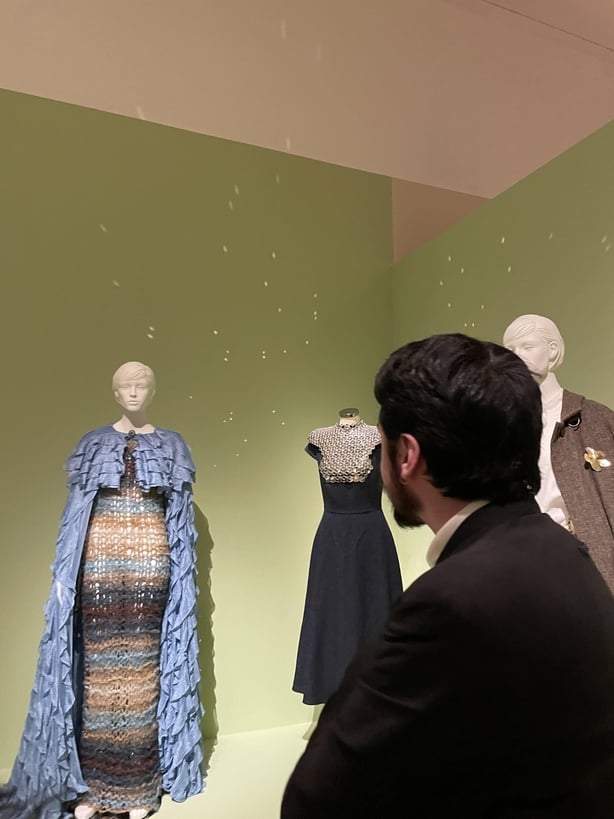
Aurelio's work entitled "Orla’ knit dress and 'Malfi’ over-cape ensemble, S/S 2025’ was donated to the museum in 2025 and his piece, as well as pieces from his mentor Peter O’Brien, join the 6,000 items now procured by the Ulster Museum – making their textile collection one of the most significant in Western Europe.
"The underdress is completely hand-knit, and the cape is a half-circle with ruffles and a vintage Swarovski button – given to me by my former lecturer Peter O’Brien", Aurelio told RTÉ Lifestyle at the exhibition launch. "I think he’s my favourite designer of all time. I truly am infinitely inspired by him and his designs.
"It’s a really special piece. It’s amazing to be among these insane designs, and I think it's just such a fabulous collection of work."
Ashes to Fashion runs until 13 September 2026 at the Ulster Museum in Belfast, Northern Ireland, and opens 10am to 5pm daily (excluding Mondays). Tickets are available here.
