


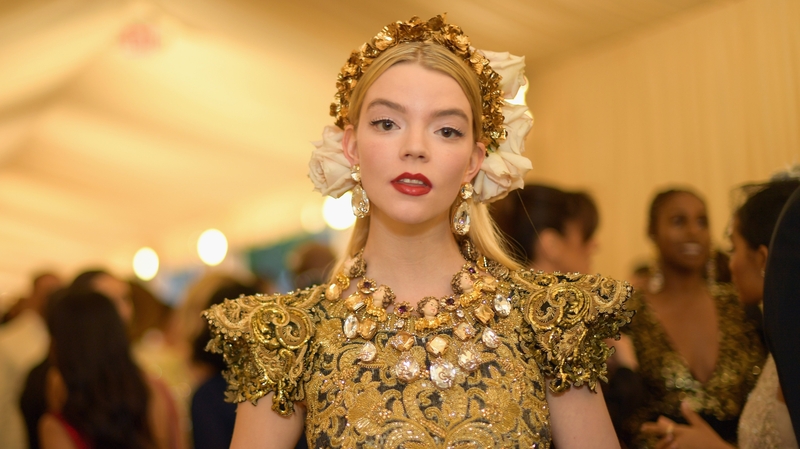

The latest adaptation of Emma finds rising star Anya Taylor-Joy in the title role of Jane Austen's legendary matchmaker. Michael Doherty caught up with the actress in London to get the inside story.
Anya Taylor-Joy was always destined to be a star. As a teenager, she was spotted strolling outside Harrod’s by a leading model agent (the very same agent who tapped the shoulder of a young Kate Moss) and immediately embarked on a major fashion career.
The young model was then spotted on a photo-shoot by an Irish actor (more later), who introduced her to his agent, which led to her breakout performance in Robert Eggers’ superb gothic horror yarn, The Witch. A star was born.
Still only 23, the Argentina-born actress has since appeared in a variety of films (Morgan, Split, Thoroughbreds) and TV productions (Atlantis, Peaky Blinders), and her dance card for 2020 is impressively full. First up is the leading role of Jane Austen’s determined matchmaker, Emma Woodhouse, in a period drama that co-stars Bill Nighy, Josh O’Connor, and Miranda Hart.
Jane Austen famously described Emma Woodhouse as 'a heroine whom no one but myself will much like.’ Did that make her a more interesting character to play?
To be honest, that quote was my jumping-off point. I didn't want to play Emma if she wasn’t going to be true to that description. That was my first thought when I agreed to do it. An issue I've always had with the way that female characters have sometimes been written is that they don't just have to be likeable; they have to be easily likable and that's so annoying because it's just not real.
Human beings have flaws and I wanted to make sure that when my Emma when cruel, she wasn’t a bit cruel: she was mean! But she does have a heart and I think audiences can see that, so they find themselves rooting for her, despite everything.
It’s a story of manipulation, but also of redemption…
Yes, and that was very important to me, too. Emma realises when she messes up and she almost grows a conscience, you know, by the end of the film. She's not tamed. She's still Emma. She's still vain and spoiled and righteous, but she has realised that it's okay to show her heart and that you have to treat people gently and they're not toys.
People sometimes treat period drama as if it were sci-fi. These people were perfect and they had no bodily functions and everyone looked beautiful and ran around in fields all the time. But these were real people with real feelings…They just happened to wear corsets!
Many actors say that the costumes in period dramas really help them to find the character. Did you work closely with designer Alexandra Byrne on Emma’s look?
Oh, we got close! I love that woman so much. I was Alex’s mannequin. All of those clothes were created on me. Alex introduced me to clothes acting, which was such a fabulous insight into the character because Emma is so vain. She is that girl who will walk to a certain place in the room to make sure that she has the best light and is framed by flowers! T
That was a big part of her and so whenever I was wearing a coat that had a really exceptional back, I found myself delivering monologues over my shoulder! Emma is very melodramatic. One of my favourite lines in the book is, ‘With her hair done and the maid sent away, Emma sat down to think and be miserable.’
It is Emma’s story but you are surrounded by an interesting ensemble, from method actors to scenery chewers…
Absolutely. I think the director, Autumn [de Wilde], is an Emma when it comes to matchmaking actors. She cherry-picked all of these different people and it just worked. It’s funny, I had a very big year last year with just one day between films. When I started working on Emma, I was trying to be very grown-up and I said, ‘Ok, I'm going to keep myself to myself and try to rest and preserve my energy.’ Within two minutes of meeting the cast, that went out the window!
When I first walked into rehearsals, I was quite nervous because, you know, these are all heroes of mine and people I really admire. And here's this, like, weirdly international mongrel and I’m going to show up and try this, so please don't be frightened. But they were all so supportive. There's a lot of love for each other and I think that shows in the film. We still have a very vocal WhatsApp group, and we’re still a big, rowdy family.
You have an interesting roster of movies, from period dramas to Viking stories, horror yarns and more. Are you making yourself difficult to typecast?
Thank you. I work hard at that! If you had told a younger version of me that I would have started off my career in horror, I wouldn't have believed you. It's just not a genre that I was particularly aware of. My imagination is too vivid so I have to be careful about what I watch.
People like to pigeonhole you and put you in a box, but I'm an actor: my job is to be a chameleon. I'm just very grateful that people have seen my performances and have given me the opportunities or have allowed me to fight for opportunities where I get to show different sides of myself.
In terms of the grand plan; are you where you expected to be at this stage in your career?
Then and now all I wanted was to be happy and to be doing work that I cared about. I haven't had a grand plan other than I know that at some point I want to be creative in other mediums.
That being said, my only hope and dream is that I can wake up every morning and say to myself, I am obsessed with this character and with this story. I will give everything and maintain that level of passion and devotion to the characters I play.
In recent years we’re hearing that scripts are getting better for female actors, and there are certainly more female crew members making their mark. Has that been your experience?
In terms of the stories; I'm a big history buff and history has been told through the perspective of the white male because they are the quote-unquote, victors. And it's not even that things are moving forward; it’s that we have a lot of catching up to do. There are a lot of stories that haven't been told.
Luckily now, we're seeing films made by women telling the stories of women, that make money. So there's clearly an appetite for them. As much as I hate the financial aspects of creative work, those stories will be told more because there's clearly an audience for them. It’s like, ‘We've been telling you this for a long time. We're very glad you're starting to listen!’ That being said, we still have a long way to go.
You shot the film Here Are The Young Men in Ireland last year, with Dean-Charles Chapman and Conleth Hill. How did you find the Dublin accent?
I actually had a D4 accent, which I’m very proud of! I have only ever been extremely proud and happy with how the Irish have treated me. I have such a soft spot for Ireland. I lived in Dublin for a while and my best friend is from Ballycastle. I'm just obsessed with Ireland!
And it was Dubliner Allen Leech, who steered you in the right direction at the start of your career?
That’s true. I call Allen my fairy godfather, which he hates, obviously. It was Allen who got me in touch with my agent, who is still my agent today, so he really started things off for me.
You mentioned earlier about wanting to be creative in other mediums. Are you keen to get behind the camera or the typewriter, or should I say keyboard, at some point?
I like the typewriter; let’s go for the typewriter; much more romantic! I am keen because I write a lot of poetry and music and I'm very eager to direct. I think the thing with all three of those is that I never want to do it just for the sake of doing it.
If I'm going to direct something, it has to be because I am supposed to direct that story and it's my story. I'm very picky about the roles that I play as an actor. I don't think that will change in changing medium. I never want to be somebody that say, has someone write them a pop song just simply to have a music career. That’s just not me.
