


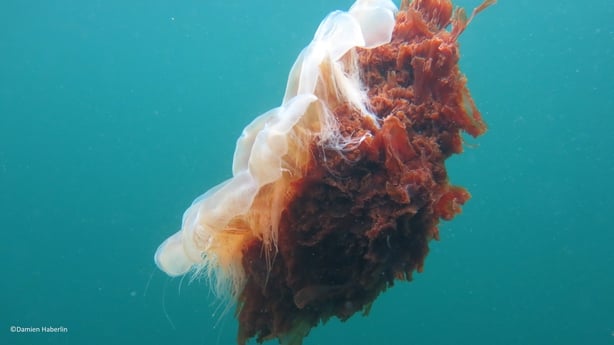
Today is World Jellyfish Day and we are going to look at the lion's mane jellyfish. It is one of the largest jellyfish species found in Irish coastal waters and is a regular site during the summer and autumn months.
They featured in the news and social media during the summer with lots of sightings. Avoid any contact with them in the water and on the beach as they can even sting after being washed up.
Please be advised the we have raised a red flag at Sandycove as a precautionary measure in repsonse to Lion's Mane jellyfish being spotted. We will monitor the situation and update as necessary. pic.twitter.com/dbegNBRl2z
— dlrcc (@dlrcc) August 18, 2020
They are most common in the cooler water of the Irish Sea, although in recent years more and more sightings are being recorded along our west coast. The lion’s mane actually prefer cooler water and if you were to travel south from the Irish coast into warmer water you would be very unlikely to encounter any, but, if you travel north to the west coast of Scotland you would be sure to encounter them.
Although the lion’s mane is almost 98% water and very delicate, it is in fact a large marine predator that eat many different zooplankton prey species.
Jellyfish are considered plankton which means that they are an ocean drifters, moving with the winds and the ocean currents. However, the lion’s mane is powerful swimmer compared with other jellyfish and can swim against currents and is constantly moving up and down in the water searching for prey.
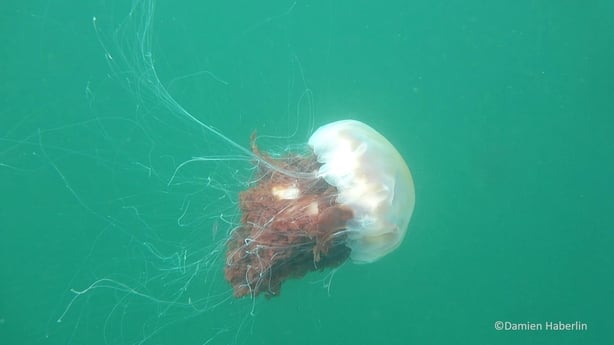
When swimming, the lion’s mane pulls all its tentacles in tight and the bell pulses to push the body through the water. When hunting, it relaxes, and the tentacles stretch out for several metres forming a large net for capturing prey.
The tentacles are packed with tens of thousands of stinging cells and when prey brush against the tentacles, the stinging cells fire injecting venom into the prey. Once the prey is paralysed, it is transferred to the mouth and stomach to be digested.
The Life Cycle of a Lion's Mane
Lion's mane jellyfish, like many jellyfish species, have a two-part life cycle. The free floating jellyfish that you might encounter during the Irish summer are in the adult stage stage of life and are known as medusae. There will be male and female medusae present.
A female will release fertilized eggs into the water during autumn and after they drift with the other plankton for a short time, they then sink to the bottom. On the bottom, the eggs which we now call a planula, will search for a hard surface to settle on and once they settle and stick to that surface they change into a polyp.
The polyp is like a tiny coral polyp and feeds on particles and tiny animals in the water and, if the conditions are right, it can replicate in a similar way to bacteria, multiplying rapidly. During the winter the polyps go through another change and the top of the polyp starts to change into a tiny medusae which eventually breaks free from the polyp.
This tiny medusae is called an ephyrae and will, if it is lucky, grow into an adult medusae during the following year, ready to reproduce again!
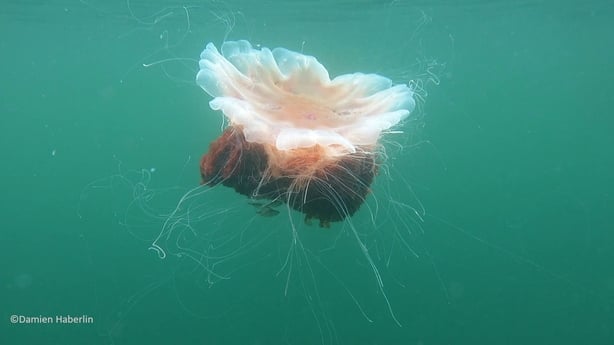
Massive thanks to Dr Damien Haberlin of MaREI, the SFI Research Centre for Energy, Climate and Marine hosted by University College Cork for this article and the amazing footage he filmed.
MaREI
If you spot any jellyfish you can log the sighting here:
THE BIG JELLYFISH HUNT and learn more at The National Biodiversity Data Centre
The following guidelines from the HSE tell you what to do IF you get stung by a jellyfish:
