The Disney Pixar movie Hoppers is the story of a young woman who hops into the body of a robot beaver to help the animals that inhabit the ecosystem where she lives.
In this episode of the Ecolution podcast, Dr Emily Fairfax hopped on a call to tell us about working as a nature consultant on the blockbuster - it all started back in 2021! And she tells us more about of the most influential builders of the natural world - the beaver!
The expert tells us how an email out of the blue resulted in her getting a taste of the movie business. It all began when the people from Pixar people heard Emily give a talk at a webinar about beavers in California. A cold e-mail followed, that she thought was fake, and the rest is history! She tells it better...
Dr Fairfax is Eco-Hydrologist and Assistant Professor of Geography in the Department of Geography, Environment, and Society at the University of Minnesota. She has dedicated the last decade of her life to studying beavers and the ways in which they change the flow of water where they live.
Listen to Ecolution on RTÉ or wherever you get your podcasts - press play up top to listen now!
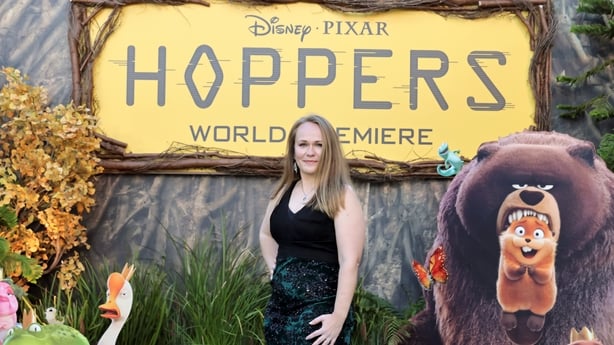
(Photo by Rodin Eckenroth/ Getty Images for Disney)
Emily says: "Beavers are nature's engineers, and they are an ecosystem engineer, which means that they are an animal that can go out and change the physical earth to better suit their needs. There's actually not a lot of animals that can do this in a big way. And when it comes to being an ecosystem engineer, beavers are the second most powerful on the planet, second only to us people.
"What makes beavers really special, though, is that they're also a keystone species. And what that means is that when they make all of these changes to make their favourite habitat, which is a wetland, a byproduct of that is they have created an environment that is perfect for so many other different things."
Beavers don't seem to have ever been native to Ireland, although they were once prevalent across the UK, our closest Island neighbour. After pilot schemes in sheltered areas of Scotland, beavers are now being actively reintroduced across the UK, with wild beavers now numbering almost 3000.
And they are making great strides in helping correct water courses wherever they are. Which is great for nature but not always welcomed by humans. In the US they help redistribute water in a way that actively slows wildfires, which are becoming ever more common in the US due to human caused climate change.
Funding is always a massive issue and there are major cuts taking place at the moment in the USA, meaning people are losing their jobs and projects are being shut down.
"In my own work, about half of my colleagues got fired. And when you lose them, you lose a lot of the momentum and the expertise that was keeping these projects going. So, we are in a pretty tough spot. But I'll also add, the young people I'm working with and the very well-established people that have been let go of their jobs, they're still very passionate and they're trying to find any avenue to continue this work. So, it's not that it's not happening. It's just that we all got shaken up and we're trying to get our bearings again so we can keep moving forwards."
Emily's work, along with many others, ensures that a film like Hoppers explains the impacts we have on nature to the broadest possible audience.
To hear more about the beaver check out this week's Ecolution wherever you get your podcasts. And to read more about Emily head to her website here!
Subscribe to Ecolution here now!
And we have lots more great podcasts for kids at www.rte.ie/kidspodcasts.