With his adaptation of the posthumous Irène Némirovsky bestseller out now on Blu-ray/DVD, the filmmaker tells Harry Guerin about his experiences making Suite Française.
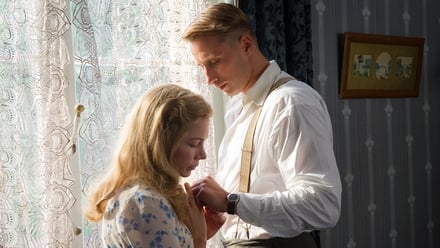
The book – two volumes of a planned five – was published in 1998, 56 years after Némirovsky died in Auschwitz. For the film, Dibb focussed on the second volume, Dolce, which tells of the relationship between Lucile Angellier (Michelle Williams), the wife of a POW stuck in a small town in Central France in 1940; and Bruno von Falk (Matthias Schoenaerts), a German lieutenant who is a 'guest' in her home. If your genres of choice are wartime drama or romance, then from period detail to performances you'll find something to enjoy on-screen.
Read our review of Suite Française here.
Harry Guerin: Now that you have some distance from the film, what are your feelings looking back on the experience of making it?
Saul Dibb: [Exhales] That's a very good question... It was, as all films are, just a fascinating journey into something, in a way, I felt like I knew very little about. A period of the war [1940], I think, that is never really looked at. This sense of a kind of 'uneasy occupation', where the German Wehrmacht were on their best behaviour, before everything turned into the things that we have seen – the treatment of the Jewish populations of Europe, the treatment of the French population in France. To look at a period, pre-Resistance in a way, I found fascinating. Every film is like a baptism of fire all over again.
By adapting the book before making the film, you'd had one baptism of fire already.
That's definitely true. If you get involved in the writing and the directing, yes; you are doing one whole job and beginning a whole new one again. The writing of it, I think, was the hardest part. The biggest single decision was what you do with this unfinished novel: how you take something that's got two parts that was meant to be five. But the two parts don't relate to each other in terms of narrative or characters, but they tell fundamentally important things. [I made] that first decision of focussing on the Dolce part, using that central sense of place from the characters and then extrapolating back with those people into the fall of France – to get a kind of first act – then forwards into what was going to happen in the part that Irène would have gone on to write.
So, I suppose, that was the fundamental decision and then trying to make sure all of that worked and that we were able to tell the story. Focus it down, inevitably, but also tell a story that contained all of the themes that Irène was dealing with when she wrote the whole novel. The whole stuff about class and collaboration and a sense of almost like a civil war that broke out in France that was kind of exacerbated by the pressure of this occupation.
When you're taking source material that is held so precious by so many people are you able to put that out of your head?
You just know the reality of it is that you will not please everybody; that is an inevitable consequence of doing it. But you just have to believe that the approach you take has integrity and is the right one. And only you can be the judge of that. I felt very strongly that taking that approach was the right approach and would deliver the most that the film could give. In a way, you just have to put all that other stuff to one side. If a person has read the book and thinks, 'Oh well I thought that bit was more important', fair enough – I can't do anything about that. But I have quite a strong sense of whether or not I feel like I've captured the spirit of it and whether I've approached it with the right kind of intentions. As long as I feel ok with that then I'm fine.
Secure in your choices...
I knew I was going to have to show the script to Irène's daughter Denise. We invited her children – because Denise died before shooting the film – to the premiere in Paris. And even before that I sat through the film with them. So I always knew the hardest task would be to show this to Irène's descendants. I always felt, 'Look, if they're happy then I feel justified in the decisions I made'. And they were.
In terms of casting, there was great chemistry between Michelle Williams and Matthias Schoenaerts. Could you tell the minute you had them both together in the same room, 'This is going to work'?
Absolutely. You can tell. You do a camera test very early on, where you do costume and everything. You kind of put them together and you see it. You see it also when they meet [for the first time]. But I think you have an inkling beforehand – through the kind of work that they've done as much as anything else –whether they share a certain sensibility.
If you look at Matthias, who had just done Rust and Bone and Bullhead; and Michelle, who had made Blue Valentine, you can see that they share a similar kind of sensibility. So you trust that once you put them together this is going to work. And they're excited by each other's work before they start working together and that makes a big difference. They're both the kind of actors who want to find it 'in the moment', who want to explore the scene and the different ways of playing things. They're not the kind of actors who just want to be told what to do and hit a mark. So it feels like their method of working together is also very compatible.
How did the film do in France?
Well, I think. My French is not good enough to be able to translate every review, and to be honest, I don't read all the reviews anyway! The sense I got is good. I think the truth is it's probably a bit weird: having a French book and it's then in English and it's shown in France. Inevitably, I think, that's probably a bit of a strange experience. But I think they also understood that this is a French story that had an international appeal, and therefore it needs a life beyond France.
So what's next?
I'd love to be able to tell you, actually! It's really annoying because the film that is hopefully going to happen next, the star in it has not been finalised, so I can't say yet. All I can say is it's a great situation where I've not had to do that first stage [of writing] – being sent a script that, to me, was absolutely brilliant, and I had nothing to do with it. I didn't have to go through however many years of tortuous process the writers went through to achieve a great script. And that is a huge relief. But I wish I could tell you because I am very excited about it.
We've only touched the surface here in a couple of minutes, so did you do a director's commentary for Suite Française?
You know what? I haven't. I've never done one. Somehow I just think... I don't know what it is, maybe I should do one. [Laughs] But what you really want to do is just tell the truth about everything that's gone on behind the scenes! Those are the directors' commentaries that nobody ever records and everyone would want to hear!
Are you a director who looks back and says, 'If I had've done this...' or if I had've done that...', or do you just put it completely out of your head and look ahead?
No, if you put it completely out of your mind then you will never learn; you will learn from your mistakes. Definitely, I would look at things and think, 'I should've done that differently' or 'I should have been tougher and held back and insisted on keeping to my instincts'. Or that I insisted on this and, in retrospect, it was a mistake. I think most directors look at their own work – or ones that I know – and they see the faults rather than the successes. I see the things that work, but I focus much more on the things that I think have worked 'less well' so I don't repeat it.