


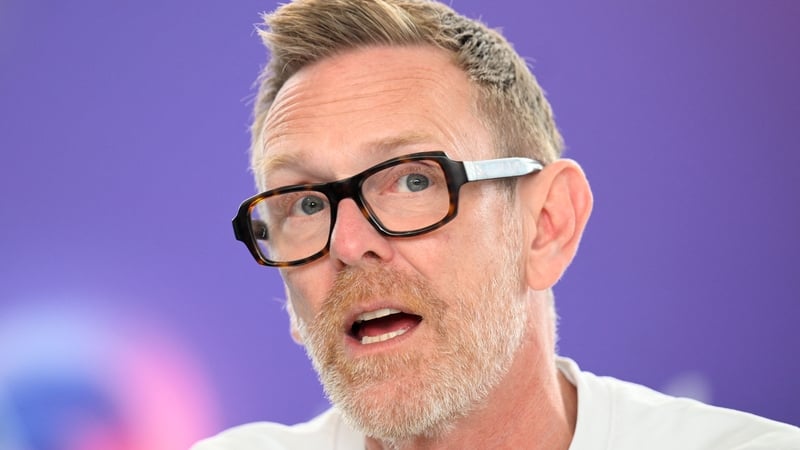
Eurovision Song Contest director Martin Green has said he hopes a "pathway back" can be found for RTÉ and the other broadcasters boycotting this year's contest, while acknowledging concerns that trust in the competition has been damaged.
Speaking to RTÉ Arts and Media Correspondent Evelyn O’Rourke in Vienna, Green said the European Broadcasting Union would do "everything we can" to try to address the concerns of RTÉ and the other absent broadcasters.
Ireland is not participating in or broadcasting this year's Eurovision Song Contest after the EBU confirmed that Israeli broadcaster Kan would be allowed to compete.
RTÉ is one of five broadcasters not taking part this year, alongside Spain, the Netherlands, Slovenia and Iceland.
RTÉ return
Asked whether he saw a way back for RTÉ, Green said: "All I can say is we’re doing everything we can to allay their concerns. As you might imagine, all the conversations so far end with, 'Let’s see how this year goes, and we’ll see where we go.’"
He said he hoped further talks would take place after this year’s contest.
"The ball is slightly in their court, because it’s their issues we want to allay," he said.
"But we can come to the end of this show and say, look, we did this, and I think we can prove this. Perhaps we can go some of the way to reassuring them and finding a pathway back."
Green described the absent broadcasters as "members of our family" and said he respected their decision not to take part.
"The way I’ve come to describe it is that we are a big family, and five members of our family are missing this year, and we miss them, and we love them," he said.
"But at the same time we fully respect their point of view. It’s really important. We are a membership organisation, and sometimes membership organisations have disagreements."
Asked about concerns that trust had been damaged, Green said: "I can completely understand how they feel that way, and that’s what we’ve set about trying to change and have an active reassurance."
Voting concerns
The EBU has since introduced new rules around voting, promotion and neutrality following concerns raised by a number of broadcasters.
Asked why the EBU had not released more detailed voting data, he said some information had to remain confidential to protect the voting system.
"We’ve been very clear with them, part of the security system of the voting is that we don’t release the deep data," he said.
"We release as much as we can, but I know it sounds like an irony, but there is part of the data that we have to hold in order to secure the safety of the system."
Israel participation
On Israel’s participation, Green said the EBU’s position was that Kan, as Israel’s public service broadcaster, was not responsible for the actions of the Israeli government.
"My first view is that it is a public service broadcaster, Kan, who participates here, and we don’t believe they’re responsible for the actions of their government," he said.
"But again, I understand the debate, I understand the argument, I respect the alternative point of view, and I respect people’s ability to exercise that point of view. We have a different point of view."
Green said the EBU believed Eurovision should remain a cultural space where countries can come together.
"We believe that there has to be spaces in the world, in culture and sport, where we can gather the world and show that the world could be a better place, and that is what we exist for," he said.
Future of Eurovision
Asked if he was concerned about reputational damage to Eurovision in its 70th year, Green said there were also many people who believed the contest should continue.
"We have nine sold-out audiences, we have hundreds of millions of people watching us, we have 1,000 media in here, as we always do," he said.
"There is another point of view of people who do believe that these events should remain somewhat away from the complicated affairs of the world and try and show that we can come together and that we can be unified against division."
Asked whether Israel’s participation could be put to a vote, Green said: "It’s Kan’s participation, the public service broadcaster of Israel, and that is a matter for our membership.
"Once again, one of the important things is we are a democratic membership organisation, and when this was put to that democratic membership organisation, 70% of them wanted to protect Eurovision as a space that could show the world as it could be, not necessarily as it is, and I’m not going to argue with democracy."
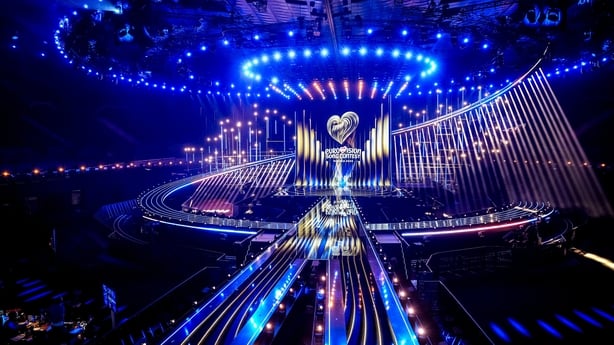
The 70th Eurovision Song Contest is being staged at the Wiener Stadthalle in Vienna, with the Grand Final taking place on Saturday night.
Looking ahead to the final, Green said he hoped viewers would see Eurovision as "a fantastic, embracing, diverse spectacle of joy, humanity, and the world coming together".
"The more complicated the world gets, and the darker it is, that light and joy and proof that we can be otherwise is more powerful and more important than ever," he said.
