


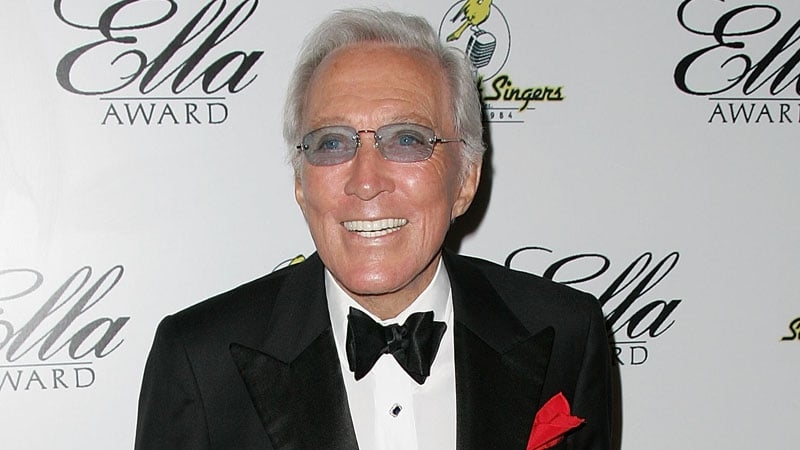
Just over ten years ago, in the Summer of 2002, the late Andy Willliams spoke to Paddy Kehoe on the eve of two Irish performances. "For years I was frightened all the time that I wasn't as good as everybody else, " the then 73-year-old singer told the RTE Guide.
Andy Williams had performed in Ireland in January 2002 and now here he was returning a mere six months later - the pop crooner was enjoying a revival for sure, and we hadn't heard much about him throughout the Eighties and the Nineties. But once again, he was bringing his 11-piece orchestra to this country and to the UK.
The singer was talking to me down the line from Branson, Missouri at 7.30am. He had an apartment nearby which he compared to "a large dressing room," close to his Moon River theatre. He was still performing at the theatre until recently, although he had been diagnosed with bladder cancer a year ago. He and his second wife also had a proper home too in Branson, and they had yet another pied-a-terre in Pam Springs.
What would Andy be like say a half an hour before his Point performance, I asked? I was indeed surprised by the reply. "I may throw up, " the Iowa-born singer told me, in that self-deprecating but unruffled way of his. "I will probably be nervous because that's the beginning of the tour. Nobody is always positive how it's going to go."
"You're never sure the lighting is going to be exactly the way you plan it, or that there will be some technical mistake that you don't know how to get out of. But musically we're all set, we don't have to rehearse, because we've been doing it here in Branson."
This was the perfectionist, striving, struggling Andy Williams I was hearing, who assumed nothing about anything. At the age of eight he was already singing with his three brothers, but was the only one to make its as a global superstar. Much of his popularity was down to weekly The Andy Williams Show, which Teilifís Éireann used to import and show, bless 'em.
The singer once recalled how his father Jay damaged him psychologically. " He screwed me up by telling me that I was not as good as the others out there, " Williams recalled. He reflected once again on this for me. "That was absolutely the wrong thing to do," he declared, while insisting that his father was a wonderful man who was only doing what he thought best. "For years I was frightened all the time that I wasn't as good as everybody else, and that I had to work harder to get where I wanted to be."
As a result of what might charitably be called his father's 'tough love,' the singer came to adulthood with a general feeling of low self-esteem. Therapy helped him to forgive his father but did not remove that feeling.
Yet he must have had some kind of self-belief, had some kind of faith in his prospects, as he set out on a musical career path? "I had that, but I also had the worry that I didn't know what else to do, " he replied. He didn't have a college education, but he also knew that he didn't want to work in a restaurant.
He made his television debut on The Steve Allen Show in 1954 and was a regular guest thereafter. "I was nervous and scared all the time I was on, but I wasn't afraid of him (Allen), " he recalls. "That's where I learned my craft, I got very comfortable working in front of television cameras."
He regarded the years 1962 to 1972 as some of the best of his life, career-wise, encompassing as they did the aforementioned Andy Williams Show. Although primarily musical in content, for the last two years the show had a more comedic slant. The reason for this is that Andy wanted to entertain his own three children in point of fact, a curious and indeed charming way of bringing your work home.
Corresondingly, the TV network saw the kiddie potential and moved the show an hour earlier in USA TV schedules. The Osmonds were regular guests, as was a bear with a taste for cookies. Er, there was also a midget who used to hammer Andy's knee to test his reflexes. " I used to just hide when my show would come on air, "Andy recalled, all those years on. "I'd end up over in a corner somewhere when I'd watch them. Thirty years later I look at the re-runs and I really like them."
The end of his TV heyday also saw the break-up of his marriage to Claudine Longet. Some years after they divorced in the early 70s, Longet was accused of shooting her lover, a skiing champion, with his own gun, a Luger. She subsequently insisted that it had been an accident. Williams at that point was her ex-husband, but he stood by her statement. It was a terribly traumatic time nevertheless, as the children were still living with Longet in Aspen, Colorado.
Their daughter actually witnessed the shooting. " I wanted to get her out of there, so I took her and hid her in Los Angeles at a friend's house for about six months, " the singer told me. But there was unease in his voice, as though he wouldn't stay long on the subject.
On somewhat spurious medical advice, he actually tried LSD when his first marriage was falling apart. "I was unhappy and there were a lot of things that I wanted to find out about myself, " he recalls. A San Diego doctor who told him that the self-discovery process would be enhanced up by such LSD treatments.
He duly booked himself into a Canadian hospital, where he had three or four treatments in tablet form. He experienced what he termed the painful business of being born again. "I don't know whether it did any good or not, " he says with a wry laugh. " All I really got out of it, when I think back on it, is that the only thing that's really important is your family and friends, and being happy and not taking things too seriously." He remarrried in the early nineties.
Around 2000, two years prior to our interview, he had stopped singing for a year due to throat problems. He spent that time enjoying life simply, be it dinner with his wife, golf, or watching movies. At the time of our conversation, he was talking about a possible duets album, to follow his pairing with Denise Van Outen on that revival of his solo hit, Can't Take My Eyes Off You. "It's darn good, if I say so myself, " he enthused. "She sings terrific."
Nowadays it might be done effortlessly and cleanly by dispatching a sound file attachment on an e-mail presumably. However, for the Van Outen duet he had been sent the orchestral backing track by disc, with instructions as to where he should sing. Then the disc went back to London and Van Outen did her parts. "Now I'm gonna meet her when I get over there, " he said, laughing a kind of life-in-the-old-dog laugh. "I hear she's quite pretty and we're going to do video on that song the day I get in."
