


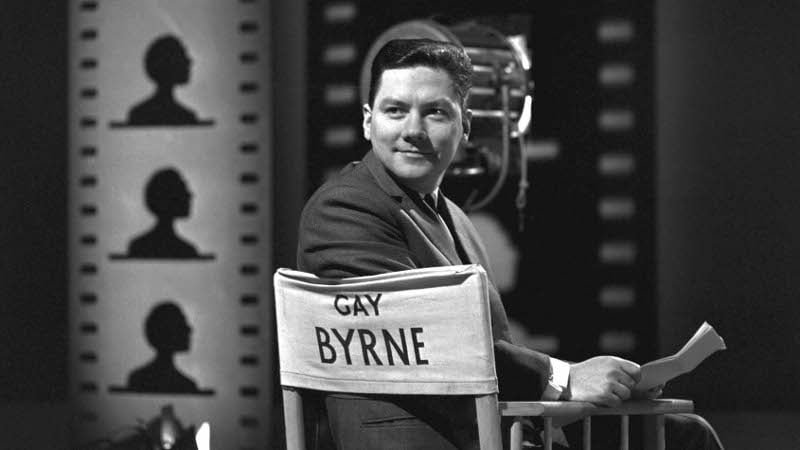
More than anyone else, Gay Byrne has been the face of RTÉ for the last 50 years. Mr Showbiz, interviewer extraordinaire, and reluctant Father Confessor. He was there at the dawn of Irish television and he’s still got some strong opinions about it now. Alan Corr talks to the Grand Old Man of Irish broadcasting about his early days in RTÉ and how The Late Late Show changed everything
Gay Byrne can’t quite remember where he was on the evening of December 31, 1961, the cold, cold night RTÉ TV first blinked into life. He wasn’t throwing snowballs with that young rascal Mike Murphy outside the Gresham Hotel (“I didn’t know him back then”), the venue where the great the good had gathered to launch Ireland’s first TV service. And he wasn’t out in the glittering new studio complex in Montrose either.
“No I wasn’t anywhere near opening night”, he says. “All the posh people were in the Gresham Hotel counting down to midnight and outside on a platform, Johnny Logan’s father Patrick O’Hagan was singing. We did have a TV set at home so I have a vague recollection that maybe I was at home with my mother watching . . . ”
What Gay does recall very well is one of the abiding myths surrounding the launch of Telefís Éireann 50 years ago and it’s about his brother Ernest. Ernest had already been working on the fledgling TV service for two years and he was the executive producer on opening night. “There is a myth that has persisted for 50 years that on opening night something went wrong with the main desk and my brother kept his finger pressed on a button for five hours and if he hadn’t done that the place would have gone black”, says Byrne. “I’ve heard that story all my life in RTÉ and the older people who were trained by Ernest, the cameramen and the soundmen, persist in telling the story that he saved the opening night.”
It's the oldest story in the broadcasting book of tall tales but it's hard to resist the notion that one Byrne saved RTÉ TV before it had even started and another Byrne became the man who placed it at the very heart of a still developing nation. He may have officially left RTÉ more than a decade ago but more than anyone else, Byrne remains the person most associated with the place.
As RTÉ TV marks half a century on air, he is also the man best placed to cast a cold eye on its early days and its development from a one channel service with a limited broadcasting schedule to today’s multimedia machine.
However, at the start of his career, Byrne was a radio man. He had joined the senior service that was and still is Radio Éireann in 1958 but he was as excited as anybody else about the arrival of television in Ireland. A granite-faced Sean Lemass, no great fan of the idea of independent voices, emitted fatherly warnings about the new technology and up in his Palace, Archbishop McQuaid was having his own perilous visions, but Gay Byrne, already a daily fixture on Granada TV, was planning his next career move.
“I had ambitions to be on Irish TV as soon as possible”, he says. “I was already on radio at that stage and we knew television was coming for three or four years beforehand; my brother had been working on TV in America and at the prodding of my mother he came home to this fledgling television service.”
Gay’s first appearance on screen was actually reading the news. “I read the news on a Saturday and Sunday night”, he recalls. “I think Charlie Mitchel was the other newsreader at that stage.” The quiz show Jackpot was next and while that was all very well (as was playing jazz records on the wireless, not to mention penning a music column for the RTÉ Guide) Byrne had much bigger things on his young mind.
So, on July 6, 1962, at exactly 11.20pm, he walked out onto the studio floor of something called The Late Late Show in a black suit, skinny tie and gleaming Brylcreemed hair. His very first guests were Count Cyril McCormack, Ken Gray, George Desmond Hodnett and broadcaster and Olympic fencer Henry Thuillier. “I can’t remember being nervous because I already had two or three years experience on Granada”, he says. “I had no nerves. The whole point of The Late Late Show was that it was live, there was a studio audience who could join in and ask questions and my instructions were that there was no research on the guests at all and anything I wanted to find out I found out on the air.”
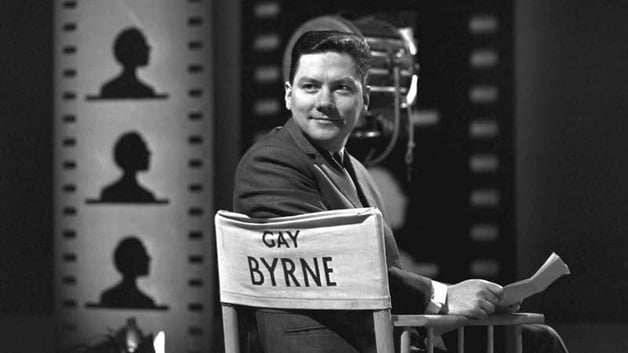
That seems fantastic now, not to mention quaint. However, this aversion to research did waste a lot of time. Either way, nobody much liked The Late Late Show. Viewers, weaned on a diet of foreign game shows and Sunday Night at the Palladium, were expecting a variety show and the critics, unused to the format, savaged it. “Everybody hated it to begin with, absolutely detested it”, Byrne says. “But then suddenly after four or so weeks it caught on and everybody started talking about it and so it was decided they’d keep it and then it became a routine and that was it.”
Byrne has always been a cool customer and ‘routine’ is a very cool way of describing a show that was to go on to have a profound effect on Irish society. In his book Window and Mirror: RTÉ Television 1961-2011, John Bowman is less reserved in his estimation when he describes The Late Late Show: “There is no other democracy in the world where one programme had made such an impact in modernising society.” Writing in 1988, future President of Ireland, Michael D Higgins said “The Late Late Show has taken issues, particularly those relating to sexuality, and put them into the realm of discourse. It breaks taboos in a society that has been so authoritarian and repressive.”
What does Byrne think when he reads that kind of thing? “Well I wish I’d known that at the time because back then we didn’t know what we were doing”, he says. “We had no idea. The simple idea was to recreate The Tonight Show for Ireland and in case it got out of hand, we had a panel to assist Gay.”
It was a formula that worked but it was only when Byrne became executive producer as well as presenter that The Late Late Show became the focal point of debate in non and anti-establishment Ireland. As producer, one of the first things he did was to ensure that the show had access to the major stars who were appearing on TV shows in Britain, something that has not changed much since. However, when the stars weren’t available, The Late Late Show instituted the idea of a weekly debate on the matters of the day. Gradually, Dev’s monochrome Ireland of bishops, vulgar architecture and sexual repression was thrown into sharp relief as the youth revolted against the bad old ways and taboos were busted on an almost weekly basis.
A flurry of bishops, nighties and mistresses, outspoken guests, drunk celebrities and venal politicians flew by, but as ever, Byrne plays down the importance of The Late Late Show and his contribution to public life. He leaves all that to the sociologists and media commentators. Anyway, he has always maintained that his role was to provide entertainment and that he was never the radical young Turk on a mission to snap Ireland out of the leaden pall of the ’60s and ’70. “I never saw myself as that in any way, shape or form”, he says. “We just did topics that were of interest to me and the viewer and with a nose to the pulse of what was going on. It was fly by wire.”
Byrne hosted The Late Late Show for 37 years before he walked off that studio floor for the last time in May 1999. That’s 40 shows a year for nearly 40 years. It was the place to be if you wanted to be big and the place to be if you were already big. The list of guests is a who’s who and a what was what of an era. It seems almost silly to ask him for a favourite. “It’s impossible to say because there’s 40 years of them. I remember we gave Billy Connolly his first start but one of my favourite interviews was with David Niven”, says Byrne. “I did that in London because he could not come to Dublin and it was one of the very rare occasions when I made that concession because I realised what the attraction of the show was – all around the country people wanted to see who was sitting with Gay at that desk in Studio 1 in Montrose.”
Regrets? “There’s no point in regretting”, he says. “It was a live show, it wasn’t perfect, there were long moments of boredom. There were mistakes made, bad errors of judgement throughout the years but what the hell, there’s nothing I can do about that now. I don’t look back with regret on anything.”
Fifty years later and RTÉ TV is a completely different place. But what role does Gay Byrne, the man who electrified the country as much as the Shannon Scheme, according to some soldiers of Christ, and indeed, Destiny, think RTÉ has played in the last 50 years?
“People constantly criticise RTÉ and say it’s lousy and it doesn’t do this, that or the other, but it’s a major part of their lives, whether you like it or not”, he says. “People criticise ITV but they love Coronation Street. Same with RTÉ, they’ll criticise it but they love Fair City, they love The Late Late Show, they will also tune in for the news. What is different now is that it is impossible to explain to young people the significance which people attached to everything on television back then. When we went on the air everything was of significance because the whole thing was a brand new experiment.
“Now we’re progressed so much that if you had told my father, not my grandfather or my great grandfather, that one day he could look at a 42-inch screen full colour of the World Masters Championships from Florida he would have thought you were out of your mind. We’ve grown so accustomed to the thing now that nobody attaches much importance to it any longer because there are 852 channels at the flick of a switch. Now the young crowd get their information and entertainment from the internet. The world has changed my dear boy. The world has changed.”
