


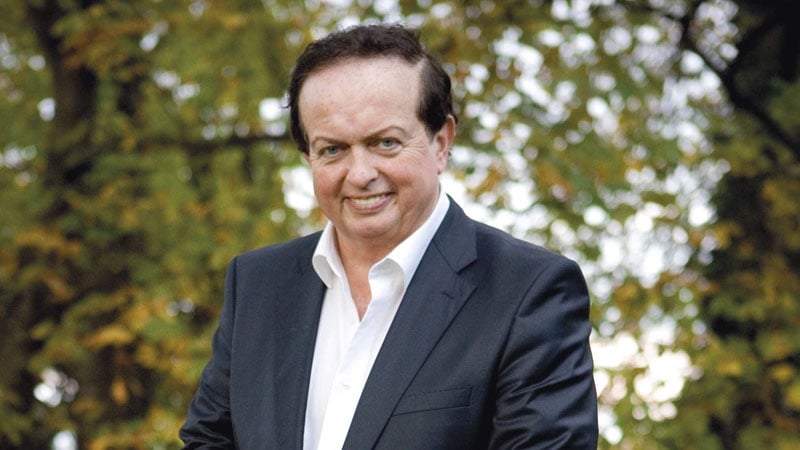
"Pride of place . . . a sense of belonging, this is our place." This is what drives the the GAA engine, according to Marty Morrissey. "I’m very proud of where I’m from, and I think everybody should be", the popular broadcaster tells Paddy Kehoe.
Marty Morrissey is known the length and breadth of the land for his GAA match commentaries, but there is plenty more to this Clareman than sport. Take, for instance, the four stars his culinary skills earned him on RTÉ One’s The Restaurant. He readily admits that he is is anxious to try other things. He’s already presented RTÉ Radio 1’s Countrywide and plans to present further editions in January, when he stands in for regular presenter Damien O’Reilly.
He made his mark more recently on TV with The Committee Room, but he muses on another kind of TV show he would like to host, “a Michael Parkinson/Graham Norton-type show – bit of fun but a good decent chat too."
While he has been a familiar RTÉ personality for many years now, there were a number of career moves during the early part of his broadcasting career, as he found his feet. The UCC graduate and former science teacher worked in current affairs with local station, Cork Multi-Channel TV in the mid-’80s. This was followed by three months in London, working on a series of programmes about Irish personalities for the Lifestyle channel. He returned home in 1988 to become news editor at the then fledgling Clare FM, where Morning Ireland’s Rachael English and TV3’s Alan Cantwell were also helping to set up the newsroom. But the future was mapping itself out, and he was already providing his GAA match commentaries for RTÉ Radio.
He worked with RTÉ Cork from 1990 to 1994, before moving to Dublin, where he has been based ever since, working as a GAA reporter, both on RTÉ Radio and TV. In recent times, he has begun to cover boxing, and he especially enjoys the crowd warm-ups before big fights at the O2. In October, he reported on the World Boxing Championships from Baku in Azerbaijan. "I like the boxing crowd, they’re fierce decent people", he says. "They kind of welcomed me in." He interviewed the late Darren Sutherland many times before his untimely death. "After he won his bronze medal at the Beijing Olympics, we went around filming for a day. He had huge ambitions, hopes, huge potential, but it was his kindness of heart that impressed, he was just a good lad. I admire boxers because of their courage – not easy to go into a square, and get roped off and you having to box yourself. It’s not like football or hurling or soccer, where in some matches you can hide, if you don’t want the ball."
Morrissey is one of the GAA’s most steadfast defenders. "Ireland would be a pretty barren place without it; the GAA is the pulse of the people of Ireland. Whether it be Owenmore Gaels in Collooney in Sligo or St Vincent’s in Dublin, it is the GAA that have put in the infrastructure for the young people of Ireland. They are the epicentre of the local community. I know that there’s money coming from Lotto and indeed from Croke Park, but essentially it’s the people themselves who have done it."
He talks of local people who decide they need a clubhouse or a field, which in turn becomes "the centre of their universe." What drives them? "Pride of place, I hope, a sense of belonging, this is our place. I mean I’m very proud of where I’m from, and I think everybody should be."
An only child, he spent the first ten years of his life in New York, where his late father worked in the travel business. However, Marty was born in Mallow (his mother is a Cork-woman). "I was conceived in the USA, but I was brought back to be born", he remarks. When the family returned for good, he spent much of his youth working in the family pub in the village of Quilty in Co Clare. (He doesn’t drink – in fact he uncomplainingly drives his drinking friends around – but he values that pub apprenticeship.)
Kilmurry Ibrickane is his club and he is proud to mention how they got to the All-Ireland Football Club Final in 2009. "When I was a young lad, we had a field which was like a meadow, and the hay would be cut, the trams, the cocks – depending on what part of the country you were from – would be made. Then the field would be cleared, we had the goalposts, and away we’d go."
Paddy Kehoe
