

You can learn a lot about movie stars by hanging out with them for a few days. While traditional interviews can sometimes adopt a conveyor-belt approach, offering little opportunity to interact with the star in question, there’s an annual movie event in Cancun, Mexico, that provides just the opposite. Each July, a handful of journalists are invited to spend a week in the company of a dozen or more Hollywood A-listers for an event that incorporates both interviews and social engagements. And so the RTÉ Guide found itself in Mexico this summer.
The A-list talent on show in Cancun this year manifested its star power in three ways. The majority of actors who took part in the photocalls and interviews left the moment they were finished and spent most of their time at the social events behind the red rope. One particular A-lister (no names, no pack drill) employed his star power in a different way by insisting on having a separate entrance to the hotel; private access to the swimming pool for himself and his entourage; and solo use of any of the hotel lifts. And then there was George.
While some of his colleagues gave the distinct impression that dealing with journalists was only marginally more pleasant than root canal surgery, Mr Clooney charmed the small press corps by arriving sans entourage (and sans Stacy Keibler, who hadn’t quite entered the frame at this stage) and chatting at length to all and sundry. Far from hiding behind the red rope, he placed himself in the middle of every social event, pressing the flesh and remembering everybody’s name with such ease that most journalists present wondered aloud how long it would be before this man went into politics.
That question is even more relevant, given the political nature of his work as a film-maker, that has seem him take on projects such as Syriana (2005) and Good Night, and Good Luck (2005), when others in his situation might have been content to use their Sexiest Man Alive tag to continue churning out Ocean's 11 movies. In this regard, Clooney's latest film, The Ides of March, is perhaps his most political yet.
Co-written by his old pal, Grant Heslov, it tells the story of a charismatic Democratic governor (played by Clooney himself) whose campaign for the presidency gets mired in double-dealing and betrayal. It’s one of Clooney’s most personal projects, given that the film-maker’s father, Nick, unsuccessfully ran for Congress on the Democratic ticket in 2004 and was subsequently scathing of electoral patronage.
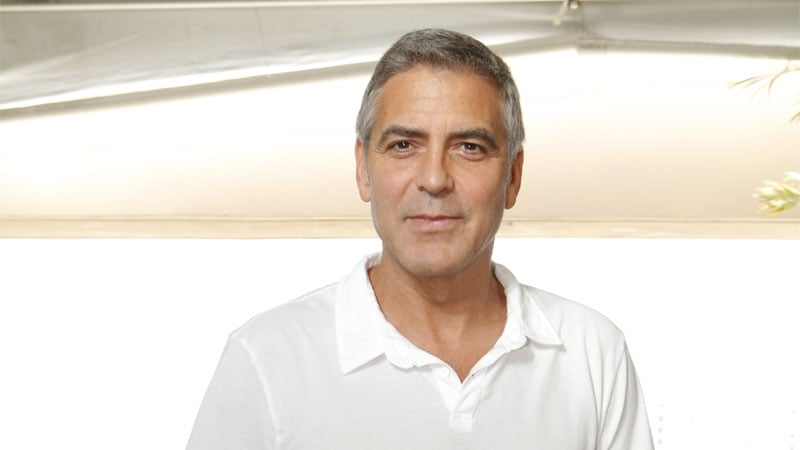
“You know my father ran for Congress”, says George, casually dressed in white polo shirt and jeans as he settles back into his seat, “and he’s a really honourable guy, my dad, and I watched him struggle with the things they wanted him to do because you have to show up at these fundraisers for things that he doesn’t necessarily want to support. That’s a very tough thing to do and everyone does it. So I think it’s very hard not to lose your soul in politics. But I lost my soul last night. There’s this thing called – I don’t know if you’ve ever heard of it, ’cause you’ve just come down here – it’s called tequila. I gave some of my soul to the tequila god!”
It’s typical of the 50-year-old Kentuckian that he would break away from a serious point for the sake of a gag, so I quickly pose a double question: is The Ides of March a deliberate throwback to those classic political thrillers of the 1970s, such as The Parallax View (1974); and how he managed to squeeze so many scene-stealers – Ryan Gosling, Paul Giamatti and Philip Seymour Hoffman – into one movie.
“We reference ’70s films in general because we kind of like the subject matter and the way they were shot”, says George. “I certainly love the way people like Gordon Willis work. These are the kind of films, when you do them, you have to to leave something to the viewer to solve, as well, you know? That can include the shots. We’ll do shots where we’ll stay on a character long enough for you to have to figure out what’s going on. We’d like to call it an homage, but we’ve stolen from all the great cinematographers from the ’70s, all the way around! And what was the other question you asked me?”
The number of scene-stealing actors on show . . .
“Yeah, I was sort of pissed off being in scenes with those guys! You know, the fun part is when you look around and you’re in a scene with Paul Giamatti. Ryan is just a really wonderful actor and his instincts are so good and he’s working with people who are infinitely more experienced than him and that can be very intimidating, but they were really kind and it’s a nice quality to have. I think that’s the secret to those guys, why they’re so good, why Phil is so good and and I’ll tell you something; wait ’til you see Evan [Rachel Wood] in this thing. She does a spectacular job with this film. It’s a really good cast. We’re very lucky to have them.”
Clooney and Heslov were indeed lucky to end up with such a superb cast given that the movie was originally scheduled to be released three years ago. Timing is everything in Hollywood and George realised that it just wasn’t the appropriate time to unveil The Ides of March on the American public.
“We were in pre-production in 2008 and were getting ready to start”, explains George, “and Obama was elected president. Everyone was so hopeful and everyone was so happy that Grant and I were sitting at dinner one night and we realised we can’t make this movie right now because people are too happy. We needed them to be cynical, you know? And it took about a year and then I looked over at Grant, I said, “I think we can make that movie now”.
Of course, releasing this film in 2011 brings an extra resonance for the US electorate, since they are currently in the throes of a presidential campaign that is getting increasingly heated. So does George thinks his movie offers any salutary advice for the new crop of Democratic hopefuls?
“Yes”, he laughs, “don't sleep with the interns! Also, don’t take pictures of any of your parts and email them to anyone. Stay off Twitter in general if you’re running for something, you know. Hey, there’s too much information out there right now for a candidate, so I think probably my favourite one would be don’t touch the interns. Always good advice.”
Sound advice but for all his cynicism, there’s no doubt that a large number of US citizens would tick the box beside George Clooney should his name ever appear on a ballot. So it’s time to ask the $64,000 question: what price George for President?
“Oh, doesn’t that sound like fun?” laughs the actor. “Doesn’t it look like fun, what President Obama gets to do every day? Gosh, I can’t think of anything more fun. I have no interest at all. None. I never have. I like the idea of being able to press issues that I think are important and I can do that from the outside.
Unfortunately, in our election process, you have to work so hard and make so many deals along the way that it’s very hard to really take one side that you think is completely right, you know, when you’re constantly having to shift positions. It’s not for me.”
To be fair to the actor, he has been particularly effective in pressing issues that are important to him, issues such as the Darfur conflict, human rights issues in Sudan, plus high profile fundraising on behalf of victims of 9/11, the 2004 tsunami and the 2010 earthquake in Haiti.
“I find that I’ve had a lot of luck in my life”, George explains, when asked about his humanitarian work, “and I think luck is only good if you kind of spread it around, so you want and try to look out for other people along the way and I don’t think of that as a great thing to do. I think that’s what you’re supposed to do. It’s how I was raised. People are overly kind to me about going to the Sudan and things like that and the truth of the matter is, I think that’s what you’re supposed to do, you know, if you’ve been lucky enough to have success. ’Cause anybody who’s been around this business long enough understands that there were equally as good, if not better, actors in acting class as me. More talented people in every other thing that I’ve done. So it requires an element of luck to play. So I feel that should be shared whenever you can.”
There may have been more talented people in the 21-year-old George Clooney’s class when he attended acting courses by night while chauffeuring his famous singing aunt, Rosemary, by day, but few could have lasted the pace as well as he did. Not only has George Clooney managed to put a number of ho-hum movies, ranging from Return of the Killer Tomatoes (1988) to Batman & Robin (1997), behind him; he has managed to survive the pretty boy tag and now finds himself, at the age of 50, at the very pinnacle of his profession, able to use his star power to finance personal movie projects that otherwise would never get made.
And that’s what makes George Clooney tick.
“Not many people are lucky enough to be in the position that Grant and I happen to be in right now in our careers and things we get to do”, George concludes, warming to the subject. “And we’re sort of in that position where we can force people to make films that they don’t necessarily want to make. I mean, that’s the truth, you know? We’re in a business now where you can look at something on paper and go, I don’t want to make this. And we have to really work hard to get it. It was very hard to get this film made. We had to do all the meetings and meet each foreign distributor and raise little bits of money at a time. We got everybody to work for virtually nothing because we wanted to make this kind of movie, because there’s a period of time in your life, and if anybody has any understanding of the history of what I do for a living, it doesn’t last all that long. So you want to exploit that period of time.
''When they give you the keys to the toy box, you want to use it as much as you possibly can until they take them away, and they will eventually. So while we’re there, we’re going to just keep pushing the envelope and trying to do stuff. You know, nobody wanted to see a black and white film about McCarthy and it was hard, you know? We had to do all kinds of things to get that film made and part of it was our theory – keep the budgets really low so the cost isn’t prohibitive, and just keep making the films you want to make until people go, ‘Enough’. Then I’ll go sell my house in Como and hide out somewhere.”
Don’t hold your breath.
Michael Doherty
