


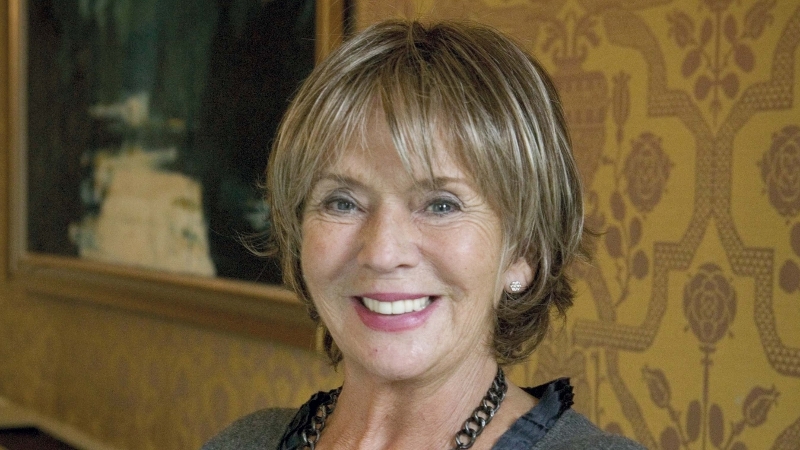
In her life, Sue Johnston survived depression, bulimia and two broken marriages, but her greatest battle was with her mum. Donal O’Donoghue meets her
Sue Johnston sits in a Dublin city centre hotel, surrounded by the buzz and bother of Friday evening. If some of the punters recognise her, they are either too polite or too steamed to acknowledge. But to anyone with even a passing interest in TV, the 67-year-old actress should be readily recognisable.
Following her profile-building turn in Brookside in the ’80s, Johnston ascended to near TV institution status with roles in Jam and Jerusalem, Waking the Dead and most memorably, The Royle Family. Now, the OBE recipient has penned Things I Couldn’t Tell My Mother: a biography studded with enough incident to keep the publishers (and tabloids) happy.
Between the covers she writes about her battle with bulimia and depression, the time she fought off a would-be rapist and the personal impact of two failed marriages. But the narrative is dominated by her difficult, and sometimes fraught, relationship with her mother. By any measure, Margaret Wright (Johnston is Sue Johnston’s first husband’s surname) was a tough cookie. When her first (and only) child was born, she made no bones about the fact that she had hoped for a boy. This subsequently lead the young Sue Johnston to believe that she was ‘a mistake’.
Today she attempts to explain her mother’s actions as a generational thing but ultimately concedes that it made her ‘feel unloved’. “That persisted all my life”, she says. “That I was unloved by my mother. It was driven by her eternal criticism and the fact that she couldn’t hug me or kiss me. There was also a moment, and this is not in the book, that I remember her saying, ‘I never breast-fed you because you wouldn’t go to the breast’. And I thought then: ‘I wonder why.’”
Even so, Johnston says that writing her biography was not cathartic – a question she’s been asked many times on the PR circuit. But the book helped her address buried issues as well as understand the most important relationship in her life. “What I did realise from writing the book was that I failed my mother and she failed me because we both wanted the other to be something that we couldn’t possibly be. I realised that I couldn’t be the girl that stayed at home and got married and raised a family. That’s what my mother wanted. She couldn’t quite figure out how she had ended up with this girl who was slightly rebellious and went away and did things that she didn’t approve of.”
In her early teens, Johnston was in thrall to the classic romantic novels like Pride and Prejudice, Jane Eyre and Wuthering Heights, fictions that contributed to her belief that a woman was defined by the ring on her finger. It was also how was it was then. “When I was a teenager the big question from aunties and uncles was: ‘are you courting yet?’”, she says. “The thing is that back then, women grew up, got a job, got married and had kids. In a way I wanted to be like everybody else. I wanted to have a ring and get married and the rest. But there was another part of me that wanted to go off and strive to be a good actor.” She was 24 when she got married for the first time. When it didn’t work it she succumbed to an eating disorder and was prescribed anti-depressants by her GP.
“Did I blame myself for the failure of the marriage? Yes I did, because I thought I wasn’t good enough I suppose, or good-looking enough or whatever. I was very upset that it failed. I didn’t want it to fail. I was very down about it. But work saved me. I got a new job and went into repertory and that helped me to get through the dark times. Work has been my escape and my saviour. If I didn’t have that I sometimes wonder what would have become of me.”
Her second marriage was to the theatre director David Pammeter (they had a son together, Joel, who is now 32). She describes him as an intense, exciting and handsome man who just ‘blew her away’. She subsequently discovered that he wasn’t the greatest husband in the world and for a long time after the break-up they didn’t talk but are now friendly again. “I was devastated by that break-up because I totally think that it was the love of my life”, she says. “He was my Mr Darcy – very charismatic and handsome and incredibly intelligent, but not great marriage material then . . . ” She pauses. “I don’t really don’t want to talk about it much really.”
The failure of her second marriage opened another Pandora’s box: bulimia. “I ignored it for ages”, she says. “I don’t know where it came from but it was a nightmare. It was over a span of ten years – I didn’t have it for those ten years but there were trigger points that sparked it. I kept thinking I was fine, but I wasn’t fine at all because I was going to pieces. It was very shaming and for a long time I told no one. That was the hardest thing to write in the book. But I’ve done it now and it’s out there. Why did it happen? It might have been low self-esteem from my marriage break-up. There was also this fear of seeing yourself on TV and being aware of how you looked. I’m much tougher now.”
In her screen life, Johnston played Ricky Tomlinson’s wife twice – first as Sheila Grant in Brookside and latterly as Barbara in The Royle Family. “We have hilarious fun together”, she says. They are also political animals (a chapter in her memoir is dedicated to the miners’ strike), something that Johnston inherited from her trade unionist father. “He was never as extreme or as left-wing as I got in the 1970s”, she says of her dad. “In fact he started frowning on my politics. But I felt a great allegiance with the miners and the miners’ struggle was something I really empathised with. Of course, I also hated Margaret Thatcher and everything she stood for, so it was easy to campaign for the miners.”
Johnston’s impressive thespian CV on stage and screen runs the gamut from broad comedy to Shakespearean tragedy. “Some person asked me recently what I preferred, doing comedy or the serious stuff”, she says. “But for an actor there’s no difference – you still have to make that script come alive and be truthful. Sometimes it’s more difficult to do comedy.”
Over the years, her fan mail has reflected the vagaries of her craft. “When I was on Brookside, I got this extraordinary strange fan mail. It was rather weird and frightening, stalker-ish stuff. There was a guy who used to wait in the car park and follow me home. So I used to drive to the local police station and he’d just shoot off then. Since Brookside, my fan mail has been ordinary. I suspect my agent takes out stuff that is not ordinary.”
At 67, she is adamant that she will remain single. “Oh yes, I can’t deal with all the hassle”, she says and laughs. “It’s not that I don’t think about it. But I think it has something to do with having a child. Also, and maybe this has something to do with being an only child, but I never feel lonely. Lonely is not an emotion that has been part of my psyche. I don’t mind being alone. In fact I embrace it a lot of the time.”
She lives in north London with a good friend who rents the space upstairs from her. They share domestic duties. “I cook and she cleans”, she says. “I hate cleaning and she hates cooking. We’re like a little Darby and Joan, a married couple except we’re not. Although some people think that we are gay. This neighbour asked me once, ‘are you two an item?’” By the time her mother passed away four years ago, the dynamic between them had changed – the mother increasingly reliant on the daughter for physical and emotional support – and they reached an understanding.
Sue Johnston misses her now, occasionally finding herself in a moment that triggers the past. “The last memory of her that makes me laugh is when I visited her at the home”, she says. “I had just rushed from the set of Brookside and was still wearing my make-up. She just looked at me and asked: ‘So what have you come as? A bus conductress?’” She says that her philosophy, no doubt shaped by her upbringing, is to see the good in everyone and seek the love in life. “Of course there will always be someone whose eyes you’d like to poke out”, she laughs.
Johnston will appear early next year in a new Sky TV series, Gates. “It’s about the politics of the school gates”, she says of the show, in which she plays a conservative deputy headteacher. But the even better news is that the actress returns to our TV screens this Christmas in another seasonal special of The Royle Family, the comedy that has replaced Only Fools and Horses as the must-see Yuletide show. “We do it in November and for me the fun of Christmas starts then”, she says of renewing acquaintances with Tomlinson and co. “We work hard because you have to do it exactly as written: even the pauses. But in between the takes, it can be hysterical. People love it too because it works and it makes them happy.”
* Things I Couldn't Tell My Mother by Sue Johnston is published by Ebury Press.
