


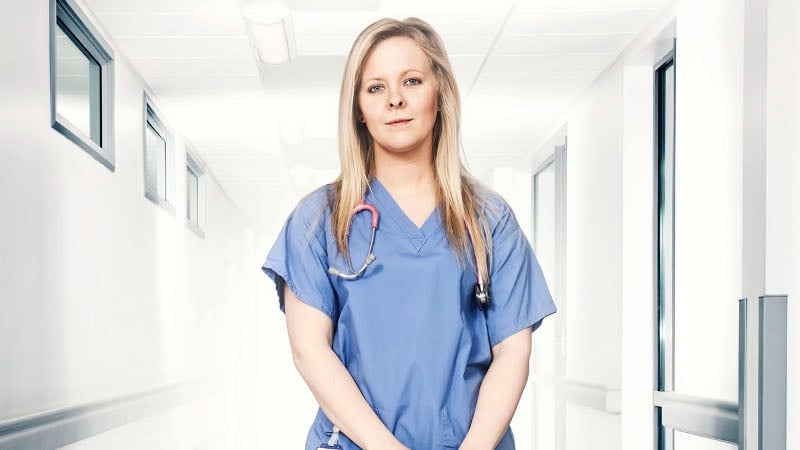
From ‘Dr Kildare’ to ‘Grey’s Anatomy’, TV has always thrived on medical dramas but what’s the real life world of doctors like? A new six-part documentary series follows the public and private lives of seven young doctors including Omagh girl Suzi Batchelor. Alan Corr talks to her.
“I suppose in most jobs your first day at work is all about drinking tea and coffee, been told how things work and being introduced to everybody. Mine was a bit different – a man was rushed in with a heart attack, there was a suicide attempt, and I had to deal with a lot of binge drinkers.”
24-year-old Omagh girl Suzi Batchelor is recounting her first day’s work in the A&E department of Newcastle’s busy Royal Victoria Infirmary Hospital. “I was having to make choices about patient’s lives, diagnoses and treatments and that’s a big thing for somebody of my years to have to think about but it’s what I’ve been trained for,” she says. “It isn’t as if I’m some random person in the street. I’ve been building up to this for years and years so I should be able to do this really. It is scary but the rush and the pressure makes you perform. I think if you have time to panic, you panic but if you don’t you’ll just do it.”
Suzi is in her second foundation year and she’s one of seven young doctors featured in ‘Junior Doctors: Your Life in Their Hands’, a new six-part series which goes behind the scenes and delves among the discarded swabs in the lives, both private and public, of NHS workers. Over the next few weeks we’ll see Suzi and six fellow medical novices as they go about their working lives in their respective disciplines dealing with 12-hour shifts, lack of sleep and the every day joy and sorrow of life at the frontline of medical care.
The seven trainees also share a house together in Newcastle and we’ll also see domestic issues unfold as well as rare nights out. The fact that the series is on BBC Three, the Beeb’s yoof channel, suggests that Junior Doctor will juggle high pressure work lives with chaotic social lives. “Um. I think it shows us having a good time,” Suzi says coyly. “Just talking about things in the house and having a laugh and going out so it does show that side of us but our jobs take up lots of our time. During my stint in A&E I barely went out at all. It shows both sides: when we do go out we have a good time but it also shows that nights out are a rarity.”
And was there romance down in the swabs? “No! Hahaha.” Are you sure? “I’m a positive!” So much for those Mills & Boon tales of young doctors in love. “I know there are lots of doctors married to doctors and other people in the NHS. I think it’s a time thing – you don’t get to meet people anywhere else. It does happen; it just hasn’t happened to me.”
Suzi, who speaks in a curious mix of Newcastle and Omagh accents and plans to work as a doctor in Africa when she qualifies, actually comes from a musical not a medical background. Her father is a singer and her mother an accompanist and she herself sang and played clarinet but when she realised her voice wasn’t going to cut if professionally, she turned to medicine and is now set to become the first person in her family to become a doctor.
“I do quite like the fact that people are quite surprised when they hear I’m a doctor,” she says. “I’m blonde after all! My parents are so proud but I’m just happy to have a job that matters. I’ve always loved science and I’ve always loved talking. I’ve always been kind and generous, so it was an obvious thing.”
No surprise then that she’s a self-confessed “girly girl.” Before she hit the wards at the RVI, she invested in a pink stethoscope and a pink lanyard to go with it. “I am a girly girl. I have two older brothers so I think I was a tomboy for quite a while but I’ve always loved the colour pink,” she says. “I have a pink stethoscope, I have pink trainers for work, I have blonde hair and my bedroom is all pink. I’m the same when I’m going out and getting dressed up. I’m a girly girl but I think there are more sides to me than that.”
The prospect of being on television both excites and scares her (“everybody has got a view of everybody on tv and I’m worried that I’m not going to make everybody happy”) but she’s happy to be taking part in a series that will bring us into the working lives of young doctors. It’s a far cry from the fictional worlds of Scrubs and Grey’s Anatomy. “I don’t think there’s anything on tv that sums up truly what our job is but I find the shows very entertaining,” Suzi says. “I’ll sit at home watching Casualty with my mum and dad and say, that isn’t how you do CPR! That’s never going to work, that would never have brought them back . . . My parents are like, will you just be quiet so we can watch it.”
Adam Beaini
F1 doctor, 24, Leeds
Designated department – Respiratory
Adam is 24 and originally from Leeds. A born “charmer” with a strong family background in medicine, his mum was a doctor and his dad is a successful psychiatrist and his big brother is a practicing GP.
Why did you want to get into medicine?
“My family has a massive medical background. This gave me great exposure and that meant I got to see that I wanted to do this.”
You have a unique way of revising
“Oh, House because it's stimulating. The first few episodes are quite good for your revision – it's very real – and rare cases. I try and get them before House himself. I think I got two rare cases before he did.”
Jon Barclay
F2 doctor, 24, Oxford
Designated department – Acute Medicine
Jon, 24, is the son of a medical salesman and a nurse. He has always wanted to work in medicine and is a bit of a trailblazer in his family as he's the first boy to go to university.
Why did you want to get into medicine?
“I like the fact that with medicine things can be unpredictable and change from day to day.”
Which on-screen character are you most like?
“I'd like to be like Turk from Scrubs. I think that he's got that balance – he does his job really well but still manages to have a laugh.”
Keir Shiels
F2 doctor, 28, Gateshead
Designated department – Plastic Surgery
At 28, Keir, who is from Tyne and Wear, is the oldest of the group. Incredibly, he already had a neuro science and psychology degree under his belt before deciding to train as a doctor.
Why did you want to get into medicine?
“I was already a neuro-psychologist – I got really fed up of assessing patients and then not doing anything about it as a scientist. And that's why I went into medicine - it's a trite reason saying: 'Oh, I really wanted to help people', but I did.”
What has made you laugh?
“You always get those amusing patients who have objects stuck in various orifices, shall we say. I've seen stolen goods, garden gnomes and mobile phones – apparently people like the vibrate function.”
Andy Kong (25)
F2 doctor, 25, Hong Kong
Designated department – Paediatrics
Andy is from Hong Kong and was inspired to become a doctor by Benedictine monks who taught him at boarding school in York.
Why did you want to get into medicine?
“I enjoy the patient contact – I like the fact that our patients are from all different backgrounds. I like the fact that I meet so many different people.”
Who would you turn to for a diagnosis?
“House! If I was sick I would go to House for a diagnosis. I aspire to be like House – he is a genius.”
Lucy Holmes
F1 doctor, 24, Essex
Designated department – Gastro
Lucy, 24, like Suzy, is the first person in her family to become a doctor. Brought up in Essex, she turned to medicine to help find a cure for her sister's life-threatening disease, Cystic Fibrosis.
Why did you want to get into medicine?
“I've got a little sister, Sophie, who was diagnosed with Cystic Fibrosis. That obviously encompasses an awful lot of care and treatment. And when she came home from hospital during that time I've been involved with her care and it made me want to go further with that type of thing.”
Does it ever feel like you are off duty?
“Some days it's difficult to walk away from work and not think about what you've seen or done.”
Katherine Conroy
F1 doctor, 24, Cheshire
Designated department – Plastic Surgery
Medicine is a bit of a family tradition for the Conroys. Katherine's mum is a nurse and her dad is an anaesthetist. Part of Katherine's foundation year one will be spent on the plastics ward.
Why did you want to get into medicine?
“I decided to study medicine because it really fits my personality and what I'm into. I've always liked science and I've always been someone that watches medical documentaries.”
What makes you laugh?
“Elderly patients! They are the funniest as they come up with the best jokes – and they're quite rude! A lot of us doctors actually have a very dark sense of humour because we're used to talking about bowels, etc, it takes so much more to gross us out.”
Alan Corr
