


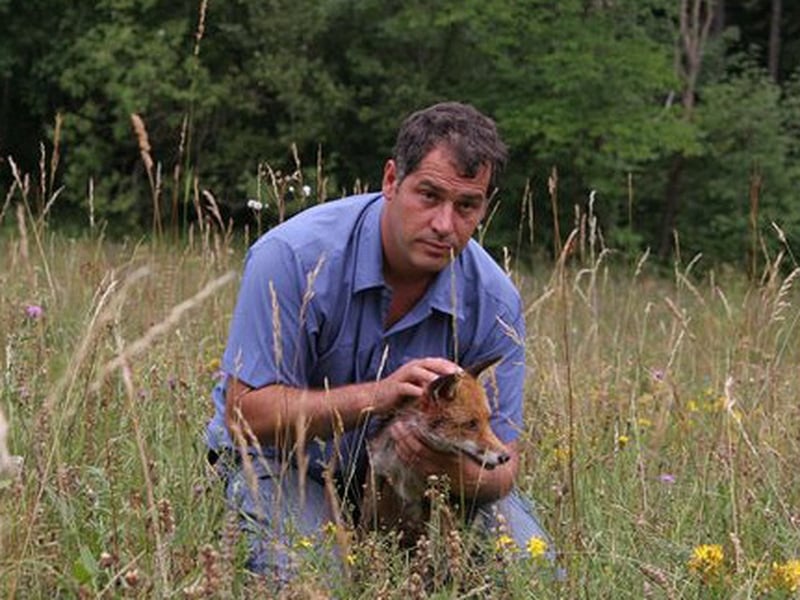
'The Fox and the Child' tells the story of the encounters between a wild fox and a young girl, played by Bertille Noelle-Bruneau.
Here, RTÉ.ie's Brendan Cole speaks to the director, Luc Jacquet, whose previous film 'March of the Penguins' was a worldwide smash hit, about the challenge of fitting a wild animal into a narrative piece; how he came up with the concept and the film's message. The interview was done through a translator.
Read 'The Fox and the Child' review here.
Brendan Cole: What can viewers expect from ‘The Fox and the Child’?
Luc Jacquet: I find your first question amusing. What viewers can expect is to see something they haven’t seen before; something unusual because it is in part a documentary but it is also pure fiction. So what they can expect is an adventure. They are going to embark on a journey into a nature that they thought they knew, but that they will discover [differently].
BC: Can you talk about the reaction to your previous film (‘The March of the Penguins’) and how it shaped your approach on this occasion? LJ: It's always difficult to forecast the reaction of the public to a film. What I wanted to do was to make something different. I went into my childhood; into a memory I have of having looked into the eyes of a wild fox when I was a kid. I also noticed that of all the encounters in the world I have had with animals, that when you lock eyes with an animal, something happens that’s very difficult to describe but that is very powerful.
BC: Talk to me about the landscapes and the photography of 'The Fox and the Child'.
LJ: I shot principally in two locations. First in the Giron in the mountains of l‘Ain, where I grew up. This landscape has actually been the backdrop for my whole childhood. The second location is the national park of Abruzzo in Italy, [I chose this] mainly because it’s very rich in Europe’s big animals; bears and, of course, foxes.
 What I wanted to show was nature and that, yes, it’s beautiful. But I also wanted to show that you could feel [it] rather than [just] describe it. I didn’t want only to show a beautiful place but also to make the viewer feel that the place was beautiful. For me, nature is a character of the movie.
BC: Although you show the fox as a wild animal, you also portray it as having almost human expressions. Can you talk to me about how you approached this aspect of the film?
LJ: Working with wild animals or, or at least animals that were as close as possible to how animals are in their natural environment, was a very big challenge, and an important one. I didn’t want to make a film with special effects because it is not my area of expertise; it [my expertise] is about animals and filming them in their own environment. It was a very complicated enterprise but also a very rewarding one. Every day he had to find solutions because you can’t actually direct a fox; you have to adapt to what he is doing.
BC: It was a new thing for you to work with a human actress - the child – for the first time. Can you talk about that? LJ: It was something I had never done before but I must say that I actually really loved it. It was a challenge, because the movement skills of the actress needed to be very rigorous and precise and it took me a little while to adapt himself to directing Bertille [the little girl] because she had a very complex part to play and most of what she had to express had to go through her face and gesture. But she had a very big instinct for that so it was a difficult job but exceptionally rewarding.
BC: There are strong messages in the film - can you tell me about your own views on the interactions of the natural and human worlds?
LJ: I have a lot to say about this subject. I wasn’t interested in nature as just being nature on its own; I was interested in nature as being like housing for humans - like a mother for humans. It’s very important that this difference is known; that the human needs nature to continue. I also wanted to use my knowledge of biology and ecology to let people share my appreciation for nature. I think that it’s extremely important that nature is a part of our lives.
The ‘Fox and The Child’ opened on Friday, 8 August and is currently showing at cinemas nationwide.
