


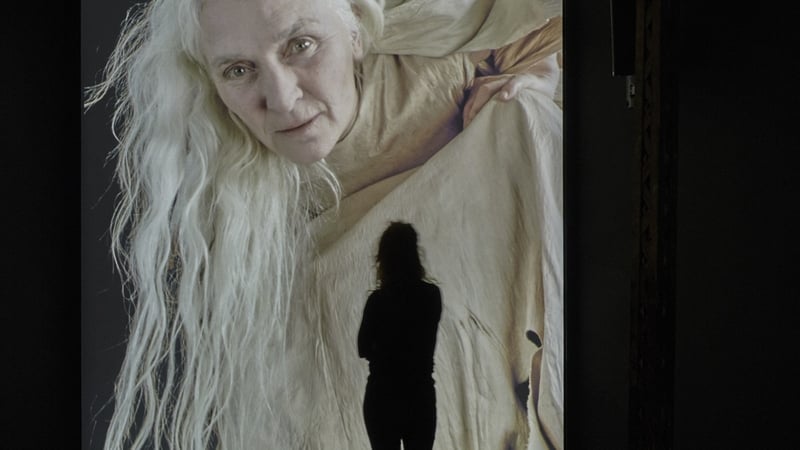
Isabel Nolan's Dreamshook is the twentieth official Irish exhibition at the Venice Biennale, writes Declan Long.
Nolan’s art takes many forms, drawing on a grand diversity of sources: sculptures, paintings, drawings and tapestries that might refer to medieval paintings in one moment, or science fiction stories in another. In Dreamshook, inspiration has come from the history of Venice — in particular, the city’s pioneering Renaissance book publishers — but in its luminous plurality, Nolan’s work is also a fitting next chapter in the history of Ireland at the Venice Biennale.
We need your consent to load this rte-player contentWe use rte-player to manage extra content that can set cookies on your device and collect data about your activity. Please review their details and accept them to load the content.Manage Preferences
Listen: Artists Isobel Nolan and Alice Maher talk Ireland at Venice 2026
Ireland’s Venice debut, an exhibition by Norah McGuinness and Nano Reid, took place in 1950. Looking back, the choice of two women painters now seems a remarkably progressive curatorial statement. McGuinness and Reid represented Ireland with an advanced vision of Irish art: forms of modernist abstraction, turning away from more traditional modes that remained institutionally dominant at home. Their modest exhibition, situated in one room of the main Italian Pavilion at the heart of the Giardini — the gardens that serve as the central hub of the Biennale — was well received in Venice, but coverage and approval were less forthcoming back in Ireland.
This mixed success had contradictory consequences. Though the Irish government’s Cultural Relations Committee was sufficiently satisfied to confirm support for further Venice participation, Ireland’s subsequent efforts to maintain a presence at the Biennale were repeatedly frustrated. In 1952, a plan to present works by Jack B. Yeats fell apart over disagreements with Biennale authorities about the availability of gallery space. The resulting breakdown in Irish-Italian relations meant that hopes for Ireland’s pavilion quickly faded: in both 1952 and 1954, no shows were staged.
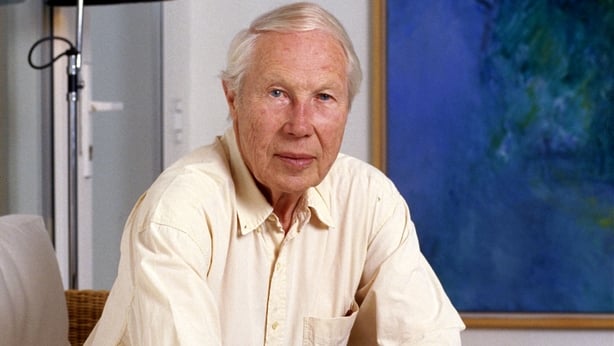
By 1956, however, the country’s cultural ambassadors had negotiated terms for re-inclusion – and Ireland re-appeared at the Biennale with a successful two-person exhibition featuring sculptor Hilary Heron and painter Louis le Brocquy, the latter winning one of the year’s major prizes. This success was followed by further setbacks. For the 1958 Biennale, the Cultural Relations Committee opted to revisit the unrealized Jack B. Yeats proposal – and once again the project ran aground. One cause was the continuing dispute over space allocation, but an additional, and deciding, factor was Yeats’s death in 1957: at that time, Biennale rules dictated that only living artists were eligible for national representation.
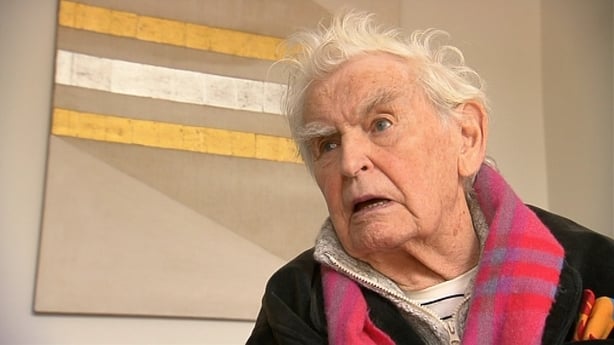
Forced to drop out in 1958, Ireland nevertheless returned in 1960: on this occasion with a solo exhibition by Patrick Scott. Scott’s show would be, however, Ireland’s last Venice appearance for many years. As space problems persisted, plans to construct a purpose-built pavilion – to be designed by eminent Irish architect Michael Scott – were explored, then, eventually, abandoned. It would be more than three decades before Ireland would again send an artist to the Biennale.
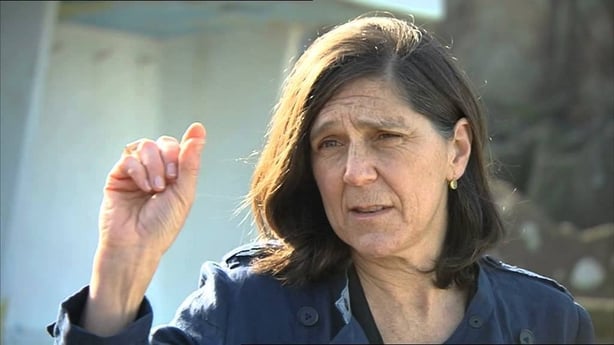
In 1993 under the guidance of Declan McGonagle (then Director of the recently opened Irish Museum of Modern Art), Ireland recommitted to Venice, moving on from the unproductive process of planning a permanent pavilion. This 1993 participation featured Dorothy Cross and Willie Doherty, at that time two vanguard figures in the emergence of post-conceptual art in Ireland. Their work was presented in two ways, in multiple places: integrated into the milieu of the main exhibition and dispersed around the city, with photographic works by Doherty appearing in poster form across several public sites.
The plan was a pragmatic solution to the problem of securing restricted, clearly demarcated 'Irish’ space; but it was also, in this moment of return and renewal, borne of speculation on what a national representation ought to be, especially in the case of a politically divided ‘nation’. Ireland re-introduced itself at the Biennale in deliberately dis-united terms: appearing in more than one place, while signalling the importance of connections to both centre and periphery.
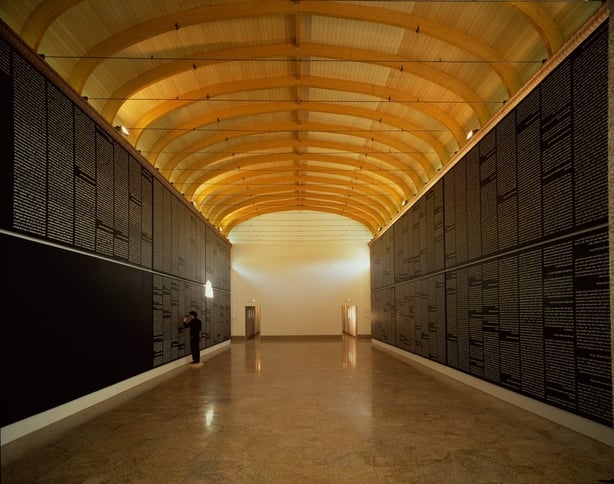
by Shane Cullen (Pic: IMMA Collection: Purchase, 2000)
A two-artist selection policy was largely maintained as Biennale participation continued throughout the 1990s. For the 1995 exhibition, curated by Peter Murray and featuring artists Shane Cullen and Kathy Prendergast, Ireland moved to the Nuova Icona Gallery on the island of Guidecca. Cullen’s dramatic installation Fragmens sur les Institutions Republicaines IV ('Fragments on Republican Institutions') (1993–97) drew on an archive of secret letters written by IRA prisoners to their leaders and families during the 1981 hunger strikes: personal and political ‘comms’, originally written in tiny script on scraps of smuggled paper, reimagined by Cullen for public display.
Hand-painted onto wall-mounted styrofoam panels, the texts were presented as temporary ‘monuments’: part of a detailed as-yet-incomplete project of memorialisation. Kathy Prendergast’s presentation was also knowingly incomplete and, like Cullen’s, the product of painstaking endeavour. This was a selection from her City Drawings (1992–1997), a series in which Prendergast aimed to create intricate outline maps of every capital city in the world, realized as humble pencil sketches, fitting each differently-scaled landscape onto the same size of paper. The uniformity of format contrasted with the Biennale’s hierarchy of national representation: all places, of all sizes, accommodated in equivalent terms. For this ambitious, open-ended project, Prendergast was awarded the prize for best emerging artist.
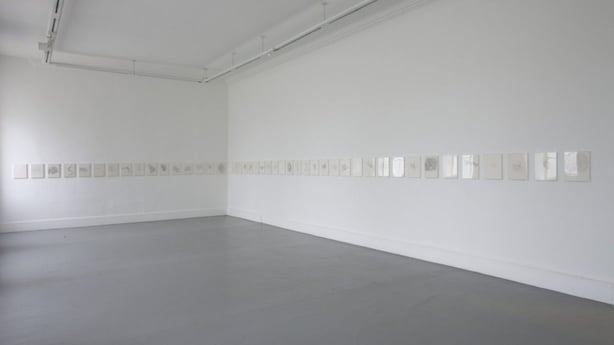
(Pic: IMMA Collection: Purchase, 1996)
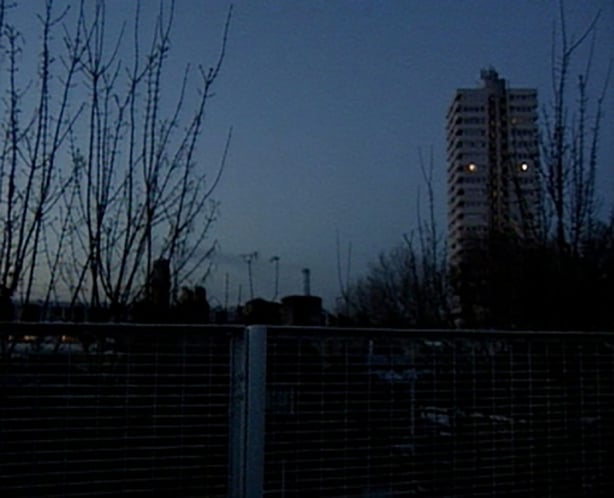
Two more Irish pavilion exhibitions took place at the Guidecca venue. Ireland’s 1997 presentation, curated by Fiach MacConghail, then director of Project Arts Centre in Dublin, featured Belfast-based Scottish performance artist Alistair MacLennan and London-based video artist Jaki Irvine in an exhibition reflecting on traumatic historical details of the Northern Ireland conflict (MacLennan) and more obliquely, on fraught questions of being and belonging (Irvine). The 1999 exhibition by Anne Tallentire, (realised with independent curator/commissioner Sarah Finley) offered further, idiosyncratic musings on location and dislocation. Tallentire – another respected Irish media and performance artist who had developed her career in London – presented, in this case, an elliptical lens-based installation entitled Instances (1999): a work that included, amongst its juxtaposed parts, meditative footage of a London tower block at dawn; scenes inspired, Tallentire noted, by a wish to reflect on ‘the restless, the wakeful, the vigilant’.
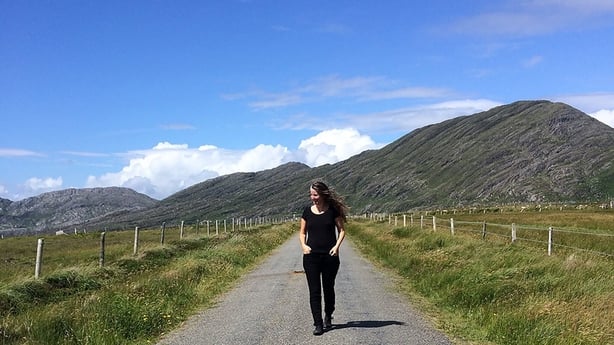
By 2001, the Irish pavilion was itself ‘restless’ once again, moving to the Scuola di San Pasquale, San Francesco della Vigna (in Venice’s Castello district) for an exhibition by Belfast-born Siobhan Hapaska and Dubliner Grace Weir, curated by Patrick Murphy (subsequently Director of the Royal Hibernian Academy). Again, the selected works advanced anxious vision of located and dislocated reality. Hapaska’s video May Day (2001) introduced a couple living in a stylish modern home, who are then, in the surrealist spirit of Luis Buñuel and Salvador Dalí’s Un Chien Andalou (1929) abruptly transported to a beach, where, face-down in the sand, their existential plight becomes disturbingly unclear. Weir’s contribution included Around Now (2001): a video installation capturing, from high in the sky, the inside and the outside of a moving cloud – an exercise in mapping constant motion and unstable form, a study of unfixed position from dual perspectives.
Subsequent exhibitions at the Scuola di Pasquale in 2003 and 2005 offered diverse responses to locality and community. Katie Holten’s 2003 project, curated by Valerie Connor, became a kind of drop-in community club for hosting conversations, scheduling events and enabling activities that highlighted multilayered aspects of life in the Venice environment, not least the challenges faced by immigrant groups. The 2005 exhibition turned attention back to the Irish context, albeit with a light-touch. Curated by Sarah Glennie – an Irish-based curator with substantial experience of commissioning and curating prominent art projects in Ireland and internationally – the 2005 show promoted a cluster of artists who had chosen to base their careers in Ireland, rather than emigrating to established centres of international art-world activity. None among this group of six Irish-based practices – Stephen Brandes, Mark Garry, Ronan McCrea, Sarah Pierce, Walker & Walker and, in a trial run for 2026, Isabel Nolan – directly focused on Ireland’s contemporary conditions. Yet across a series of understated, multi-media works, they emphasised uneasy experiences of inhabiting places: alone and with others, isolated and affiliated, rooted and rootless. This multi-vocal commentary on location came together, nonetheless, just as Ireland’s representation in Venice became newly divided.
In 2005, seven years after the signing of the Good Friday Agreement, the Irish representation at the Biennale was partitioned. Breaking with the general convention of all-Ireland, cross-border participation, a standalone Northern Irish exhibition was presented for the first time. Entitled The Nature of Things, Northern Ireland's show was proposed (by curator Hugh Mulholland) as an opportunity to promote artists who had participated valuably in the Northern art scene. Taking up residence in the Istituto provincial per L’Infanzia Santa Maria della Pieta, conveniently positioned near the main, canal-side route to the Giardini, the Northern Ireland exhibition was well-placed to attract significant Biennale audiences.
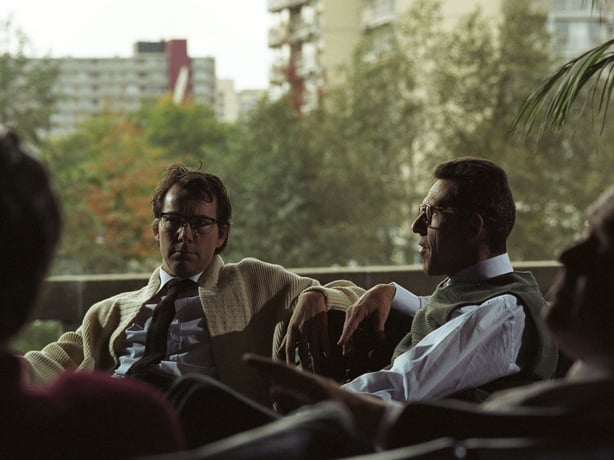
For the following Biennale in 2007, the Republic of Ireland team (led by Limerick-based curator Mike Fitzpatrick), chose to re-locate its ever-mobile pavilion to this enviable address, occupying the upper level rooms used previously for the debut Northern Ireland show, with the latter returning for a second exhibition, now based in ground floor spaces of the same building. Though not (quite) by design, the 2007 Venice participation of Northern Ireland and the Irish Republic had the appearance of a package deal — an impression strengthened by the fact that the artists chosen for the coinciding exhibitions, Willie Doherty for the North and Gerard Byrne for the South, were similarly recognisable as prominent presences within the international art world. Together at the same location, these adjoining exhibitions by high-profile artists, both working with video and photography, shared a dual Ireland-Northern Ireland billing.
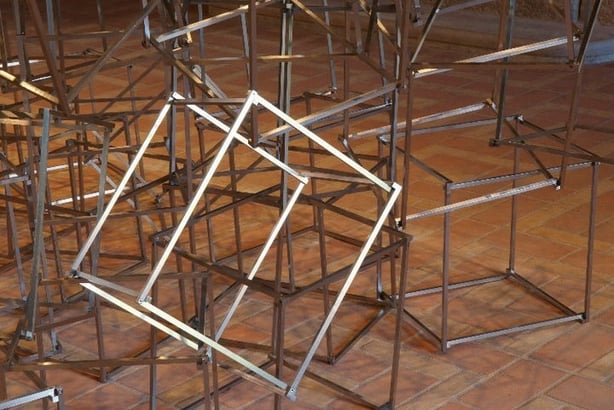
At the 2009 and 2011 exhibitions – also based in the Istituto provincial per L’Infanzia Santa Maria della Pieta – aftereffects of Government cuts to arts funding following the global financial crisis were evident — shaping the types of exhibition and the interests of selected artists. 2009 representatives, Gareth Kennedy and Sarah Browne drew attention to Ireland as a hub of accelerated globalisation, celebrating the nation’s new multi-cultural, ‘multi-national’ diversity, while questioning the high-risk financialization of Ireland’s economy. Ireland’s enchantment with neo-liberal economics was, in that historical moment, catastrophic. At the 2011 Biennale, the devastation of the crash was symbolized in the work of minimalist sculptor Corban Walker, in an exhibition curated by Eamon Maxwell, with commissioner Emily Jane Kirwan. Located for the last time in the Istituto, Walker’s Irish pavilion involved a combination of modest, site-specific interventions and a central structure: Please Adjust (2011), constructed from 160 open-form steel cubes — an abstract response to a contemporary situation of global and national precarity.
Since 2011, two other venues have hosted Ireland’s exhibitions. The first of these – the Fondaco Marcello, a converted canal-side warehouse – housed a spectacular 2013 presentation, by the US-based Irish photographer and film-maker Richard Mosse: a six-screen film installation (with accompanying photographs) entitled The Enclave. A visually dramatic record of landscapes and communities in the Democratic Republic of Congo, the work was distinguished by its use of outmoded military surveillance film to create lavishly ‘unreal’ documentary imagery dominated by pink, red and purple hues. Curator Anna O’Sullivan (of the Butler Gallery in Kilkenny) praised Mosse’s installation as ‘an explosive fusion of photographic image, sound and film’ that made visible a largely ‘unseen humanitarian tragedy’, bearing witness to the people of the Congo, but also posing ‘disturbing questions’ about the role of the camera.
Watch: Richard Mosse talks The Enclave at the Venice Bienalle, 2011
The second venue used in recent years is set within a sequence of sizable spaces at the tail end of the Arsenale, the colossal industrial structure that serves as the main exhibition space of the Biennale. Home to five Irish exhibitions – and now, in 2026, Isabel Nolan’s Dreamshook — this prominent, accessible location is linked directly to adjoining exhibition spaces, along a line of national pavilion venues at the conclusion of the vast central show. Here, Ireland is both close to the main Biennale activity and adjacent to several other pavilions. This permeable base for Ireland’s exhibitions, guarantees consistent footfall from the perpetual flow of visitors along a vital Biennale artery — and each presentation there by Ireland’s visual artists has addressed audiences in strikingly different styles.
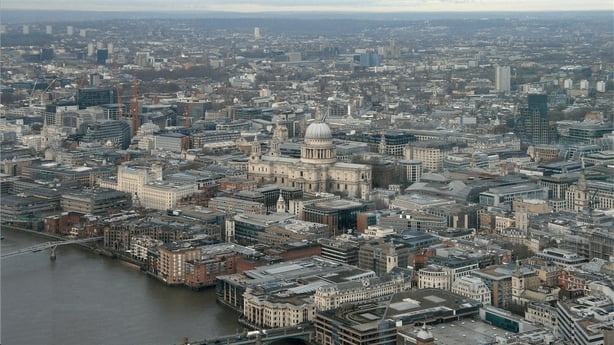
The 2015 exhibition by Sean Lynch – a sculpture-and-video installation entitled Adventure: Capital (2015), curated by Woodrow Kernahan (at that time, director of the EVA Biennial in Limerick) – drew into shared orbit a series of disconnected cultural, historical and geographical references: forging offbeat links between Britain and Ireland, the City of London and rural Co. Waterford, banknote illustration and public art, bronze age myths and minimalist sculpture. Centring on a meandering essay-film, Lynch’s work progressed through multiple digressions, following archival leads along divergent associative currents.
Watch: Jesse Jones talks Tremble Tremble at the Venice Bienalle, 2017
The 2017 exhibition by Jesse Jones also arranged historical knowledge in unorthodox ways – though with more agitative intent. Entitled Tremble Tremble (2017) and curated by Tessa Giblin, then curator at Dublin’s Project Arts Centre, Jones’s project was, like Lynch’s Adventure Capital, a work of multi-layered research into history and myth – in this case taking the figure of the witch as, in Giblin’s words, ‘a feminist archetype, a disrupter who possesses the potential to transform reality’. On two large-scale, vertical screens – positioned alongside mysterious faux-archaeological artefacts – a giant sorceress confronted gallery visitors. It was a fantastical response to an urgently felt contemporary necessity: the repeal of Ireland’s regressive laws on women’s reproductive rights, an issue that, at that historical moment, problematised the artistic task of representing Ireland.
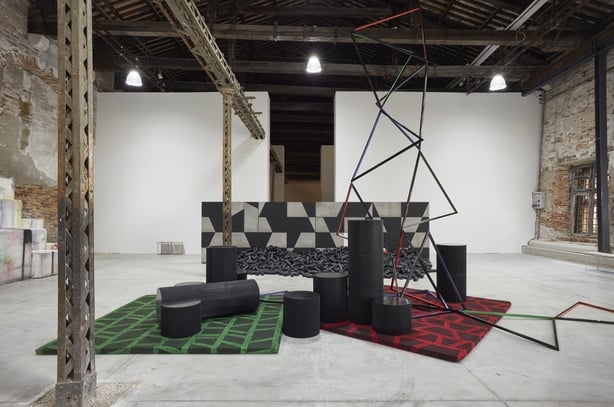
The 2019 team of London-based sculptor Eva Rothschild and Derry-based curator Mary Cremin, addressed this ambassadorial issue too: framing the exhibition as a moment to question how ideas of nationality and identity find form in architecture and urban design. As an Irish artist living in London, Rothschild’s approach was particularly informed by the difficult aftermath of the 2016 Brexit vote. Entitled The Shrinking Universe (2019) – hinting at the revived influence of xenophobic, isolationist rhetoric in Britain and beyond – Rothschild’s array of sculptures evoked both order and chaos, construction and collapse. Walls, blocks, rubble, architectural columns, precarious towers, variously robust and insecure structures, some positioned as awkward obstacles in the exhibition space, disrupted the easy flow of the coming-and-going Biennale public or invited participatory involvement, offering places to temporarily settle. The miscellany of sculptural forms was typical of the controlled plurality of Rothschild’s art: shapes and styles hinting at all manner of public structures and communal situations. As with Rothschild’s art more generally, the exhibition was an astute response to the manifold ways in which communities, societies and nations express their values through aesthetics in public space.
Warch: Niamh O'Malley talks Gather at the Venice Bienalle, 2022
Following the COVID 19 pandemic, Venice Biennale authorities opted to postpone the planned 2021 Biennale by a year, deferring until 2022 in anticipation that patterns of travel and social interaction would return to normal. Ireland’s 2022 exhibition nonetheless displayed lasting cultural symptoms of the COVID era. As its title implied, Niamh O’Malley’s Gather — curated by Cliodhna Shaffrey and Michael Hill of Dublin’s Temple Bar Gallery — expressed acute sensitivities about human connection. O’Malley’s beautifully understated installation comprised sculptures and videos focused on home-bound isolation (extended looping imagery of garden birds) or, by association, the risks and necessities of life in public places (sculptural allusions to drains, LED imagery of air vents). Measured and meditative, O’Malley’s exhibition contemplated, through close attention to surfaces and structures, many low-key tensions and everyday necessities associated with "the same people living in the same place" (as James Joyce once defined the nation).
We need your consent to load this rte-player contentWe use rte-player to manage extra content that can set cookies on your device and collect data about your activity. Please review their details and accept them to load the content.Manage Preferences
Listen: Eimear Walshe talks Romantic Ireland at the Venice Biennale, 2024
In 2024, Eimear Walshe (supported by Project Arts Centre curator Sara Greavu) ventured more determinedly into the outside world with Romantic Ireland, a multi-screen video installation showing scenes of figures interacting — by turns tenderly and aggressively — on a rural construction site: strange characters, costumed as present-day farmers or 19th century peasants, their faces concealed by green latex balaclavas. This turbulent outdoor drama, sound-tracked by a commissioned opera (with a libretto by Walshe) centred on the enduring politics of home-making, house-building and land ownership in Ireland, warping the past into the present, and vice-versa, in its depictions of unending struggle to settle and co-exist.
In 2026, Isabel Nolan’s Dreamshook builds on these many-layered foundations: once again blending the past with the present, the real with the imagined, while bringing an entirely new, powerfully individual vision to the Irish pavilion at the Venice Biennale.
Isabel Nolan's Dreamshook is at the Pavillion of Ireland, Arsenale di Venezia, Campo de la Tana, Venice from 9 May - 22 November 2026 - find out more here
About The Author: Declan Long is a writer and critic, and Head of Doctoral Studies and Co-Director of the MA/MFA Art in the Contemporary World at NCAD, Dublin.
