


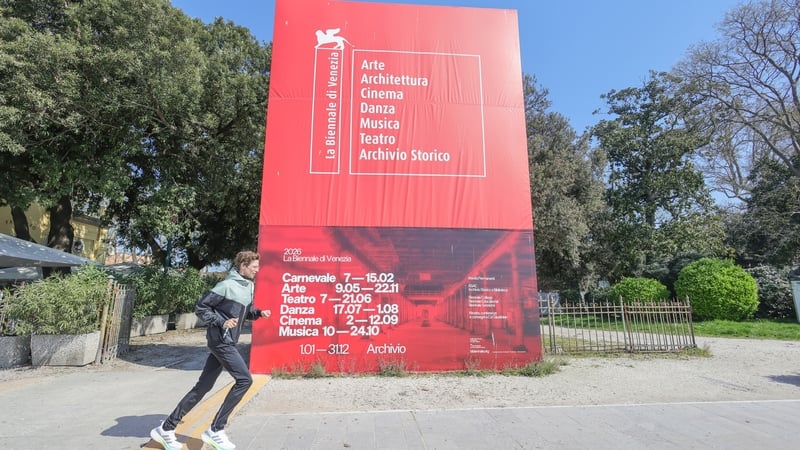

Whether or not to go to Venice for the 61st Biennale may be on the minds of some travellers this summer.
It certainly promises to be a stand-out year. The Venice Biennale is a vast art exhibition organised every two years, with international contemporary artworks grouped into either a large, curated exhibition (at the industrially scaled Arsenale) or in solo presentations at national pavilions in its surrounding gardens (the Giardini), or in pop-up pavilions along the narrow, cobbled corridors of this eerily beautiful urban archipelago. Serious modern and contemporary art displays elsewhere (including at the Nicoletta Fiorucci Foundation, the Pinault Collection, and Peggy Guggenheim Museum) add to the city's existing richness of Renaissance and Gothic palazzos and museums - but mean that seeing everything during the Biennale is simply impossible.

(Pic: Stefano Rellandini/AFP/Getty)
Technically, it is accessible to anyone with a standard ticket priced at €30. And as nationally selected artists compete for Golden and Silver Lion prizes, this makes it significantly cheaper to attend than the coinciding World Cup or Eurovision Song Contest. Outside the gates of the Arsenale and Giardini, other pavilions are usually free - but a biannual real estate reshuffle between the less imperial nations means that finding them can be tough. And this medieval city with narrow winding pathways and bridges between key sections can be challenging for those with or without impaired mobility. Aside from the vaporetti (boat-buses) or the far more expensive water taxis, the city is traversable only by foot. Physically navigating the Biennale is not for the faint-hearted, and some years it is politically difficult to manoeuvre as well.

The origins of the world’s first Biennale are significant. What began as a celebration through art of the Italian King and Queen (Umberto I and Margherita of Savoy) in 1895, soon became the concrete articulation of European power at the height of Western modernity. The Giardini introduced national pavilions from 1907 with the Belgian, then the Hungarian, German and British pavillions opening in 1909, then the French and Russian pavillions following in 1914. There are now 29, each a manifestation of diplomatic force and architectural merit. Sverre Fehn’s Nordic Pavillion from 1952 is a minimalist conduit of light, while Takamasa Yoshizaka’s Japanese Pavillion is a Le Corbusier-esque sanctum of calm, and Bruno Giacometti’s measured modularity in the Swiss Pavillion a lesson in delicacy. The British pavilion faces the German and French with Italianate and neo-classical frontages that nod to century-old alliances that seem somehow tragicomic.

As a world competition, the biennale is often described as a kind of Olympics and yet, as the decades roll on, the Giardini has become something of a memorial park - like Las Vegas’s Neon Boneyard of retired neon signs, or Budapest’s Momento Park of severed sculptures of Communist leaders – collected relics of bygone political ages. Blow hard and you can raise the dust off its surface. Walking through these avenues and pathways can feel nostalgic. But look southwest, beyond the pavilions and over the Giardini fence to the glistening waters of the Bacino di San Marco, where the superyachts have docked for the Biennale’s opening. Here you will see the faces of a new world order, oligarchs, plutocrats and tech billionaires: the art collectors are partying. This will appear, for some, not wistful but menacing.
Russia’s pavilion will open to visitors for the first time in four years, since its invasion of Ukraine in 2022. That year, outside its closed doors, performance artist Aleksey Yudnikov created a spectacle wearing a latex mask of Vladimir Putin on his groin, before being removed by Italian police. This year, the Latvian Pavillion plans to protest the Russian entry with a campaign called 'Death in Venice’, where visitors can download a symbol (the biennale’s logo transformed into the Kremlin wall) to wear as badges. Israel’s pavilion (which first opened in 1952; there is no Palestinian one) was shuttered in 2024 with a note taped to the door, scripted by that year’s artist and curator, declaring it would stay shut until ‘a ceasefire and hostage release agreement is reached.’ It remains closed this year for renovation work, but the Biennale Foundation will host the Israeli pavilion in a pivotal position in the Arsenale. These two presentations, during a time of continuing violence, dispossession, and genocide has provoked adverse reactions. The campaign group ANGA (Art Not Genocide Alliance) has called for the ‘immediate and complete’ exclusion of Israels contribution to the Biennale, with an open letter signed by 223 contributors to the Biennale, addressed to its president, Pietrangelo Buttafuoco. Butttafuoco is a right-wing public intellectual, and head of the Biennale Foundation, complex system of governance originally modelled by Mussolini’s ministers in the 1930s. He has not publicly replied.

There have been other voices of dissent closer to the biennale’s core. For every edition, a major international curator is appointed to the Arsenale exhibition to represent a certain zeitgeist or feeling of the moment. For this one, the Cameroonian Swiss curator Koyo Kouoh was appointed. She gathered her artists, articulated her theme and title (‘In Minor Keys’, including works of subtle resistance), and appointed a jury of five international women experts (Solange Farkas, Zoe Butt, Elvira Dyangani Ose, Marta Kuzma, and Giovanna Zapper) to assist her awarding the Golden and Silver Lions. But since Kouoh's tragic death from cancer last year, her five jurors have been working with the Biennial Foundation alone. The jury’s stance, published on April 22 was that, in defence of human rights and in tribute to Kuouh’s spirit, they would, ‘refrain from considering those countries whose leaders are currently charged with crimes against humanity by the International Criminal Court.’ Public statements from various organisers, implicated cultural diplomats, and Italian politicians have rebounded in the interim days, until Thursday 30 April, when the jury of five women announced their resignation. It appeared as a short sentence, without detail or reason on a ‘story’ on e-flux’s Instagram account.
An official statement from the Biennale Foundation immediately followed. This year, in an unprecedented turn, the final prizes will be called 'Visitors' Lions’ and be juried not by experts but the ticket-holding public who are eligible to slip their vote into a ballot box in the Arsenale and Giardini. All the national presentations, including those of Israel and Russia, will now be eligible for these audience-elected prizes. The biennale’s website’s statement announced, ‘This is consistent with the founding spirit of La Biennale, based on openness, dialogue, and the rejection of any form of closure or censorship. La Biennale seeks to be, and must remain, a place of truce in the name of art, culture, and artistic freedom.’
Watch, via FRANCE 24: Jury of Italy's Venice Biennale resigns over Russia row
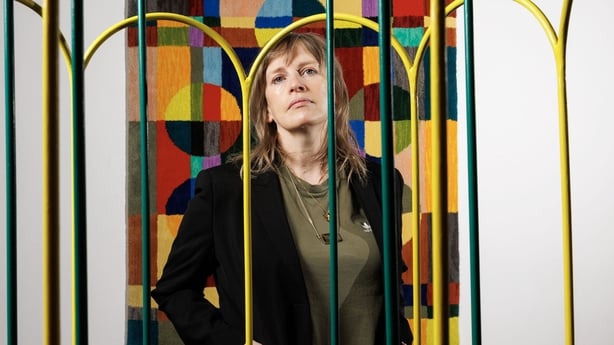
Those who do decide to travel to the event will find a worthy prize-winner in Isabel Nolan at the Irish pavilion, in the Arsenale building immediately north of the main exhibition. It will be obvious to many international visitors those who deserve ‘nil points.’ That is if they decide to pay the ticket price to this organisation at all.
The views expressed here are those of the author and do not represent or reflect the views of RTÉ
