


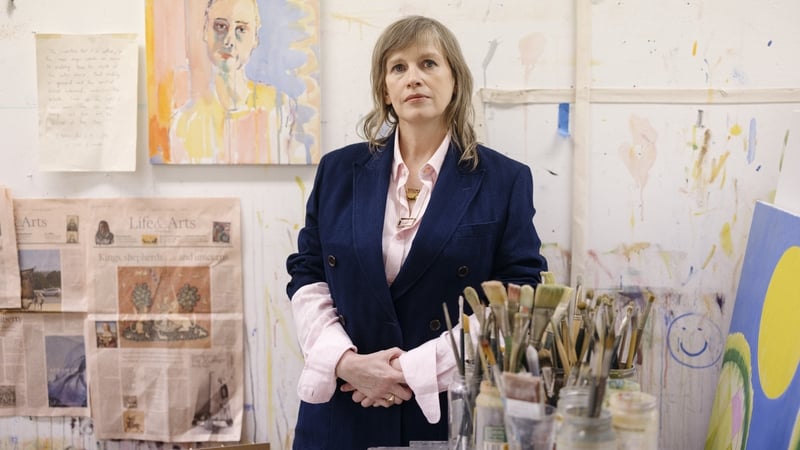

Representing Ireland at this year's Venice Biennale is Dublin-born Isabel Nolan, a visual artist who emerged in an era of Irish art that felt full of possibility and money: Celtic Tiger Ireland.
In the early 2000s, there was a sense that Irish art college graduates could really make a career of this. Nolan is one who has. Graduating from NCAD in 1995, her first solo show, I keep dreaming that I’m a fictional character, was at Proposition Gallery in Belfast in 1998. By 2005, she was part of Ireland’s unusual move to send seven emerging artists to Venice for a group show simply called 'Ireland at Venice 2005’. So, 2026 isn’t Nolan’s first time showing, or representing Ireland, at the longest-running, most prestigious international art exhibition of its kind in the world.
We need your consent to load this rte-player contentWe use rte-player to manage extra content that can set cookies on your device and collect data about your activity. Please review their details and accept them to load the content.Manage Preferences
Listen: Artist Isobel Nolan talks to RTÉ Arena
Then in her early thirties, Nolan was the youngest of the 2005 Irish group of Mark Garry, Walker and Walker, Ronan McCrea, Stephen Brandes and Sarah Pierce, curated by Sarah Glennie. By comparison, Britain sent the then sexagenarian duo Gilbert & George and the USA sent veteran pop artist Ed Ruscha. Twenty-one years ago, Nolan had just mounted a major solo show at Project in Dublin. Her approach has remained consistent since then, although her work has matured in ambition and scale. She makes art with a strange intimacy that emerges from her engagement with a wide-range of source material, including scientific, literary, architectural, cosmological, historical and art historical records, artifacts and texts. There is something about her frequently brightly coloured sculptures, textiles and drawings that succeeds in reminding us of our fundamental interconnectedness within the vastness of time and space.
"Art has a relationship with time, so there's something about being involved in a conversation about materials and images that have been around for a long time – that kind of connection is sustaining and emotionally valuable."
For the Irish Pavilion at the 61st Venice Biennale, she presents an ambitious installation called Dreamshook. The title refers to the sensation of waking from a dream: a moment between physical reality and unconscious sleep. Nolan is fascinated by thresholds. Dreamshook began with her interest in the 15th century Venetian printer-publisher Aldus Manutius, who is regarded as having invented the predecessor to the modern paperback. The body of work draws on ideas from the late Middle Ages and early Renaissance, humanism and the origins of printing in Europe, 13th and 14th century architecture and the Book of Kells. She says, ‘I’m really interested in art history… Art has a relationship with time, so there’s something about being involved in a conversation about materials and images that have been around for a long time – that kind of connection is sustaining and emotionally valuable.’
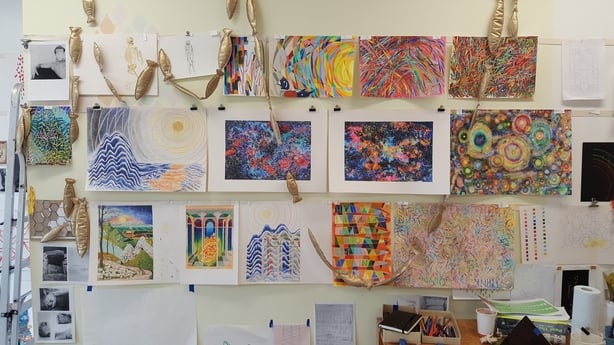
Now a weighty mid-career artist, Nolan has shown her work all over the world, including in New York, Hong Kong, Tokyo, Sydney, London, Paris and Berlin. Her art is in collections including Tate Britain, the Irish Museum of Modern Art, the Hugh Lane Gallery and the National Gallery of Ireland. Anyone travelling through Dublin Airport’s Terminal 2 will have seen her 28-foot-tall yellow Turning Point sculpture, a permanent public artwork commissioned by the DAA. She hides a quietly undermining scepticism and a determined questioning of accepted histories and narratives in visually enticing works that might at first seem to seek to point in other directions. ‘I’m quite committed to the aesthetic ability of artworks to speak to us,’ she says.
Isabel Nolan's Dreamshook is at the Pavillion of Ireland, Arsenale di Venezia, Campo de la Tana, Venice from 9 May - 22 November 2026 - find out more here
