


Inspired by Parsons Bookshop and the artistic and cultural hub known as Baggotonia in 1950s Dublin, The Bookshop Sisters is the new children's novel by award-winning author Sarah Webb. Read an exclusive extract below...
In 1956, bookworm Rosy Heron and her big sister Martha are sent to Dublin to help their aunt Toto in her busy bookshop for the summer and their quiet lives change overnight. The two sisters quickly become part of the Baggot Books team as junior booksellers and bicycle delivery girls. But the bookshop is also full of secrets…
'Here we are,’ Alice says. ‘Baggot Books. Home sweet home.’
We’re standing across the road from a three-storey redbrick building which is perched on the left-hand side of a bridge. It looks a little shabby; the green paint around all the windows is peeling, and one of the upper windowpanes has a board instead of glass. The green-and-white striped awning across the front of the shop on the ground floor has a small rip at one side. There’s a faded wooden sign reading ‘Baggot Books’ above the awning.
But none of the shabbiness matters – the shop window is full to the brim with rows and rows of multi-coloured books. It looks magical!
I’m so eager to cross the road I step out and almost get mowed down by a cyclist, who rings her bell at me. Ding! Ding! Ding!
‘Careful, Rosy,’ Martha says. ‘We don’t want a hospital trip on your first day in Dublin.’
Alice puts her hand on my arm. ‘It’s a busy road,’ she says. ‘Martha’s right. Best wait for the traffic lights to go red.’
As soon as the traffic stops, I dash across the road towards the shop window and stare inside. On one side, I spot lots of Irish myth and legend books for children, with covers in different shades of green, from grassy green to a darker moss green. The middle is full of poetry books by someone called Patrick Kavanagh and short story books by a writer called Mary Lavin. Those books are cream and white. No Nancy Drews, but I do spot another book I like on the right-hand side – The Lion, the Witch and the Wardrobe – as well as a book with a bright yellow dust jacket called The Emerald Ring.
I realise the books are displayed like the Irish flag: green books on the left, white books in the middle, and gold and yellow on the right.
Alice appears beside me. ‘Do you like the window? The windows and displays are my job.’ ‘It’s fantastic!’ I say. ‘I love the way it looks like the Irish flag. Did you do that on purpose?’
She grins. ‘Absolutely! The books are all by Irish writers.’ ‘C.S. Lewis is Irish?’
She nods. ‘He is indeed. Born in Belfast. He lived there as a little boy.’
‘Wow!’ I say. ‘I didn’t know that.’
I hear the noise of babbling water.
‘Can I look over the bridge?’ I ask eagerly. ‘It’s the Grand Canal, isn’t it?’ I remember it from my map.
‘That’s right,’ she says. ‘Go ahead.’
I walk onto the bridge, and Alice and Martha follow me. I stand in the middle of the bridge and look down at the dark-green water.
‘Does someone live there?’ I ask Alice, nodding at the long, midnight-blue canal boat that’s moored just beside the bookshop. It’s got a large wooden and glass area at the back, like a greenhouse, and the boat’s name – Grand Canal Princess – is painted along the side in silver, surrounded by a pattern of stars.
‘Yes, Harry and Yasmin,’ Alice says. ‘That’s Yasmin’s art studio at the back of the boat. And you see that building at the back of the bookshop?’ She points at what looks like a wooden garage with a wall of high windows on the canal side. ‘That’s Harry’s sculpture studio.’
She looks at her wristwatch. ‘It’s almost six. The shop’s about to close, so let’s go in and find Toto. Then I’ll show you to your room, and at seven it’s time to eat. Your very first Baggot Books family dinner.’
As I follow Alice into the bookshop, the small bell above the door tinkles. I take in the familiar smell of books, a musty, warm smell, full of promise, one of my favourite scents in the whole world.
Apart from the window area which has low shelves in front of it, the walls are lined from ceiling to floor with dark wooden bookshelves. Several customers are browsing, and I can’t help staring at their stylish clothes. There’s a woman wearing wide-legged orange trousers, a matching silk top and a wide-brimmed white straw hat, and a man in a cream linen suit, with a red silk cravat around his neck.
‘This sure ain’t Skibbereen,’ I whisper to myself.
There’s a counter towards the back of the shop and an old round table in front of the door with a vase of pale-pink roses in the middle.
There are two more tables covered in books, one on either side of the shop, and another room through an arched doorway to the left. I have a good look at the front table – most of the books on it are by two of the writers from the window, Mary Lavin and Patrick Kavanagh. There’s a handwritten sign on the table reading ‘Local Authors’. They must live nearby.
I’ve never met a real-life writer before. I wonder if they’ve ever been in the bookshop. Before I get the chance to ask Alice, I hear the deep, smooth, velvety voice that I’ve only ever heard on the telephone at Christmas.
‘There you are! Finally! Come in, come in.’ Aunt Toto walks towards us. She’s tall, much taller than Mum. She’s super chic in carefully pressed navy trousers that skim her ankles, shiny red leather shoes with a block heel, and a crisp white shirt. Her blonde hair is in a neat high bun, like a ballerina’s. Everything about her is rather neat.
She looks a lot like Mum – they have the same grey eyes and the same strong, high cheekbones, like a cat’s. Funnily enough, for someone so neat and tidy, her fingers are stained with blue ink. She must have used a leaky pen.
‘Welcome to Baggot Books.’
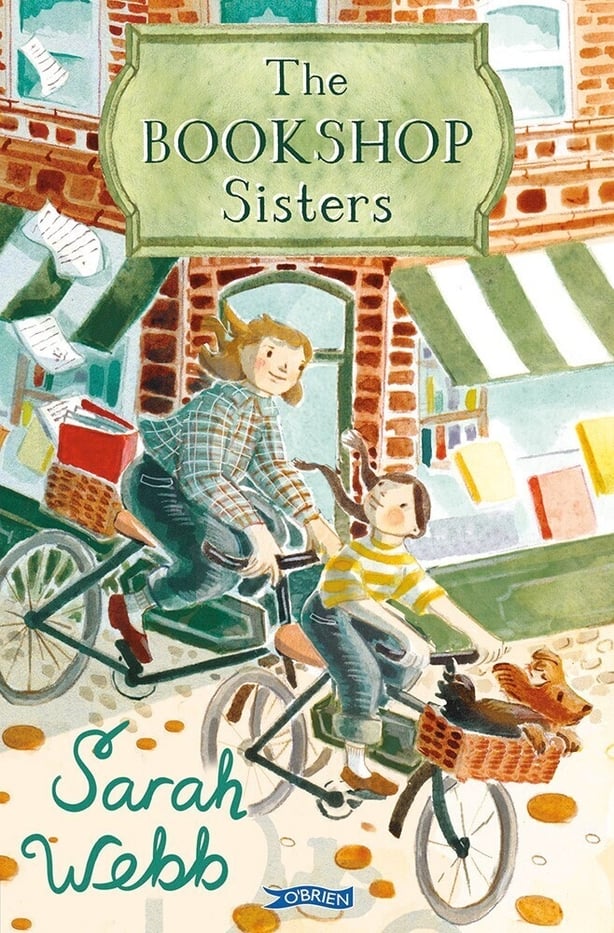
The Bookshop Sisters is published by The O'Brien Press
