


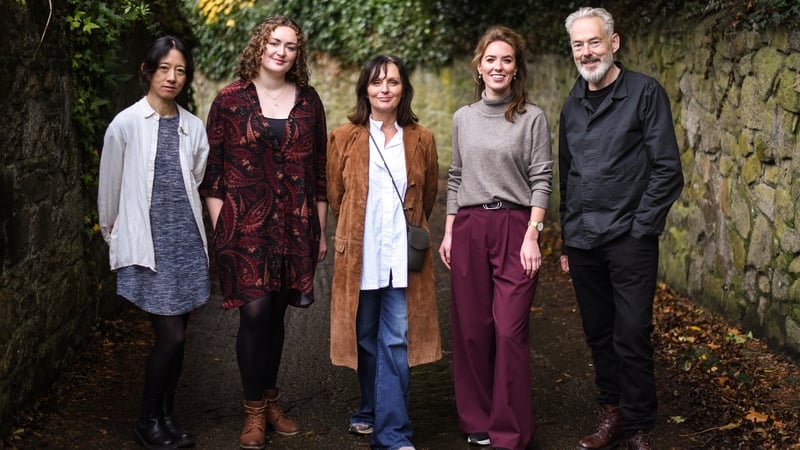
Ahead of their performance at New Music Dublin on 19 April, director Judy Hegarty Lovett and conductor Elaine Kelly discuss Gare St Lazare Ireland's The Last Tape, a new hybrid adaptation of Marcel Mihalovici's chamber opera in one act, with a libretto by Samuel Beckett, based on his play Krapp’s Last Tape.
Gare St Lazare Ireland has built an international reputation through its sustained engagement with Samuel Beckett's work. But in this exploration of Beckett’s work, we hear his words through the medium of Marcel Mihalovici’s operatic writing. Has this therefore informed a different kind of creative process for you as artistic director?
Judy: Beckett and Mihalovici worked together on the opera, which I expect will have informed an understanding of adapting a play text to an opera. GSLI are working towards a hybrid of spoken and sung text, which has insisted on a revision for both media; in that the opera score has been rearranged and the play version is being coupled with the rearrangement. There’s an interesting evolution of media intersection at play, adding layers of insight and perspectives to the original.
Of course, the process of staging prose works and integrating music has been a long pursuit of GSLI, and so we are not strangers to the adaptation process. In fact, I find it to be a liberating process and enjoy how each medium forms and shapes the other. I have found that the text in song admits an emotional access to Krapp that I hadn’t previously experienced in the play. The emotional register is a little more suppressed when spoken and is released, for better or worse, when sung.

The contrast is stark and has offered me a different understanding of what Krapp, the character, has sacrificed. I’m very interested in how spoken word and song intersect and synchronise. I’m interested in what that offers the original. I’m also curious about how words spoken and words sung sit together and inform one another, and if the experience of language is changed when they coexist.
I have found this process a little different to most of the work I’ve done before with Beckett’s writing, in that the precision of delivery must be met with musical timing. If you miss a note, whole moments can fall apart, and that’s a different kind of measure to delivering spoken word. This precision brings the rigour and discipline of directing to another level, and I have enjoyed the lesson in that.
I see each medium, one informing the other, as an exercise in expanding one’s own craft, opening a dialogue to approaches. It’s a real treat to hear Beckett’s language sung.
This project presents the music of Mihalovici’s original work in a reduction and rearrangement by Andrew Synnott. Can you tell us about the musical aspects of the rearrangement?
Elaine: Mihalovici’s original score is highly distinctive: it’s atonal, sparse, and intensely colour-driven, with a large orchestral palette - especially an extensive percussion section - used to mirror Krapp’s psychological landscape. The orchestra doesn’t just accompany; it actively paints the inner world of the character, from heartbeat-like rhythms to more abstract, disorienting textures.
Andrew Synnott’s rearrangement reimagines that sound world for a much smaller ensemble—two pianos and percussion—which inevitably shifts how that colour and drama are conveyed. Rather than losing detail, the reduction creates a kind of heightened intimacy. The pianos take on a dual role: they function both as harmonic anchors and as percussive instruments, allowing them to echo the original score’s rhythmic drive and psychological tension while also bringing clarity to the vocal line.
What’s particularly striking is how the reduction foregrounds the structure and gesture of Mihalovici’s writing. Without the full orchestral weight, the music becomes more transparent, and the relationship between voice and accompaniment feels more exposed—mirroring the raw, introspective nature of Beckett’s text. The percussion, meanwhile, retains its crucial role in articulating time, memory, and physicality, preserving something of the original score’s visceral impact.

Overall, the rearrangement doesn’t simply shrink the piece - it reframes it. It draws the audience closer into Krapp’s interior world, turning what was orchestral expression into something more chamber-like, immediate, and psychologically direct.
The role of Krapp is shared in an unusual way here, with tenor Mark Padmore and actor Conor Lovett both inhabiting the character. Judy, how did that dual presence emerge in the staging, and Elaine, how does it influence the musical structure of the piece?
Judy: It happened fairly organically, in that from the first day of rehearsal we had an actor sharing insights into the play with the singer and musicians, and the conductor. Gradually, we started mixing spoken text while the opera was being sung. I enjoyed hearing those two worlds live side by side and felt it could offer another experience of this brilliant play and of this equally brilliant opera.
The musical structure is naturally changed; it’s changed from the original score already via Andrew Synnott’s rearrangement, and the play being sung is another change, and its original lives inside of these changes. What I notice is the intensity of the operatic form and how its qualities are reshaped through moments of silence and suspension via the insertion of spoken text.
I believe we listen differently to the same text when sung or spoken, and I enjoy how that informs a new understanding of the character. My hope is that through the fragmentation of mediums we create another way of hearing the text.
For me, a festival like New Music Dublin creates a context where experimentation is expected and welcomed, which is incredibly freeing.
Elaine: From a musical point of view, the dual presence really reshapes the structure of the piece. The introduction of spoken text alongside the sung material creates a kind of ebb and flow between two different modes of expression - music and language - which alters the pacing and tension.
It allows moments of intensity in the opera to open out and breathe, as Judy mentioned, and gives the audience a different way of engaging with the text. The sung lines carry a certain emotional and musical weight, while the spoken word can feel more immediate and direct, so the contrast between the two becomes a structural and expressive feature in itself.
Rather than a continuous operatic line, the piece becomes more fragmented and reflective, which feels very true to Beckett’s world.
This presentation involves live instrumentalists (two pianos, percussion) as well as sound design by Mel Mercier. Is that sonic world difficult to negotiate?
Elaine: I wouldn’t say the sonic world is difficult to negotiate—many of the works I conduct integrate live instruments with other sound elements, and that combination is really exciting to collaborate on. Mel Mercier has already been deeply engaged with the production before I came on board, so his work is very integrated into the piece.
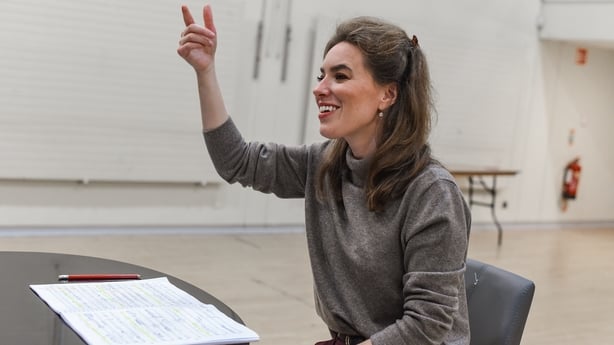
So far, I’ve been focused on the live music aspect with singer Mark Padmore, pianos, and percussion, and I’m really looking forward to working with Mel next week to bring everything together ahead of the performance. It’s thrilling to see how the live and designed sounds will combine in the space - it really adds another layer to the world of the piece.
This presentation at New Music Dublin is described as a work-in-progress ahead of the Irish premiere at Kilkenny Arts Festival later this year. What are you hoping to discover about the piece by placing it in front of an audience at this stage?
Judy: Gare St Lazare has always road-tested our work by inviting an audience to see it while it’s still in the rehearsal stage, still in progress, and for The Last Tape I see no better way to do that than with an audience who love music. The audience inform and steer a work at every turn, and I like to believe that they too are part of the process of making.
New Music Dublin often creates a space where music, theatre, and experimentation meet. What makes a festival like this a useful environment for developing a project like The Last Tape?
Judy: The word "New" is both thrilling and liberating for me. The festival suggests change and experiment. That’s what I feel I’m part of, so this festival is an ideal vehicle for this work.
Elaine: For me, a festival like New Music Dublin creates a context where experimentation is
expected and welcomed, which is incredibly freeing. There's also a willingness from audiences to engage with something unfamiliar, which changes the energy in the room and allows us to take risks with form and structure.
Because the piece is still a work in progress, it’s especially valuable for us to perform it in front of an audience like this—it helps us understand and shape the work as it develops. So it becomes not just a platform for presenting it, but a really supportive environment for exploring it.
Gare St. Lazare Ireland's The Last Tape is at the National Concert Hall on April 19th at 3.30pm, as part of this year's New Music Dublin programme - find out more here
