


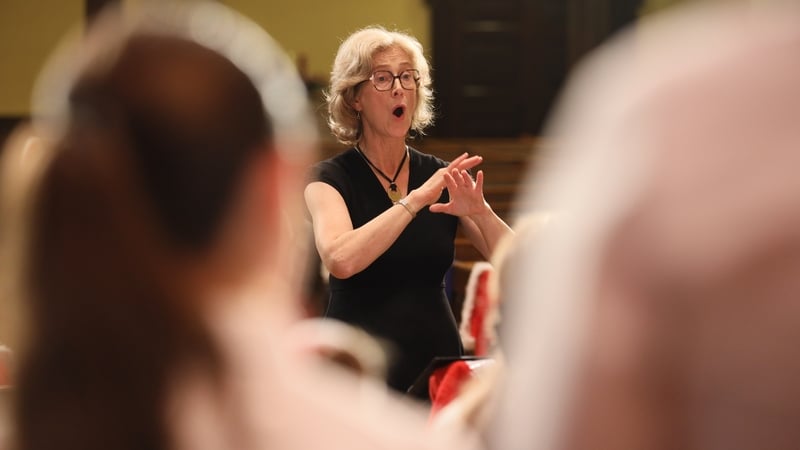
The NCH Cór na nÓg youth choir return to this year's New Music Dublin festival with Love the Earth, a concert programme featuring works by Irish composers Elaine Agnew, Sue Furlong, and Marian Ingoldsby, alongside American composers Robert Cohen, Nick Page and Barbara Sletto.
The environmentally-minded title and theme of the programme was inspired by an intergenerational project undertaken by NCH Cór na nÓg in 2025 with Floating World and The Elders, titled A Conference of Birds, which highlighted red-listed bird species in Ireland. Composer Elaine Agnew was commissioned to write a song of the same name, to be presented to a public audience for the first time as part of NMD 2026.
Ahead of their performance on Sunday 19th April, Cór na nÓg's Mary Amond discusses the project.
This year Cór na nÓg performs at New Music Dublin for the seventh time. What has the festival meant for the choir and its singers over the years?
Over the last seven years New Music Dublin has become one of Cór na nÓg's favourite performances, giving the singers an opportunity to perform lots of new music; music they more than likely would not have had the chance to explore and discover. Most years as part of their performance the choir have premiered new works, which tasks them with literally taking the music off the page and bringing it alive for the very first time. They have gotten to meet and work with composers who have been invited to write for them. One of the composers was a past member of Cór na nÓg - Ferdia O’Cairbre, who at the time was not much older than them. Seeing and hearing what Ferdia was achieving at such a young age was guaranteed to have a positive impact on them; maybe one day some of them might become a composer like Ferdia.
I strongly believe the opportunities given to them to perform in the festival has given an overall sense of respect to them as singers in their own right, not just as a children’s or young person’s choir; believe me when I say there have been compositions over the years that would tax and challenge any adult choir. This is what I absolutely love about working with children, they don’t really know when something is difficult!
The 2026 festival theme is Love the Earth and your programme includes Andrea Scott’s Conference of Birds. What drew you to that project?
When our team met with Andrea to discuss the possibility of Cór na nÓg being part of Conference of Birds, I was immediately taken with her passion for educating and creating awareness about birds that were being seen less and less in our everyday surroundings and environments. A new commission was also part of the project, which drew us in further. Elaine Agnew agreed to come on board as the composer - I had worked with Elaine before, so I knew her approach to a new composition would involve an enjoyable and explorative workshop with Cór na nÓg. Children are always going to play a vital role in all our futures, and creating awareness about these red-listed birds through music and drama was going to bring this issue to a deeper level of understanding for everyone involved.

Andrea works with The Elders as part of her theatre company Floating World; this meant that ‘COB 1’ became an intergenerational experience with young and old singing together to tell an important story and send out an important message. Children’s Choirs’ audiences are always going to include their families - siblings, aunts, uncles, grandparents - and of course those with a love for children’s choirs. There is something uniquely special about the purity of the sound when children sing that draws audiences in to listen more intently about what they are singing about. I hope our audience will be inspired by the young singers, and in turn aspire to being advocates themselves.
Conference of Birds focuses on bird species on Ireland’s red list. How do young singers respond when they realise the environmental story behind the music?
They responded with great understanding and a sense of genuinely wanting to make a difference in what ever way they can. Some of the singers were already very well-read on environmental issues, either through what they are learning in school or through their own individual interests. I witnessed this many time when some of the singers express their own thoughts and opinions during a discussion we might enter into during rehearsals - I learn so much from them every time we explore new things, the interest they openly demonstrate encourages me to develop mine further; they are so well able to articulate themselves, a lot better than I was at their age!
What is different about preparing contemporary music with a youth choir compared with a more traditional choral repertoire?
Contemporary music definitely has an element of excitement about it for all of us, singers, choral director and accompanist. When there is a new commission involved, I have to admit as a choral director that I experience equal parts excitement and trepidation while waiting for the final score to arrive in my in-box; hoping it is something the singers will be able to achieve, something that they warm to, and for me something that will ignite a passion within me for teaching it. When working with young singers it is important they become accountable for learning new music. I also have to trust them to learn it and remain positive and encouraging throughout, seeing, hearing and valuing each singer.
I think singing is such a powerful experience for young people; after all, they are the future!
I read something recently about the saying ‘holding people accountable' that really stood out for me; instead of holding them ‘accountable’ hold them‘ able’. It turns it completely around, making the action of ‘accountability’ more achievable. During our preparation for Love The Earth it is my responsibility to hold them ‘able’ through how I work with them, so they in turn can believe, trust, and hold themselves ‘able’.
While keeping the singers foremost in my mind, it's important to me that I get to work collaboratively with the composer throughout the whole process, from conception to performance. That way I can feedback my thoughts to them during the process and suggest any changes we may need. I love getting the singers' thoughts and opinions too, about why a composer might have chosen a particular melody, rhythm, tempo etc. I love analysing and marking scores; seeing how the composer has crafted the music, trying to get into their head to see why they did this or that, finding similarities and differences within the score, identifying the challenging parts and breaking them down for ease of learning for the singers.
My preparation impacts directly and immediately on how the singers respond at that very first rehearsal - positive first impressions lay the foundation for a successful and, more importantly, enjoyable performance for all of us.

they don't really know when something is difficult!' (Pic: Molly Keane)
You have worked with Cór na nÓg for fifteen years. What have you learned about working with young voices over that time, and why do you think singing can be such a powerful experience for young people?
I love working with young voices, I’ve been working with them since 1997; I do my best at every rehearsal to never allow myself take that for granted. The most important thing I have learned over the years is that a lot of the time we, as choral directors, can be the limiting factor; we put limitations on them with regard to what they are able to achieve musically. Because I have had the absolute pleasure and rewarding challenge of working in both auditioned and non-auditioned settings at the same time, I discovered that the only difference in the non-auditioned setting is that while it often takes longer to get there, the end result is very much the same. This taught me that the process of what I do - and how I do it - is where all the magic happens.
Of course the performance is the ultimate goal, but it is ultimately during the process that the singers and I learn a lot about ourselves, and not just musically. Together we develop skills that are so connected and aligned to life in general, ones that are very much needed in our world today - listening, active listening, working together as a team to reach or achieve a goal or challenge, and understanding the importance of individual responsibility for group success. They need each other to achieve and I need them to be the best I can be! This is why I think singing is such a powerful experience for young people; after all, they are the future!

inspired by an intergenerational project undertaken in 2025 (Pic: Mark Stedman)
Why do you think projects like this matter for young musicians today?
Projects like this give them an opportunity to explore and discover new music they may otherwise not get to rehearse or perform. My approach to new commissions for children and young people over the last seven years is for the new song to have a life beyond its world premiere performance, giving other choirs in Ireland and around the world the opportunity to perform these works too.
New Music Dublin has given these young singers an opportunity to meet composers in person and work closely with them. It's given them a platform to perform, goals to achieve, personal and musical values to uphold, compositions that excite and challenge but above all, as mentioned, it gives them the respect they truly deserve as singers in their own right, not just as children and young people, but as singers full stop!
The NCH Cór na nÓg youth choir come to the New Music Dublin festival with Love the Earth on Sunday April 19th at 12 noon - find out more here
