


Folklorist Michael Fortune celebrates Ireland's ancient Easter traditions...
While many of us now will be cracking into chocolate eggs on the sofa on Easter Sunday, there was once a widespread practice around Ireland where children collected hen and duck eggs, boiled them, and ate them outside. This was a countrywide tradition and is still done in some parts, going by different names - from clúdóg to prahóg, pleadóg to pruthóg.
My own grandmother did it growing up in rural north Wexford, and it was widespread, with children using sweet tins, tea drawers, and billy cans to cook and feast outside. It remains very strong in Cavan, and I know a Cavan man called Niall Madden, now living in Wexford, who still keeps up the tradition.
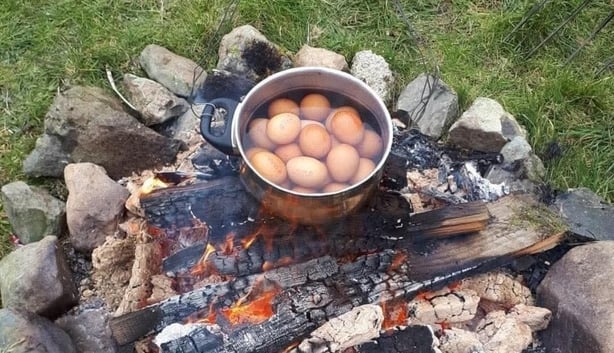
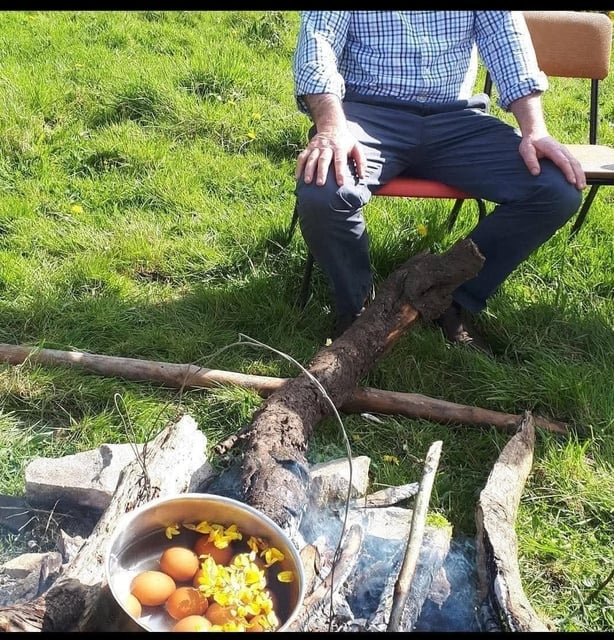
I've included some photos Niall sent me of his family clúdóg near Lough Gowna, Co. Cavan over the years, where young and old gather to boil and feast on eggs on Easter Monday. When you look through the photos, you’ll spot gorse (furze) petals in the pot, which were used to colour the eggs, while in the photo from 1997 you can see they used the lid of a creamery can to boil them. He also told me there would be a drop of whiskey knocking around to wash down the eggs for the adults.
Folklorist Patrick Kennedy from Kilmyshall records an account of the practice in his 1867 book The Banks of the Boro. These accounts were witnessed by Kennedy around the Clonroche and Duffry areas of Co. Wexford during the mid-1800s.
"Very different were the 'pleidhogues', or village reunions of little boys and girls whose school days were not yet at an end. During the last week of Lent, as nobody dreamed of eating an egg, eggs in abundance graced the Easter breakfast table, and on Easter Monday the little men and women under thirteen years of age assembled in some dry, sheltered ditch or quarry hole, bringing their supplies of griddle-cakes, eggs, butter, dry sticks or turf, and egg-spoons fashioned by themselves of ash or oak boughs, or any suitable splinters that had come in their way. A roaring fire was soon made, the eggs roasted, and the social meal proceeded."
Good Friday eggs
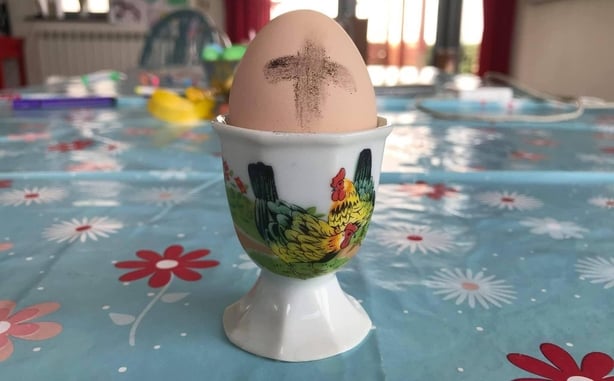
Another lovely tradition from this part of the country was shared with me back in 2015 when I recorded a woman called Breda Kavanagh in Castletown on the northeast coast of Wexford. She told me that the eggs they’d eat on Easter Sunday had to be laid on Good Friday. Not only that - before the eggs were eaten, they had to have a small cross marked on them with soot.
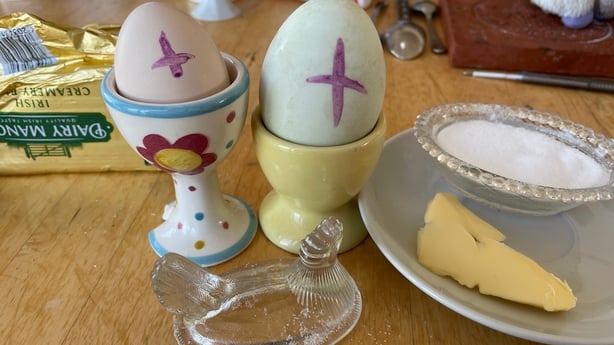
I have found this practice around the country too, but sadly that older generation is fading fast, along with their memories, stories, and traditions. The general belief was that an egg laid on Good Friday was lucky and would keep until Easter Sunday. With the popularity of the chocolate egg in the 1960s and ’70s, the hen and duck eggs once so common at Easter faded away.
'Blest' Salt at Easter
Another Easter tradition many older people will remember from the southeast was having water and salt blessed at Easter. The salt was taken to the church and left on the altar, while the Easter water was brought home. In some places, butter and seed potatoes were also brought to be blessed, but generally it was mostly water and salt.
I recorded older people in Castlebridge who told me how they would also sprinkle their Easter Sunday egg with this 'blest' salt, which would have been blessed the day before, on Holy Saturday. The tradition of blessing salt is not countrywide, and I find it to be strongest in Wexford, Carlow, and Kilkenny.
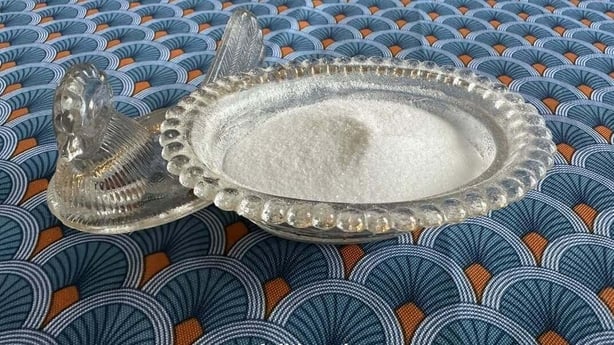
Easter water and salt
The blessing of Easter water is still strong to this day in Wexford and across much of the country. The blest water is used by people for protecting their houses, animals, and farms, while the salt had multiple uses in the past.
The blest salt was used beyond Easter as well, especially on farms. When a cow calved, one of the first things many older farmers reached for was the blest salt, which would be sprinkled on the newborn calf. Some say it helped the cow bond with the calf, as the mother would lick the salt and strengthen the bond, while others say she would have done so anyway. Either way, salt was very important in the story of food preservation and rural livelihoods.
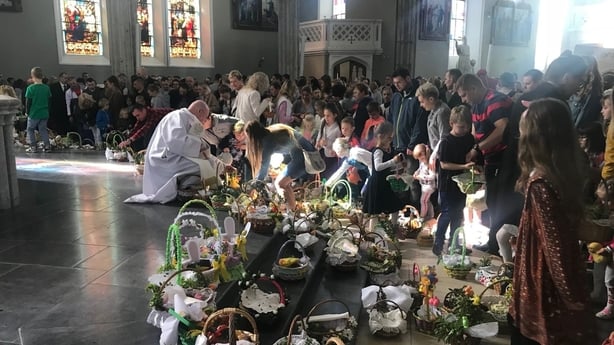
The blessing of the Easter baskets (Święconka) on Holy Saturday
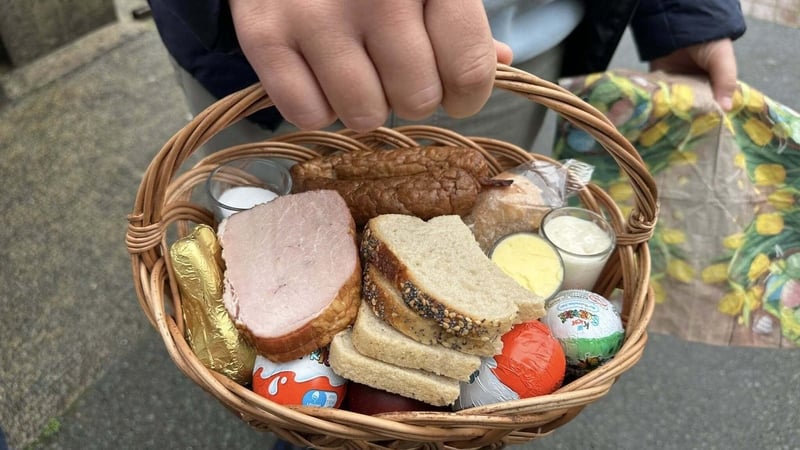
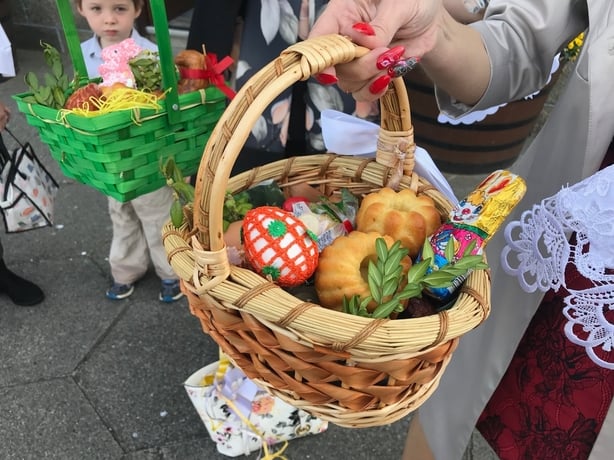
Similar to the old tradition of blessing butter, potatoes, and salt is the blessing of the Easter baskets (Święconka) among Polish and other Eastern European communities in Ireland. I first noticed this tradition growing in Ireland around 2002 and have been documenting it since.It’s a lovely thing to witness, and it always struck me how it relates to what we once did here, though in a more elaborate and colourful way. As you can see from the photos, these ornate baskets contain salt, eggs, butter, meat, horseradish, chocolate, water, and more - truly something special to witness and a fascinating cultural crossover.
now living in North Yorkshire in England
Simnel cake or Easter cake
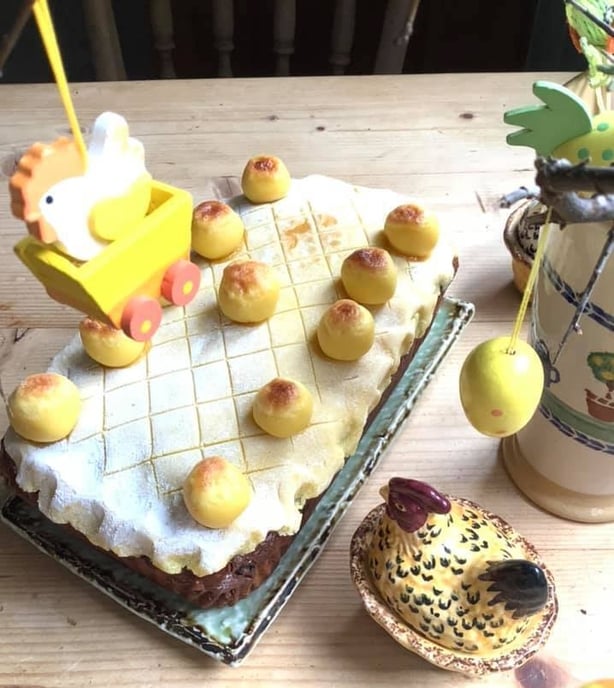
And speaking of sweets, here’s another Easter tradition, thanks to Catriona Cullen from Crossabeg. I took the photo of Catriona on the 4th of April 2021 after she gave me a slice of a Simnel cake she had made from a recipe passed down by her mother. Every year she makes one, and this one has a little chick and eggs added for decoration. However, there are only ever eleven almond balls on top - representing the eleven apostles. Judas, the twelfth, is omitted for obvious reasons.
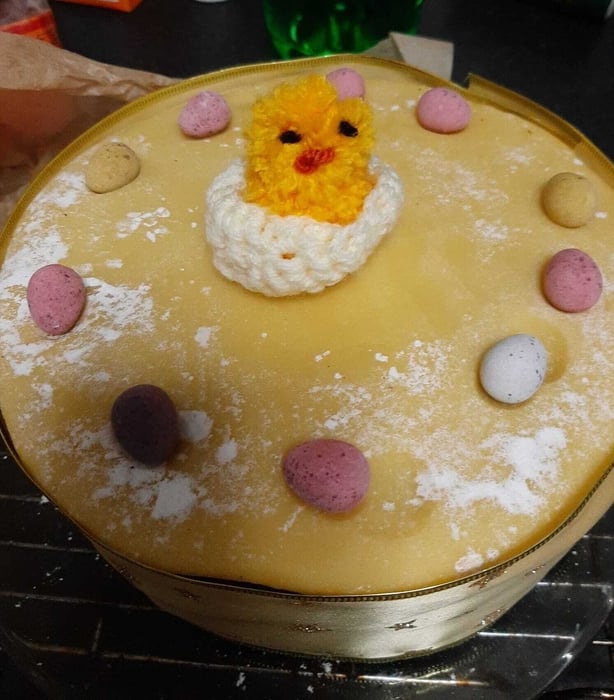
Catriona was the first person I came across in Wexford making this, as I had never seen one growing up. Like the tradition of 'gugging' for eggs at Easter, which I have written about before, I would guess these customs were introduced from England in the 1700s–1800s and took root in parts of Co. Wexford. It is associated with the end of Lent and Easter, and is a light fruit cake made with dried fruits, spices, and layers of marzipan, decorated with eleven small marzipan balls. The name comes from the Latin simila, meaning fine flour, and is related to another dessert from our childhood - semolina. Aside from the cake itself, the story of the name "Simnel" also travelled. I’ve heard the same tale in Wexford as in England, though I don’t think there’s much truth in it. The story goes that a couple named Simon and Nell made the cake but argued over whether it should be baked or boiled. A compromise was reached—and so the name Sim-nell was born.
Good Friday and hair
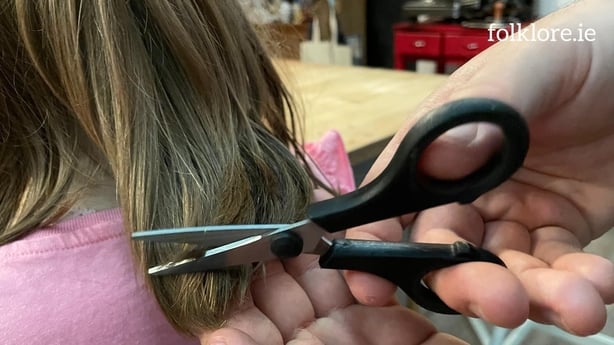
Finally, it was always said in Wexford that anything planted on Good Friday would grow. Among the Travelling Community in the county, the idea of rebirth and regrowth is still strong. On this day, many young Traveller girls would have their hair cut or clipped. This tradition was once practised across Ireland - the belief being that if a girl’s hair was cut on this day, it would grow stronger and thicker throughout the year. As with many folk practices, traditions vary from place to place. Some people observe it on Thursday and call it Clipping Thursday in Cork, but in Wexford it is always Clipping Friday.
These are just some of the stories collected and featured in Michael Fortune’s book The Folklore of Wexford, available from www.folklore.ie. Follow Michael on Facebook and/or Instagram for daily posts and observations
