




With each passing week, it becomes more and more difficult to remark upon the strength of Irish debut fiction with any kind of originality. It should be obvious by now that we are in a golden age of creativity, as the well-spring of Irish history renews itself as an endless source for good storytelling.
We've had the Sally Rooney phenomenon play itself out on a global stage. We’ve had Michael Magee’s re-defining of how we think about masculinity in the post-conflict north of Ireland. We’ve had Ferdia Lennon’s inventive take on Greco-Roman mythology, and we’ve had Louise Kennedy’s remarkable upgrade on the love-across-the-barricades narrative.
Given this environment, it would be easy to feel intimidated. How, after all, can one be expected to meet these high standards? But the debuts keep coming and - to borrow from Wicked - defying gravity, and it feels like a rare privilege to chart their arrival through reviews.
This week I had the pleasure of reading Neil Tully’s The Visit; a novel about the quasi-father/son relationship between kind-hearted Garda sergeant Jim Field and the recently bereaved young social outcast Patrick Hatten. It’s 1963, and the Wexford town of New Ross is preparing for a visit from John F. Kennedy, and right from the off Tully’s story is thick with foreboding.
"The lad is a bit like a stray dog. I keep an eye on him and throw him a few scraps. There are plenty of people in the town who’d just as soon drop him off in the wilderness and hope there’s no scent to follow home. The problem is that Patrick could find his way out of any wilderness and they wouldn’t like whatever starved thing came back."
But fair warning. The constant flitting between perspectives can become jarring - from first person to third then back again—so that instead of the absorbing portrait of 1960s rural Ireland that Tully is so keen for us to settle into, The Visit at times bears the attention-stealing quality of an overzealous Tarantino quick-cut. The third-person sections following Patrick are by far the strongest, and I sometimes wish that Tully had committed to them throughout the book.
Despite a few stylistic hiccups, Neil Tully's The Visit is perhaps the strongest Irish debut novel of the year so far.
Still, there’s no denying Tully’s sharp eye for detail or his natural way with fashioning the common idiom into an elevated poetry that sings with Joycean panache. Describing an encounter with one of the graver of New Ross’s townfolk, Tully writes: 'You’d get more chat from a headstone.’ At another point he remarks on the quality of Patrick’s marksmanship and the metaphor he employs is so beautiful, so deftly visual, that it bears repeating in full:
"Say what they might in town, they couldn’t deny his shot. He could perch on a wall above the beach at Duncannon Fort and shoot the flake from a 99 at fifty yards."
It would be tempting to read Tully’s debut within the narrow confines of Irish literature alone, especially given its familiar treatment of the local as emblematic of the nation. Small town Wexford, in particular, has proved to be fertile ground in this regard, taking in everything from the Magdalene laundries at the centre of Claire Keegan’s Small Things Like These to the hopeful expectation of the would-be emigrant in Colm Tóibín’s Brooklyn.
But to meet The Visit on purely these terms would be a failure of imagination. It is as much indebted to the mid-Century canon of great American writers as it is to its Irish or even county-specific forebears. At times, Patrick’s alienation feels remarkably close to that of Lester Ballard in Cormac McCarthy’s Child of God and there are more than a few nods to Ken Kesey’s One Flew Over the Cuckoo’s Nest in how Tully examines 1960s attitudes towards mental illness.
All of which is to say that despite a few stylistic hiccups, Neil Tully’s The Visit is perhaps the strongest Irish debut novel of the year so far. His characters feel like real people with whom the author has lived and spent a significant amount of time. His historical rendering of New Ross—in the shadow of Kennedy’s visit to his ancestral home during the 1960s—is well-defined, well-researched and, above all, believable.
I’m already excited to see what Tully does next. Perhaps by the end of this year, we’ll have a better idea of how The Visit has been received into that pantheon of illustrious debuts.
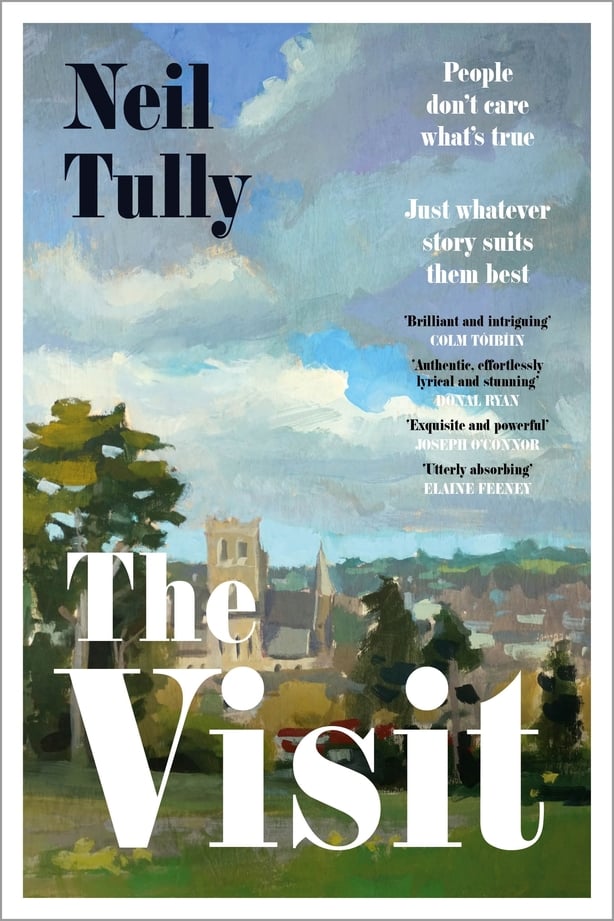
The Visit is published by Eriu
