




Would you trust technology to make a piece of art "better"? Can it really decide what you want to see, hear, watch, and play? And do we even need it constantly modernising everything we enjoy — even when it's only a few weeks old?
That debate is gripping several creative industries worldwide, but none more so than video games, as companies seem determined to incorporate artificial intelligence (AI) into their work — often against the wishes of their own consumers.
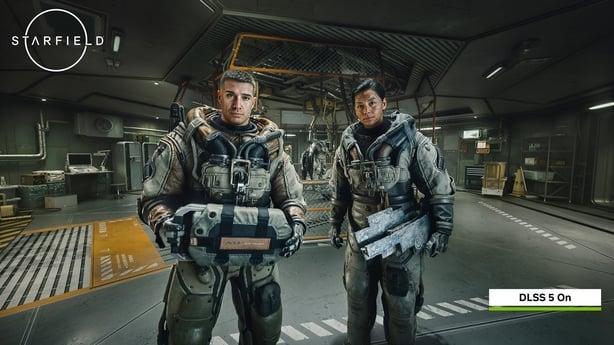
The latest AI flashpoint comes courtesy of Nvidia, now the world’s most valuable company. It recently announced DLSS 5, a technology promising to "bridge the cinematic gap" and "transform visual fidelity" in gaming.
In simple terms, the goal is to make games more photorealistic. Sounds great, in theory. Just imagine the immersive possibilities of a new graphical era.
And yet, the announcement was engulfed in controversy almost immediately. Here’s why...
DLSS 5: A new frontier in realism - but at what cost?
The hostility becomes easier to understand once you realise generative AI sits at the heart of how DLSS 5 works. Yes - it’s everywhere now.
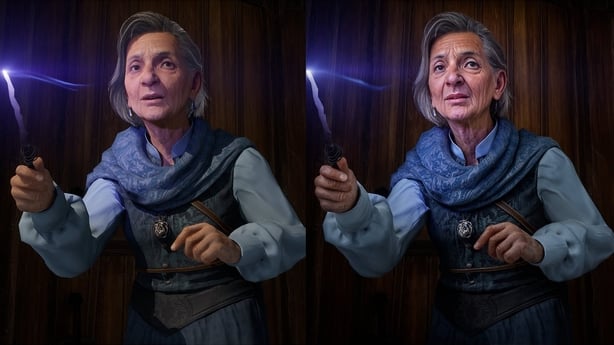
According to Nvidia’s website, DLSS 5 takes a game’s colour and motion data and uses an AI model to infuse scenes with photoreal lighting and materials. The model is trained end‑to‑end to understand complex scene details - characters, hair, fabric, translucent skin, environmental lighting - all from analysing a single frame. It then produces what Nvidia claims are "visually precise" images.
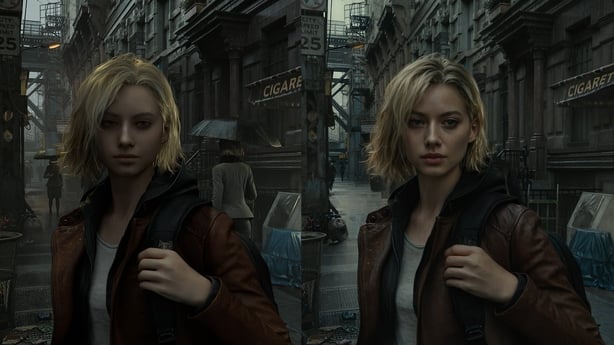
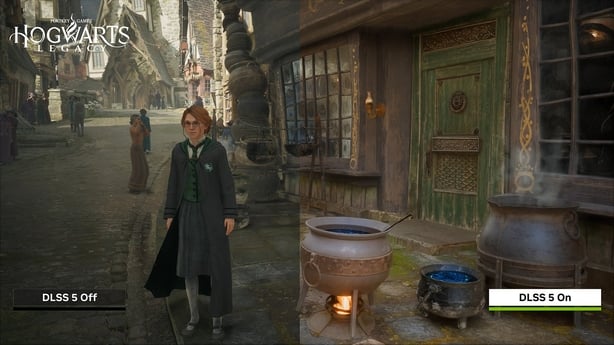
Ahead of its planned Autumn release, Nvidia showcased several games with DLSS 5 toggled on and off. The differences are often stark: richer colours, sharper materials, more visible detail.
But the criticism has vastly outweighed the excitement Nvidia likely expected.
The recurring question many players have about generative AI can be summed up in one word: why?
Across YouTube and social media, almost all of the 17,000 comments currently posted are deeply critical of the embrace of generative AI. Many accuse it of being a "glorified Instagram filter" that "changes what the devs originally designed." Others liken it to creating a game via ChatGPT prompts.
In a now-pinned comment, Nvidia insists developers retain "full, detailed artistic control over DLSS 5’s effects" and rejects the idea that it functions as a filter.
But the backlash continues to grow, with players and developers alike questioning — and often mocking — the technology.
Even with the backing of studios like Bethesda, Warner Bros. Games, and Capcom (whose titles appeared in the demo), the anger only deepens the broader cultural debate: what role should generative AI play in art?
Anti‑AI? The gaming community will need convincing
In today’s climate, openly promoting generative AI is a bold move for any studio. Gamers have shown time and again that they are unforgiving when AI is detected in the games they love.
From six‑fingered Call of Duty character art to Clair Obscur: Expedition 33 - disqualified from awards after its developers admitted using AI‑generated images - backlash is often swift, intense and impossible to shake off.
The recurring question many players have about generative AI can be summed up in one word: why?
Why risk the embarrassment?Why not just hire an artist?Why not hire a voice actor?And in DLSS 5's case, why can’t we trust the developers to decide what realism should look like?
In my own recent playthrough of Resident Evil Requiem, heavily featured in Nvidia’s demos, I never once questioned the game’s visual credibility. Nor did I want it to look more "real" than it already did.
Does protagonist Grace really need a fresh beat of makeup after escaping a rabid zombie? Hardly - it’s a horror game. Do I need to see pristine light refracting off a doorknob as I sprint past? No - I’m too busy running for my life.
Using a recently released game like Requiem to showcase DLSS 5 is, I suspect, a big part of what fuelled the backlash. Nvidia presented a game barely weeks old - a game already praised for its atmosphere and realism - as though it still needed fixing.
Are we really talking about "improving" something that only just hit shelves? And framing it as if it has "limitations"? It all feels exhausting, and makes you wonder where, or if, this debate ends.
Should games even be life‑like? Like any art, it depends…
As with any art form, preference varies. Depending on the title, genre, or your mood, you might care more about visuals, or more about gameplay, story, characters, length — or dozens of other qualities.
But this shift toward prioritising visual enhancement feels dangerous. Much of what makes games enjoyable can’t be upscaled, re‑rendered, or face‑tuned after launch. Games have always promised something beyond looks alone. Chasing realism for its own sake is a fool’s errand.
Like many peers, I can get as much joy from the pixelated 1997 Final Fantasy VII as from its 2020 remake. I’m not against better graphics or evolving aesthetics.
But if a game chooses to reinvent its visuals, I don’t think that decision should be made by generative AI. Nvidia still has months before DLSS 5’s launch to convince the masses.
Until then, expect the debate to keep burning.
The views expressed here are those of the author and do not represent or reflect the views of RTÉ
