


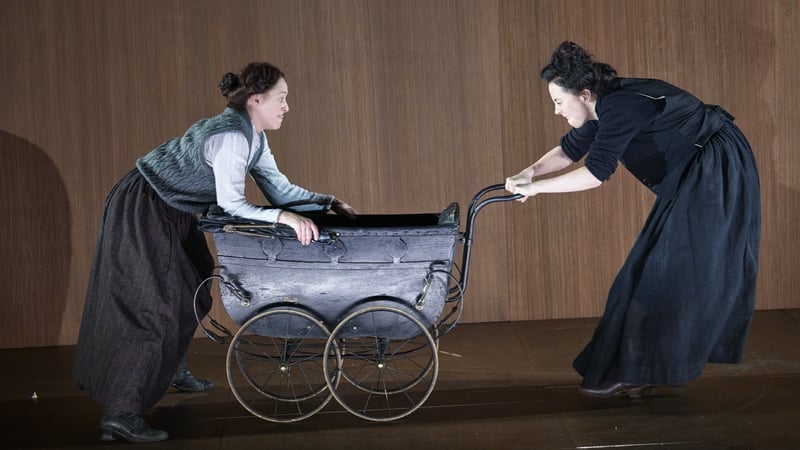
As it marks its 100th anniversary, Tom Creed, director of the current revival of The Plough and the Stars at the Abbey Theatre, pays tribute to Seán O'Casey’s iconic revolutionary drama.
On the night of 23rd November 2023, our dress rehearsal of The Quare Fellow at the Abbey Theatre was cut short by riots that erupted in the streets around the theatre, and the company was evacuated. As a Dublin bus blazed on O'Connell Bridge, two young men ran past, shouting about looting in nearby shops, and it almost felt like we had stepped out into the third act of The Plough and the Stars. When a bewildered tourist wandered into the foyer, trying to find out what was happening and reach their hotel, it was like the Woman from Rathmines had arrived in off the page and off the street. It seems like we might need O’Casey and this play more than ever.
We need your consent to load this rte-player contentWe use rte-player to manage extra content that can set cookies on your device and collect data about your activity. Please review their details and accept them to load the content.Manage Preferences
Listen: Director Tom Creed and cast talk The Plough and The Stars with RTÉ Arena
More and more I find The Plough and the Stars to be a bridge from O’Casey’s earlier more naturalistic plays to his later more expressionist and experimental work. After The Plough, nothing could be the same again. It’s as if the form of the play increasingly fragments and shatters from the chaos in the nation and the trauma experienced by the characters. We start with someone putting a lock on a door and end with a bullet coming through a window.
Watch: In the reheasal room with The Plough and the Stars
This production is a lens through which to look at the past, and a mirror to reflect the present moment. We use clothing, objects and furniture to root the play in the period of its creation and original setting, with a kind of deliberate blankness in the surrounding sets to make space for us to imagine Ireland then, and now, and all the places in the world, past and present, where human lives try to exist alongside uprising and conflict.
More and more I find The Plough and the Stars to be a bridge from O'Casey’s earlier more naturalistic plays to his later more expressionist and experimental work.
The major social and political events that underpin the play – the lead up to the 1916 Rising and the violence of Easter week – are always offstage, but they loom closer and closer as we move through the four acts. We start in the Clitheroe’s room where Nora gets a new lock for the door and tries to keep revolution at bay, but soon find ourselves in the pub where the action is literally and physically interrupted in this production by the Figure at the Window addressing the meeting outside. In the third act we are on the street, with danger just offstage as if in the theatre’s wings, and by the end there is nowhere left for the characters to escape to as history revolves slowly onwards and Nora’s reality gives way to madness.
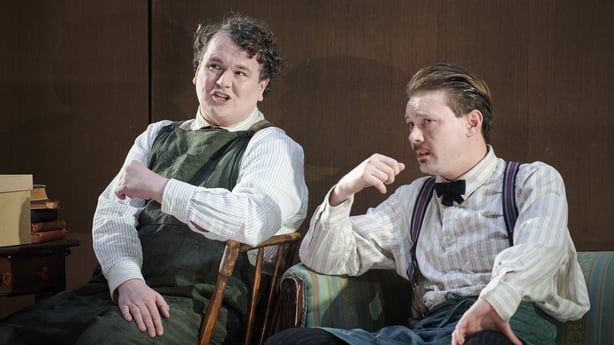
And all the while, we are in the Abbey, with the ghosts of the hundreds of actors who have inhabited these roles and the thousands of audience members who have greeted these scenes with hushed silence and voices raised in protest.
The Plough and the Stars is at the Abbey Theatre, Dublin until April 30th 2026 - find out more here
