


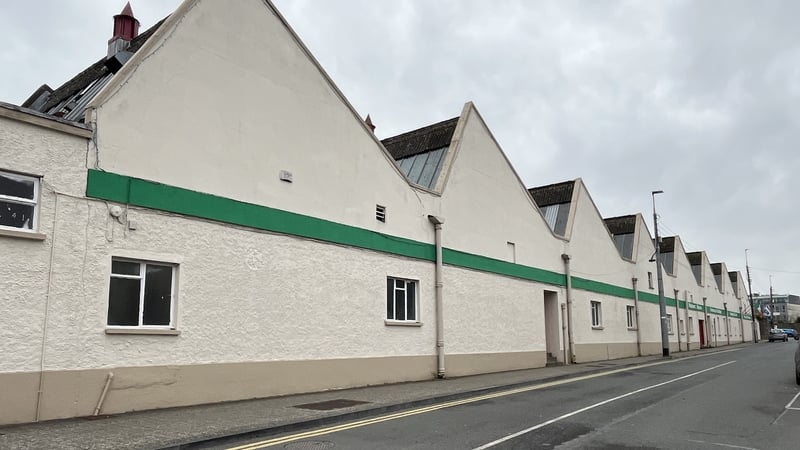

'The Boot Factory', as Padmore and Barnes will forever be known, is Kilkenny’s landmark of Industrial Modernism. Its existence is due to the Irish Free State’s ambition for industrial self-sufficiency. At the heart of the town, the factory hooter, like the saw-tooth roof, formed the rhythm of Kilkenny.
In 1932, the new Fianna Fáil government placed tariffs on imports from Britain to tackle chronic unemployment by stimulating industrial development. This would last until the signing of the Anglo-Irish Trade Agreement in 1938. Ironically, in this act of self-sufficiency, British companies became heavily involved in the expansion of the Irish footwear industry, subject to close supervision by the Department of Industry and Commerce.
In 1933, Padmore and Barnes, a long-established Northampton shoe manufacturing company (est. 1897), in response to the drop in sales of shoes and boots in Ireland due to the tariffs, decided to establish an Irish subsidiary and began the search for a suitable site¹. Initially, a location near Dublin was favoured, but the local industrial development committee in Kilkenny was so determined to secure the factory that they raised the necessary £9,000² from local subscriptions. They even commenced construction on a 22,000-square-foot factory before the Padmore and Barnes directors had made any firm commitment to come to Kilkenny. A site was selected on Wolfe Tone Street, convenient to the railway station, in a field owned by the Great Southern Railway Company, which sold it to the local committee for £150³. Padmore and Barnes (Ireland) Ltd was incorporated as a public company on 10 January 1934, with several prominent Kilkenny business people becoming shareholders. Unusually, the then Borough Treasurer, Mr J. P. Hawe of Kilkenny City, was nominated as a director of the Irish operation to reflect the public interest.
The factory was formally opened by the Minister for Industry and Commerce, Seán Lemass, on 23 May 1934. In his address, the Minister said that 'the opening of the factory marked another milestone on the road to the complete development of the country.' He hoped that ‘once the wheels of the factory commenced to move, they would never again cease, and that it was only the beginning of a very great industry in the historic city.’⁴ The Irish Press reported: ‘The factory, which is admirably lighted and ventilated and designed on the most modern lines… [t]he latest types of machinery have been installed. A cooling and heating apparatus enables the interior temperature to be maintained at the level desired for the comfort of the workers.’
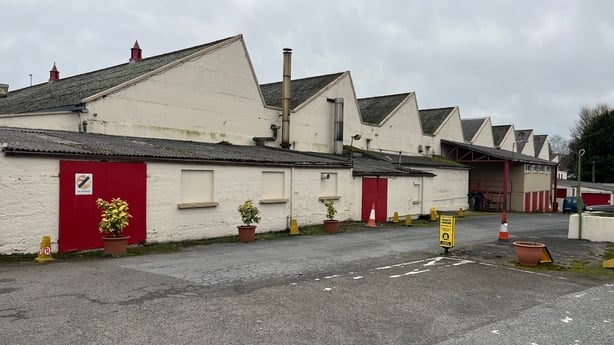
The plans and specifications for the new factory were approved on 24 August 1933 by architect Richard F. Bowen (1895–1938), Kilkenny County and Borough Surveyor, and the contractor was Messrs. T. Connolly and Sons. The committee secured a licence to import duty-free the maple wood and steelwork used in construction. The most distinctive feature of the factory is the saw-tooth roof profile across eight bays (originally six), with gable ends facing the street. Each corrugated-asbestos roof is finished with clay ridge tiles, concrete coping, iron-clad polygonal vents, and rooflights. The building is finished with painted roughcast walls and rendered bands supporting painted rendered gables. The front façade is punctuated by square iron casement windows and timber-panelled double doors.
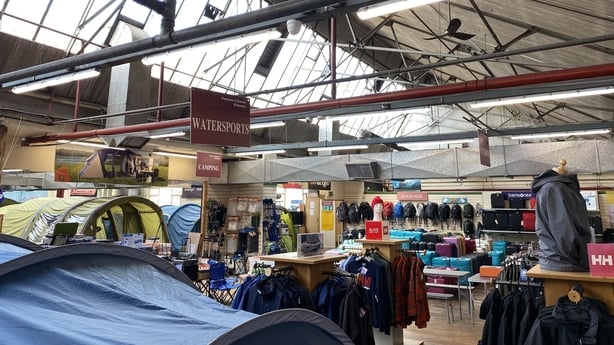
Inside, the interiors retain their industrial past, with exposed structural steel columns, trusses, and clerestory skylights in an open-plan factory. The geometric precision of the saw-tooth roof profile is the ideal architectural solution to bring maximum daylight into a deep plan, aiding shoe stitching. The shoe-making process began in a room where men cut and worked the leather, then moved to the closing room, where mainly women (who were deemed better suited to this detailed work) stitched the shoes on sewing machines, producing the finished products for the shoe room, where managers inspected each pair.
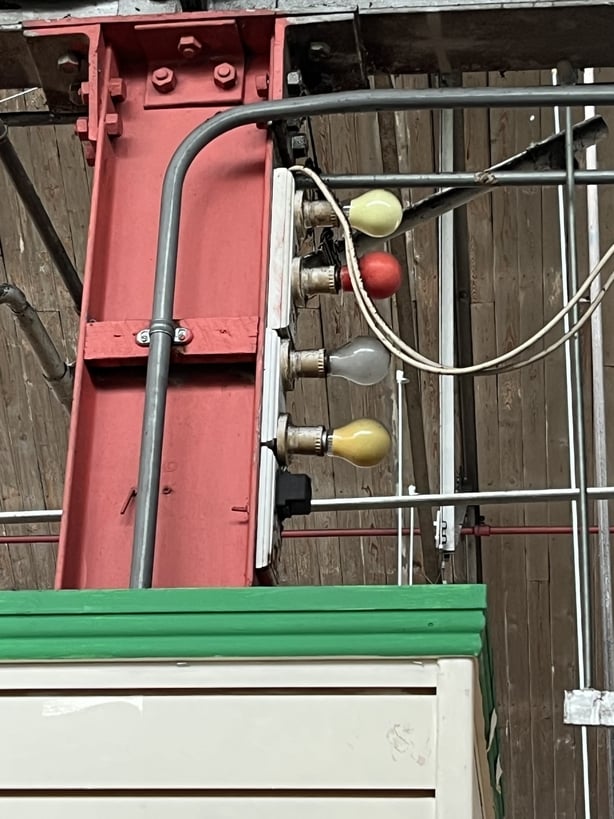
A silent call system was in place on the factory floor in the form of a row of coloured light bulbs. Each foreman had their own colour, and when the manager wanted to see them in his office, he would light their corresponding bulb. This contrasted with the blast of the factory hooter, which signalled the start of the working day, the beginning and end of lunchtime, and the end of the working day.
Padmore and Barnes are known for their moccasins. The ‘Grasshopper’ shoe was introduced to North America as the ‘Wallabee’, as ‘Grasshopper’ was already registered in the US. By the 1970s, Padmore and Barnes became wholly owned subsidiaries of C. & J. Clark Ltd (Clarks Shoes). By 1975, the Kilkenny factory was producing 23,000 pairs per week and employing 650 people. In addition, hundreds of people in the surrounding areas were employed part-time, hand-stitching the shoes in their own homes. In the late 1970s, a second manufacturing unit was set up in Clonmel to meet increased demand, although this was later forced to close. The Kilkenny factory was the subject of a management buyout in early 1987. While physical manufacturing has ceased, the Padmore and Barnes building and name continue as a retail presence.
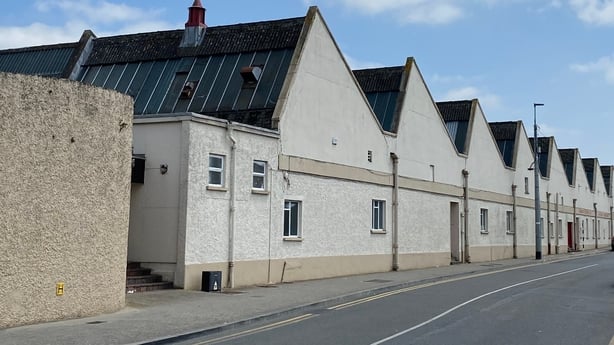
This factory building is a monument to local craft, labour, and cultural exchange, prioritising functionality over historical ornament. It embodies the story of Ireland’s post-independence drive to establish a self-sufficient footwear industry.
Thanks to Pauline O’Connell and Colm Ó Murchú for their images.
Read more from the 100 Buildings series here
1 Jon Press 'The footwear industry in Ireland, 1922-1973 (Irish Academic Press, 1989), p.31
2 'Boot Factory for Kilkenny' Kerry News, 19 July 1933
3 Irish Press, 19 July 1933
4 Kerry News, 23 May 1934
