


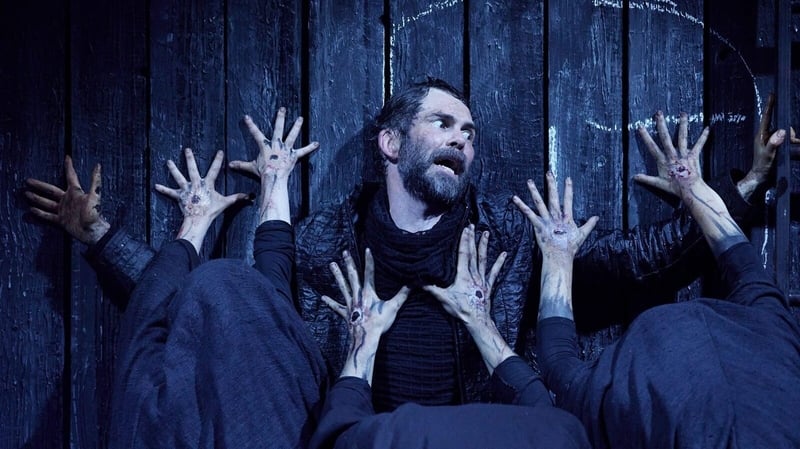
Following sold-out runs in 2025, Druid Theatre's acclaimed 50th anniversary production of Macbeth returns this spring for a three-city tour, with dates in Galway, Belfast and Limerick. Writer and academic Patrick Lonergan takes a deeper dive into "a rare expected event".
William Butler Yeats once suggested that the best way to produce Shakespeare might be to stage his work outdoors in the west of Ireland. "Play it in full light," he proposed, "and invite an audience of Connaught farmers or sailors before the mast."
He was being a little whimsical in making that statement; and he knew that it was impractical anyway – partly, he joked, because staging Shakespeare in such a setting might make his work too easy to understand. "The moment it becomes intelligible it would be on the list of censored books," he claimed, probably accurately.
But the suggestion is intriguing, nevertheless. If you wanted to find an audience who were properly attuned to Shakespeare’s imagination, Yeats implied, you shouldn’t be going to Dublin, London, or Stratford-upon-Avon – but to the west of Ireland.
Watch the trailer for Druid's Theatre's production of Macbeth
So as Druid revive their production of Macbeth – taking with them a stage covered in west of Ireland soil – Yeats’s idea is worth digging into. What does it mean to produce a contemporary version of Macbeth that is rooted in an Irish context?
This production began life last year, during Druid’s fiftieth birthday season, when it was staged in Galway in a co-production with Synge’s Riders to the Sea before touring to Dublin’s Gaiety Theatre. It now becomes the first production of the company’s fifty-first year, opening in Galway before tours to Belfast and Limerick – cities that will allow Macbeth to be seen and understood in new ways.
Watch: DruidShakespeare on RTÉ, circa 2025
Druid have a long history of staging Shakespeare – often in ways that have surprised their audiences. For example, when they were invited to open the Hawk’s Well Theatre in Sligo in 1982, they were expected to do an Irish play, but instead staged Shakespeare’s Much Ado About Nothing, relocating it to an Anglo-Irish country estate. For their tenth birthday, in the summer of 1985, they produced ‘Tis Pity She’s a Whore by John Ford (a near-contemporary of Shakespeare) – presenting it during the same summer that Ireland experienced the "moving statues" phenomenon, which involved tens of thousands of people flocking to Marian shrines around the country in the hope of witnessing a miracle (reminding us of Macbeth’s observation that "stones have been known to move"). And they celebrated their fortieth birthday with DruidShakespeare, a four-play mash-up of the Henriad by Mark O’Rowe which – with enjoyably brazen bad-timing – was deliberately not produced in 2016, the year of Shakespeare’s 400th anniversary, but in 2015, the year of Druid’s fortieth anniversary. That production travelled from Galway to Skibbereen, Letterkenny, Sligo, Limerick, Kilkenny, and New York.
Druid have a long history of staging Shakespeare – often in ways that have surprised their audiences.
Such tours have always brought Druid into conversation with the wide variety of Shakespearean performance histories across the island. There is a long tradition of Shakespearean performance in Belfast, for example – and Macbeth has been a favourite there since (at least) the early 1800s. Mary O’Malley, the founder of the Lyric, did much to reinforce that relationship by programming plays by Yeats and Shakespeare throughout the 1950s and 1960s; and more recently there have been several important Macbeths in Belfast, from a presentation of the play with northern accents on the Lyric’s new stage in 2012, to Big Telly’s COVID-era Macbeth on Zoom.
Similarly, Limerick has played host to great Shakesperean performances for more than a century. The celebrated actor Frank Benson (who did much to lay the groundwork for what later became the Royal Shakespeare Company) regularly performed in Limerick in the 1890s and early 1900s – and once declared that the audiences he met there were among the ‘finest judges’ of Shakespeare that he’d encountered anywhere. That tradition continues into the present, as shown in 2021 when Paul Meade premiered his play Sham – which is inspired by Hamlet – at the Belltable.
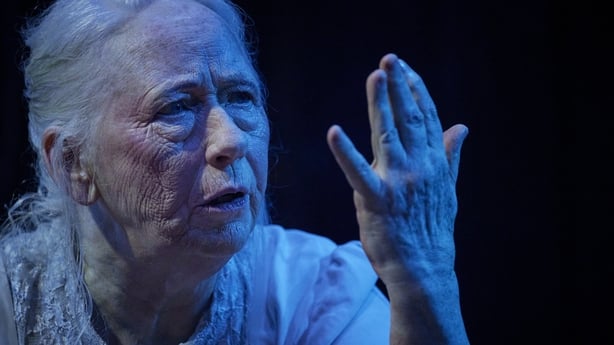
Shakespeare means different things in Galway, Belfast, and Limerick, of course – but in all three places, there has been plenty of evidence to support Yeats's claim that modern Ireland can often seem remarkably similar to Shakespeare’s Scotland.
One example of that resemblance can be found in Shakespeare's representation of the real. Nowadays, we tend to think of the witches in Macbeth as supernatural beings – and thus forget that the play was written at a time when the demonic was seen by many as a literal fact. The patron of Shakespeare’s company, King James I, had written a book about black magic called Daemonologie roughly a decade before Macbeth was first performed, and the king’s views of witchcraft are very likely to have informed the composition of the play. Even the ingredients that the witches choose – the eye of newt and toe of frog – were believed to have been taken from "real" spells that were thought to have supernatural effects (perhaps best not to try them at home, then). There is a boundary between the natural and the supernatural in this play – but it’s not very clearly demarcated.
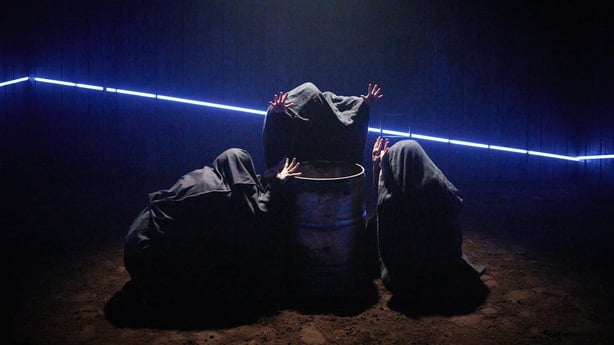
And, as Yeats knew, a similar conception of the "real world" could readily be found in rural Ireland in the early twentieth century. Yeats's friend John Millington Synge had once been asked by an old woman where he’d learned the simple magic tricks that he used to entertain people on the Aran Islands. "Tell us now," she said, "didn't you learn those things from the witches that do be out in the country?" Those witches were thought to be very powerful, Synge explained: once, when a local family was about to be evicted from their home on Inis Meáin, a boatful of bailiffs was twice prevented from landing due to the onset of a sudden storm, which had been summoned by the power of a "native witch", according to the islanders.
Synge later brought those beliefs into his plays. In Riders to the Sea, one character mourns her brother’s death with the anguished observation that there will be "no one to keen him but the black hags that do be flying on the sea". In The Shadow of the Glen, a tired-out tramp borrows a needle to ward off ghosts. And in The Playboy of the Western World, we encounter a hero whose father needs to be "killed a third time" – a denial of death’s finality that is both funny and unsettling, and which faintly echoes Macbeth’s depiction of a world in which "charnel houses and our graves must send/ Those that we bury back".
In her first ever programme note for a Druid season, back in 1975, Garry Hynes expressed something vital about the company by declaring that its remit would be to "make voyages" – to use their Galway home as a base for an engagement with the rest of the world.
Macbeth and Synge’s Playboy are therefore similarly unsettling, perhaps because in both cases their most fantastical features are also their most realistic. Yes, Macbeth features witches – but it’s the all too believable Lady Macbeth who summons spirits, demanding that they "fill me, from the crown to the toe, top-full/ Of direst cruelty!" And then there’s the concluding depiction of Birnam Wood moving to Dunsinane. In one sense, that image is simply a realistic representation of a camouflaged army on the move. But it’s also a profoundly uncanny metaphor (especially in our era of ecological crisis) for how human ambition will always be dwarfed by the power of the natural world.
So perhaps that’s why Yeats imagined that Shakespeare would be newly intelligible in an Irish context: Ireland was a place where the miraculous could seem mundane. "The wonder," wrote Synge, "is a rare expected event, like the thunderstorm or the rainbow, except that it is a little rarer and a little more wonderful". In Ireland as in Shakespeare’s Scotland, fair was often foul, and foul often fair – or, as Synge put it in The Playboy, "there’s a great gap between a gallous story and a dirty deed".
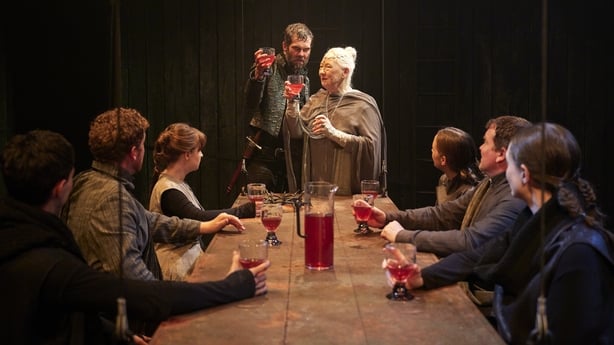
In her first ever programme note for a Druid season, back in 1975, Garry Hynes expressed something vital about the company by declaring that its remit would be to "make voyages" – to use their Galway home as a base for an engagement with the rest of the world. This production of Macbeth stays true to that founding ethos, revealing a Shakespeare that feels at home in an Irish context. Druid’s Macbeth is bloody in its depiction of the older generation’s violence against the young – but that theme dominates Irish drama too, from Synge’s Playboy of the Western World onwards. Macbeth shows how Shakespeare was resolute in his presentation of women who refuse to be defined by their society’s categorisations of them – but that’s also been a key Druid theme for decades, as shown in its productions of plays by Tom Murphy, Martin McDonagh, Lucy Caldwell, John B Keane, and many others. And in Marty Rea and Marie Mullen’s portrayals of the Macbeths, Druid suggests boldly that the most difficult "voyage" that any of us can make is the one towards self-knowledge – and that too has been one of their most enduring preoccupations.
Druid’s staging of Shakespeare is therefore "a rare expected event": one that finds the space where a great world playwright and Irish theatre histories meet and overlap. As such, it is building on the past while anticipating future wonders – allowing us collectively to embark on new voyages.
Macbeth is at Galway's Black Box Theatre from 25 March - 5 April, Belfast's Lyric Theatre from 16 - 19 April and Limerick's Lime Tree Theatre from 23 - 25 April 2026 - find out more here
About The Author: Patrick Lonergan teaches Drama and Theatre Studies at the University of Galway, and is the author of Druid Theatre: 50 Years, which is published by Lilliput Press
