


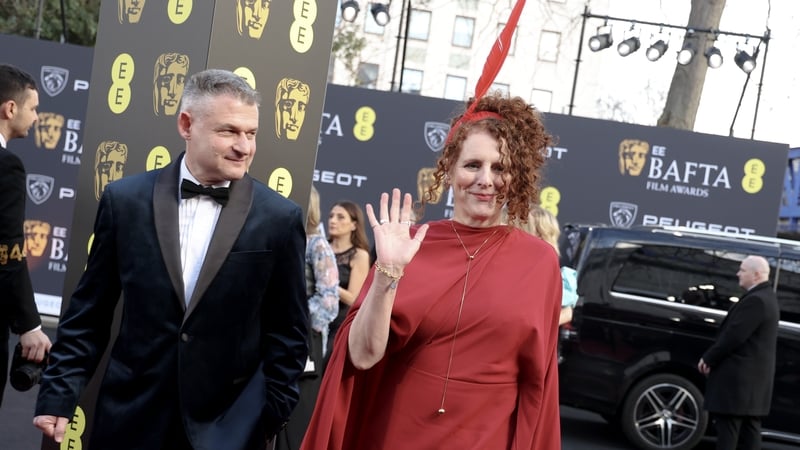
Conceptual artist, milliner, and accessory designer Margaret O'Connor has earned acclaim for her singular creations; her latest challenge took her to London and the BAFTA Awards, where she was commissioned to work her magic on Hamnet novelist‑turned‑screenwriter (and BAFTA nominee) Maggie O'Farrell. She tells the story below.
Sometimes the most magical projects arrive right in the middle of something else.
I was in my studio, deep in the flow of painting for my new collection, Easily Led. The paintings I’m making aren’t really paintings in the traditional sense - I’m creating them as the basis for textile prints. I’m about a third of the way through the collection now, and at the time I was working on a massive canvas when an email landed in my inbox.
It was from Maggie O’Farrell’s assistant.
She told me that Maggie had worn one of my bold necklaces to a premiere in Dublin - a piece her mother from County Down had given her as a gift. Apparently Maggie’s mum is a fan of my work. The message said Maggie also owned one of my red turbans and had worn it before, and she’d love to wear some of my pieces to upcoming events.
I was delighted - completely chuffed - but also very moved when I looked online and saw her wearing the necklace. It meant a lot.
What made it even more special was that just a week earlier my sister Sarah and I had gone to see Hamnet. My sister had insisted: "We have to go see this." Being from County Clare and raised with stories of healers, holy wells, and folk traditions, the themes of the story resonated deeply with me.
Growing up in the west of Ireland, you hear about figures like Biddy Early from Feakle — a famous healer who kept a mysterious bottle with a rounded base. Those kinds of stories were part of the landscape of my childhood. My uncle Jerry O’Donoghue is a seventh son of a seventh son and is known for helping people as a healer. My mother always said our granny used to read tea leaves.
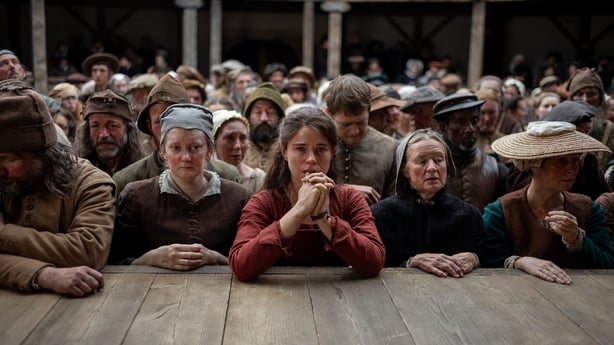
So the world of Hamnet - especially the character played by Jessie Buckley - felt very familiar to me. She’s deeply connected to the land, to intuition, to nature. I’m from a farming background myself in the Burren in County Clare, so that sense of being rooted in the earth really speaks to me.
In fact, the first collection I ever made that truly felt like my own was called Pachamama. It was inspired by Mother Earth - by landscape, by the meeting of old and new traditions. That collection was shaped by a trip I took years ago to Lima in Peru with my ex-boyfriend and his godfather, a priest who worked there. That trip changed the way I thought about fashion. It made me reflect deeply on fast fashion and consumer habits. I came home determined to focus on quality, craft, and longevity - buying less, but buying better.
So when the email arrived asking if I would create a headpiece for Maggie to wear to the BAFTAs, I jumped at the chance.
Seeing Irish design on the BAFTA red carpet meant the world to me.
At the time I was mid-flow in the studio, painting, so it was actually the perfect excuse to shift from two dimensions into three. I began experimenting with feathers and materials, thinking about Maggie herself - what she might wear, how she carries herself, what would feel authentic to her.
She showed me the outfit she planned to wear, and we discussed a few possibilities. But I always like to give people options. As a designer, part of your job is showing someone something they didn’t know they wanted.
In the end I made thirteen pieces.
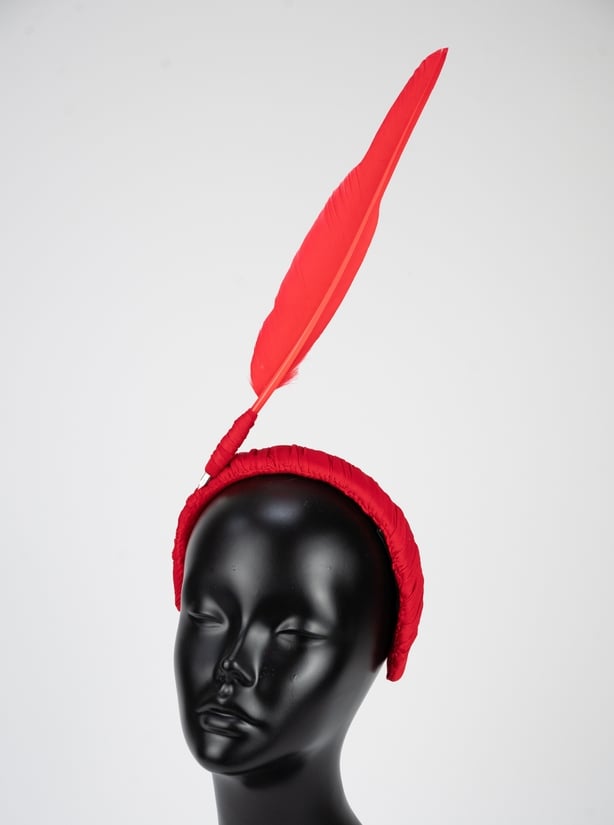
I was completely immersed in the process - working long hours, pushing myself to create as many possibilities as I could. At one point my hands were literally bleeding from the work, but I was so happy doing it.
During that process something new emerged: a new signature crown. Whenever I work on a collection I try to develop something that's both wearable and iconic. I’ve created a few signature crowns over the years, but I hadn’t made a new one in about three years. Somehow, through this project and the Easily Led collection, a new one appeared.
But the most special idea came when I asked myself a simple question:
If I were Maggie O’Farrell, what would I wear?
The answer arrived almost instantly — a writer’s quill.
From there began a small adventure trying to find a fountain pen. Living in rural Ireland makes sourcing materials tricky. Hickey’s has closed and options are limited, so when I had to go up to Dublin for a check-up on my ears I made the most of it. I visited the Fabric Counter and W.H. Trimmings to gather supplies.
Still, the pen was elusive.
Eventually I rang a lovely shop in Gort - the Gort Education Centre - which sells school supplies and bits and pieces for the local community. A man named Gareth answered the phone. I asked if he had any fountain pens.
He said, "I actually have two, but they’re not for sale. They’re old stock - out of the packet."
Then he paused and said, "But you can have them."
So I drove in and collected them, and those two pens became the heart of the headpiece.
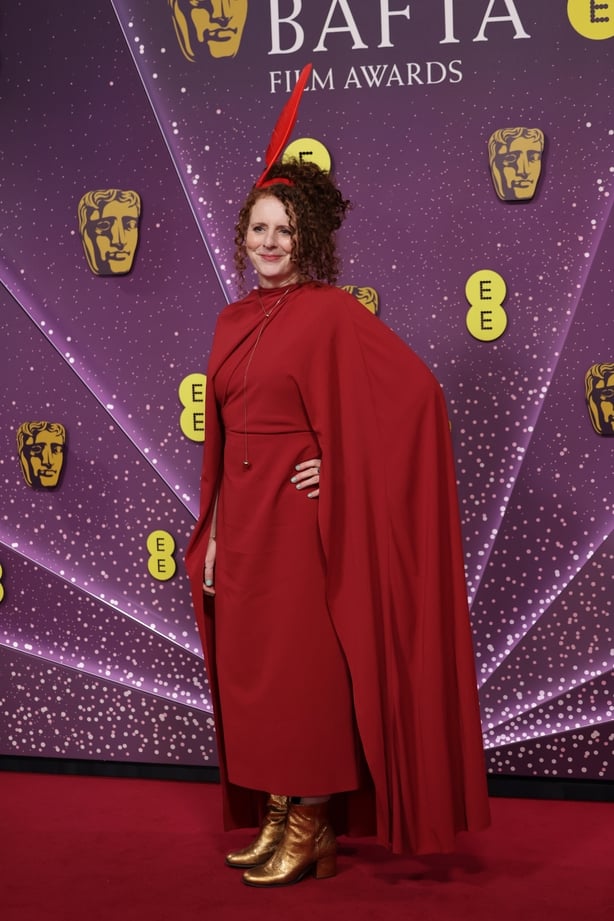
(Pic: Max Cisotti/Dave Benett/Getty Images)
I paired the fountain pen with feathers that matched Maggie’s dress and transformed the pen into a sculptural quill. My idea was that from a distance it would read as an elegant headpiece, but up close you would realise it was actually a writer’s pen — complete with the nib of a calligraphy pen at the tip.
A quiet tribute to the craft of writing.
Originally I planned to post the pieces, but I’ve been let down by the postal service before. Once I made a headpiece for a woman who had lost her husband, and although it was supposed to arrive the next day, it didn’t make it in time for the funeral. It broke my heart.
So this time I decided to deliver the pieces myself.
It gave me the perfect excuse to travel to London, visit family, and see the Marie Antoinette exhibition at the V&A before it closed. I’m a member and had seen it once already - it was one of the best exhibitions I’ve ever experienced - so I couldn’t resist going again.
Maggie and I met in London, where I fitted the headpieces and measured her head properly. I made a few final adjustments afterwards - popping into MacCulloch & Wallis for needle, thread, and scissors to tweak things.
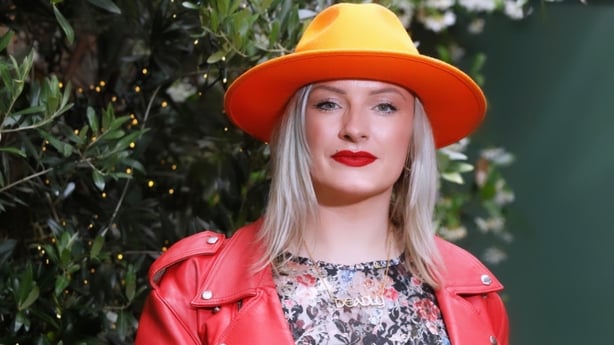
Then I left the rest up to the fashion gods.
Not everyone feels comfortable wearing hats, and I would never pressure someone to wear something. I wanted Maggie to choose it only if it felt right.
So you can imagine how thrilled I was when photos appeared online of her arriving at the BAFTAs wearing the red writer’s quill headpiece.
The night before, she had worn another piece I made - a beautiful teal velvet rose - to a pre-BAFTA event. But the quill was the moment.
The design itself is actually very simple: a small headband with the sculptural quill. As I get older, I’m learning more and more about restraint in design. When I was younger I tended to put the kitchen sink into everything. I had so many ideas that when I was studying millinery in Kensington and Chelsea, my lecturer Kirsten Scott once told me I wasn’t really a milliner - I was an accessory designer.
She was absolutely right.
But over time I’ve learned the power of "less is more." The writer’s quill didn’t need anything else. Maggie’s incredible fiery red curls did the rest.
Meeting Maggie was also incredibly special. She’s warm, thoughtful, and completely authentic - an extraordinary writer and artist. We had a beautiful conversation, and I was so happy she understood the idea behind the piece: stepping into her world and celebrating the craft of writing.
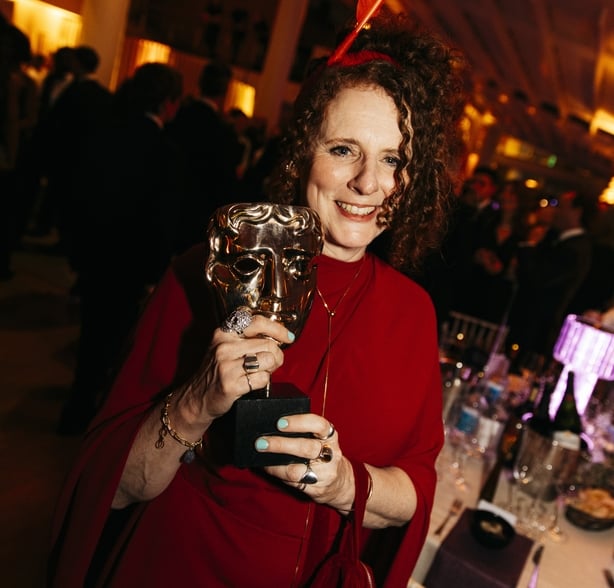
(Photo: Iona Wolff/BAFTA via Getty)
Seeing Irish design on the BAFTA red carpet meant the world to me.
I couldn’t watch the broadcast live from my Irish phone, so my cousins in England sent me photos and videos from the BBC coverage as it aired. Watching those clips arrive on my phone - seeing Maggie walk the red carpet wearing the piece - was a moment I’ll never forget.
And that’s how a painting day in the studio turned into a writer’s quill on the BAFTAs red carpet.
Find out more about Margaret O'Connor and her work here
