


Editor Ailbhe Malone introduces her new anthology Banshee, which sees a formidable line-up of acclaimed female writers (amongst them Naoise Dolan, Megan Nolan, Wendy Erskine and Sarah Maria Griffin) breathing new life into ancient Irish myths, reclaiming the stories of women who 'have too long stood in the shadows of warriors and kings'.
'Fadó, fadó' is how Irish fairy tales begin. It’s the Irish language version of ‘once upon a time’, a way to signal to the listener (because these are stories to be told aloud, and remembered, and passed on) that they are about to go on a magical journey, full of druids and demons, fairies and fighters. But this phrase is also something of a trope – it places the telling firmly in the past, and sets up the archetypes of the tale before it even begins.
We need your consent to load this rte-player contentWe use rte-player to manage extra content that can set cookies on your device and collect data about your activity. Please review their details and accept them to load the content.Manage Preferences
Listen: Ailbhe Malone talks all things Banshee with RTÉ Arena
Irish mythology is a tapestry of characters and ‘cycles’ that seep into everyday life in Ireland, from the Fianna of the Fenian Cycle (a band of mighty warriors from which Fianna Fáil – one of Ireland’s main political parties – gets its name), to the mighty Cú Chulainn or Setanta of the Ulster Cycle (from which Ireland’s sports TV channel – Setanta Sports – is named), we have adopted these names into the most common cultural language. Legend is woven into the landscape and into our childhoods: away for the summer at the Gaeltacht in the Aran Islands, I sat by a Stone Age wedge, known locally as Diarmuid and Gráinne’s bed; at my Irish-language school, my brother was in a modernist musical retelling of The Táin. Despite the choices presented to these women in these stories, it seems like they are driven by the actions of the men around them and by fate – but where might they have agency too? In the stories my friends and I have learned, these women have no interiority, even though they are often the titular characters. In Banshee, I’m simply asking: why not let the women lead?
There is a long historical tradition of women writing (or rewriting) Irish fairy tales – one of the first collections of myths and legends is Lady Gregory’s 1902 collection, Gods and Fighting Men. Part of the Celtic Revival (she was a contemporary of W. B. Yeats and J. M. Synge), it was a reclamation of Irish fairy tales, albeit through an Anglo-Irish lens. Seventy years later, Sinéad de Valera (the wife of former Irish president Éamon de Valera) wrote several collections of Irish fairy tales for children, similar in style to Roger Lancelyn Green’s retellings of Greek myths. Growing up in Ireland in the ’90s, I devoured these fairy tales – and hungered for more. I can draw the cover of Sinéad de Valera’s Irish Fairy Tales without having to open my eyes, and I still feel the sparkle of the scales of the salmon of knowledge, as described by a seanchaí in Connemara National Park. And, to be frank, this is not the first time these stories have been rewritten through a new lens. While some of these tales – including sections of the Fenian Cycle – have been written down, others shared in the oral tradition were altered with the arrival of Christianity. In stories like The Children of Lir, this edit is not hard to notice – there is an abrupt moment where a monk, or Saint Patrick, appears and blesses the characters. Equally, as Irish myth is part of an oral tradition, modulations such as adding flourish and ornamentation, and changing elements to suit the circumstance or listeners, are to be expected.
As part of my work researching which legends to include in this collection, I sifted through the Schools Collection (a collection of folklore compiled by Irish schoolchildren in the 1930s). The entire archive is online, and you can read scanned handwritten retellings, but I also recommend John Creedon’s Irish Folklore Treasury, in which the best are reproduced. It was fascinating to see the beats of a story rippling through the water, differing but the same (in The Merrow – which is retold by Sheila O’Flanagan, for example, the sea woman’s red cap appears each time, despite other differences in the text). Meanwhile, Credhe and Cael (The Battle of White Strand) is one of the few retellings I saw that has the same line come up again and again (‘The most deceiving woman in Ireland’); it felt only right to assign this story to a poet (Nikita Gill). Another element that’s worth knowing is the concept of dinnshenchas – the importance of how places get their names. You can see this expertly explored in Anne Griffin’s contemporary take on Clíodhna’s Wave, as well as Jess Kidd’s otherworldly version of How the Boyne Got Its Name.
My brief to these authors was simple: rewrite these legends so that the women are the fulcrums of the stories rather than the levers.
Some of these legends I have never known in English – when I was researching translations of Diarmuid and Gráinne, I wondered what the translation for tóraíocht (‘the hunting’) would be – ‘pursuit’ doesn’t seem to capture the terror at the heart of the legend. But Megan Nolan’s version has a beating heart of fear and dread – like a hare being chased through brambles. Other legends I know so I well I could recite by heart – yet Salma El-Wardany’s reimagining of Deirdre of the Sorrows in an Ireland ruled by the Catholic Church, rather than a pre-Christian society, surprised me with every page.
The authors in this collection represent the cream of contemporary Irish writing. There are writers I know personally, and those whose work I have grown up admiring. There are writers for whom a short story is their metier, poets who are making their short-fi ction debut and novelists who were excited to test the challenges of a new format. You don’t need to be familiar with the original text to enjoy these stories – but for some context, I’ve added a line or two of précis for each retelling. I’ve kept these deliberately oblique; I’d like the stories to stand on their own – if you’d like to read more about what came before them, there’s a list of selected reference books at the end of this collection. My brief to these authors was simple: rewrite these legends so that the women are the fulcrums of the stories rather than the levers. In the Children of Lir, why must Fionnuala be both mother and sister to her siblings during the exile? Naoise Dolan revisits this story that she had grown up learning in school, and slants the narrative.
The stories of a fairy snatching a young child and leaving a dupe in its place are numerous – but at the heart there is a real fear, something Jane Casey uses to sinister effect in her story. Sarah Maria Griffin grapples with how to parent an eternally reincarnated being in the Wooing of Etain, and in her take on the Labour Pains of the Ulaid, Wendy Erskine’s Belfast is both ancient and new – a strange land where curses and half-magic still exist. My goal with this collection is to loosen the ties of the past on these fierce – sometimes frightened, sometimes ferocious – women. Like all fairy tales, these myths and legends have depth and danger. In these worlds, desire and domesticity collide.
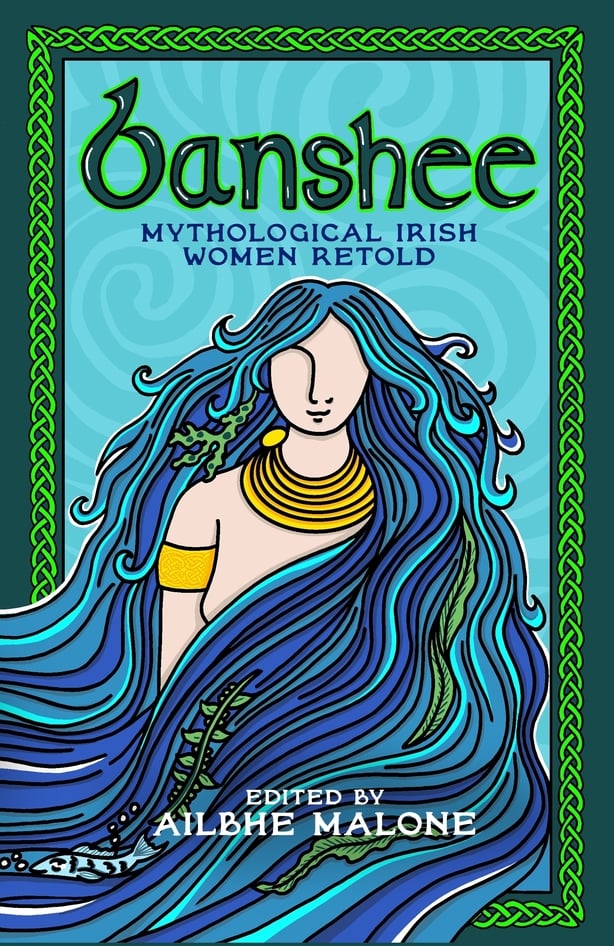
Banshee: Mythological Irish Women Retold is published by John Murray
