


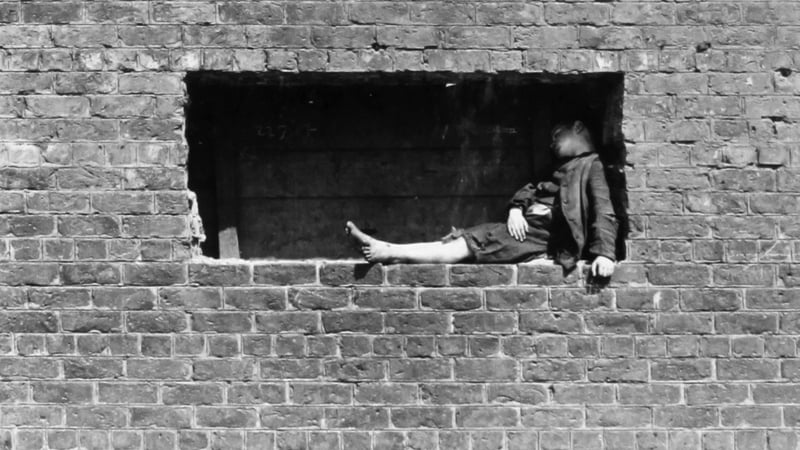
Writer, academic, and curator Catherine Morris introduces an extract from her new book Intimate Power: Autobiography of a City, a unique literary journey described as 'a meditation on forms of personal losses that we carry with us all our lives'.
Intimate Power: Autobiography of a City is a series of walks through Liverpool made on a return journey from a feeling of long exile. It is a recovery of voice through which I situate parts of my own life into a collective solidarity that I sought out in conversations, chance encounters and in the stories that I uncovered in the city's local and international multimedia archives. I walk through versions of myself in Liverpool via twenty episodes that I name after revolutions: moments in which transformations occur. Each revolution is connected through a photograph and inter-episodes of "Walking" that carry the words of the living and of the dead.
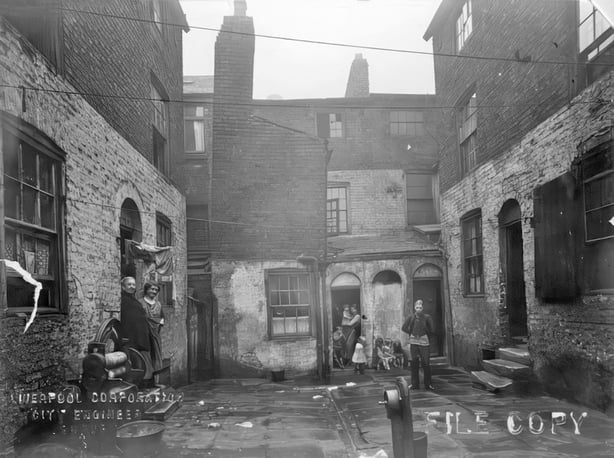
Liverpool time-travels through the imaginary as its buildings and streets morph into an on-screen body double performing other countries, cities and times: I watch as snow falls in Summer; once on my way to the library, St George’s Hall was being Moscow; a deserted road in the Welsh Streets translates in time to become the blacked-out Birmingham headquarters of 1920s crime gang the Peaky Blinders. After being invited to become Liverpool Central Library’s first ever Writer-in-Residence, I connected my autobiographical enquiry with a utopian space that stores and enables shared memory in the city through its collections of war records, ships’ passenger logs, maps, newspapers, photographs, parish registers of births, deaths, marriages, orphanage and workhouse records, diaries, letters, political campaign archives, census documentation and film reels.
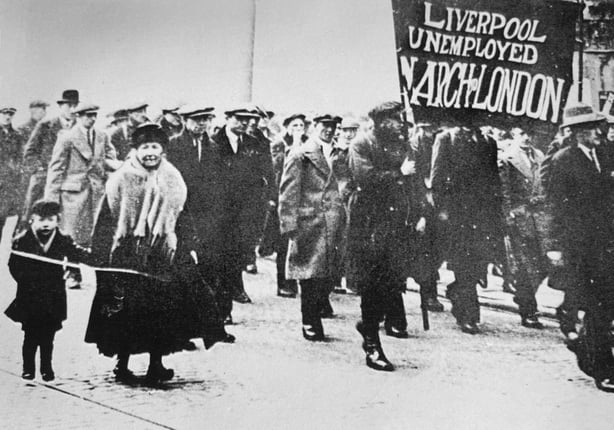
Arrivals and return journeys; escape routes out of coercive institutions that remain open when collectively felt. I walked the city without a map and followed the pattern of memory and chance encounter towards conversation wherever possible. Intimate Power documents the arrivals and the departures of people whose voices I recovered in the archives as I searched for a way out of the silences of institutionalized and societal shaming and into a collective reanimation of local and international connection.
Facing the Berlin Wall, an angel in Wim Wenders' film Wings of Desire whispers: "I want to transmute. To sustain a glance." While the fragmented narrative perspective of my book is constantly moving, the I/she/her is stilled by that long gaze back. Documenting her own feminist navigations towards the self, poet Adrienne Rich concluded: "I need to understand how the place on the map is also a place in history within which . . . I am created and trying to create. Begin, though, not with a continent or a country or a house, but with the geography closest in—the body. Here at least I know I exist, that living human individual whom the young Marx called 'the first premise of all human history.’ "
Dublin, March 2026
1
1989: THE FALL OF THE BERLIN WALL
An elephant walked down County Road. Sounds of Yiddish caught somewhere between doorways, she could hear the world of the city spoken by her Russian grandmother. Brenda said: "A sudden feeling of fate attached itself to my life as I sat in the small hospital room nursing a child recently arrived from Jamaica." 1949. "Windrush" - a word that has been mentioned before.
*
1919. A cinecamera fixed to the front of a tram records how the city moves like a dream through winter. A man reads his newspaper in a warm overcoat as he waits outside the Adelphi. 1919. The cotton is on fire at the docks. St Luke’s clock at the top of Bold Street still ticks. 1919. Not yet Civil War in Ireland. What was in that newspaper that he reads? So busy he cannot look up at the tram that has stopped and the tram that is a second away.
*
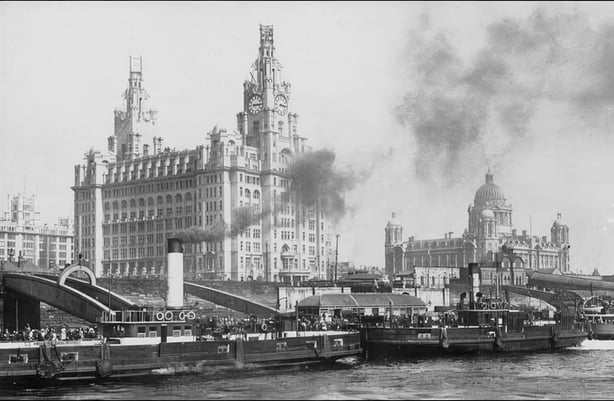
Ghosts of the enslaved; their mark of absence arriving on ships that passed in and out of the Mersey. Those who built and owned slave ships here in Liverpool. Those who built and owned plantations far away. Interconnected distances. Which United Irishman in 1798 said: "In every spoon of sugar, I see a drop of blood"?
The waterfront.
The East Africa Bank.
The East India Insurance Company.
The Royal Insurance Company.
Cafes and sweet shops now. To let. To let. To let.
*
Outside under a streetlight she looked into a map of the disappeared.
Ghost streets. Conway, Luther, Ellison, Elias, Robesart, Beatrice, Opie, Arkright, Kew, Benledi, William Moult, Taliesin, Juvenal, Dryden, Virgil, Rachel, Beau, Aughton, Mitylene, Conyers, Zante.
Scattered lives; collected in the aftermath of clearances.
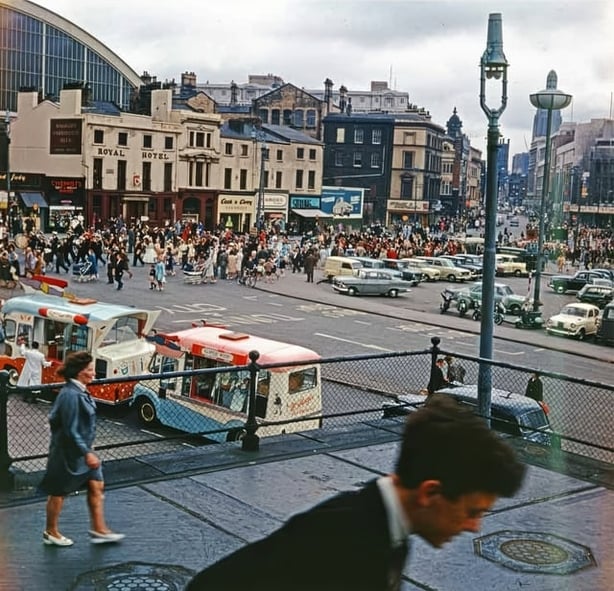
WALKING
On Old Hall Street Herman Melville in 1849 said:
Taking out my map,
I found that Old Hall Street was marked there,
through its whole extent with my father’s pen;
a thousand fond, affectionate emotions rushed around my heart.
Yes, in this very street, thought I, nay,
on this very flagging my father walked.
Then I almost wept . . .
little did he think, that a son of his would ever visit Liverpool
as a poor friendless sailor boy.
But I was not born then: no, when he walked this flagging,
I was not so much as thought of;
I was not included in the census of the universe.
My own father did not know me then.
2
1942: THE RESISTANCE
St Patrick’s day. I see the police before I see the march. The band looks like it is playing out through the doors of the old Irish Center at the Wellington Rooms. Closed now. I danced there in the 1980s with doctors from Africa, Ireland, students from Communist Hungary. The black berets and banners lit by an early afternoon unexpected sunlight on Hope Street. Larkin Liverpool. Che Guevara Liverpool. Signs and signals of solidarity and of despair. As I pass the Everyman Theatre, a balcony closed to the public is filled with staff who watch the Irish in Liverpool perform being Irish in Liverpool. They pass the stone sculpture luggage of emigrants where an Irish leprechaun lifts himself onto a suitcase to film the parade. Tricolors and Irish flags fade into St James’ Cemetery. Do the Famine Refugees hear the music still? Do they feel the colors of their once imagined Republic burning through this sunlight?
*
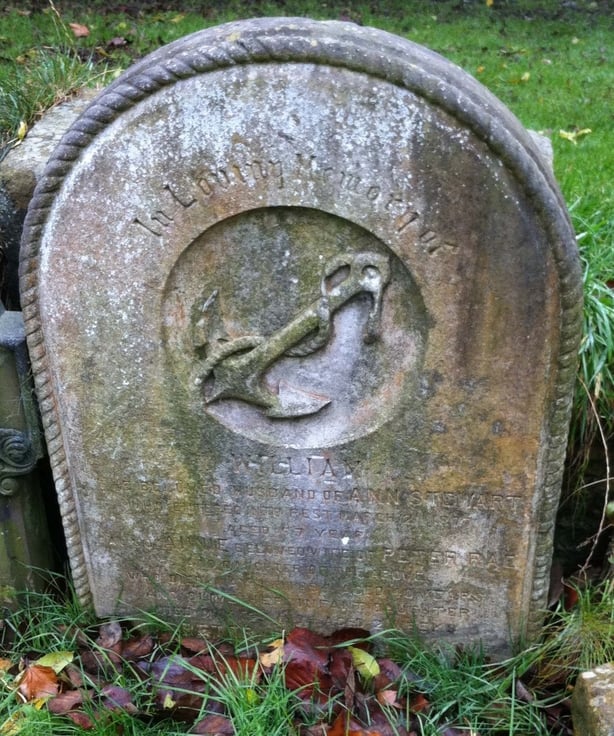
In St James’ cemetery she read the stone inscriptions of those who belonged to each other: Catherine Widow of the above; Son of, daughter of, wife of. Names, places where they were born or lived or died. Dates and names inscribed in stone: two hundred years later, where they were from and to whom they belonged was still declared and known in the elements of a late afternoon stroll.
*
Which Irish ancestor answered "Traveller" when asked about his father for a marriage certificate?
Catherine performing the role of Susan in The Waves thinks: I am fenced in, planted here like one of my own trees. I say, "My son," I say, "My daughter."
*
When did Moses Leary stop following the news from home? When did Michael Quinn stop knowing the price of oats in Dromore?
*
Each night I dream another version of family. A world making and unmaking itself. A bed I must lie in.
WALKING
On Water Street Alexandros said:
I went to get me passport. You know, because of Brexit.
A copy of my birth certificate arrived.
I called my father: "I’m not Italian, am I?
When were you going to tell me I was adopted?"
On Thomas Steers Dock, Gomer said:
From the first day of January 1806 to the first day of May 1807,
there had sailed from the port of Liverpool 185 African ships,
measuring 43,755 tons that were allowed to carry 49, 213 slaves.
3
1798: UNITED IRISH REVOLUTION
The city rains night. Lights burning time out to the river and across to where the bombs fell. Distances etched into this landscape of relationships like the gaping yields of a quarry. Over there. I know they are not two miles away, my parents. I am stranded still.
*
I pass through Sweeting Street. Alderman Thomas Sweeting, Mayor of Liverpool in 1698. Elbow Lane. Another once-upon-a-time bank built by an émigré who founded the synagogue on Hope Place that is now the Unity Theatre where Catherine performing Brecht in 1988 said: "Acting and working / Learning and teaching / Intervene from your stage / In the Struggles of our Time. / Make the experience of struggle / the property of all / Transform justice / into a passion."
*
The Irish Times in November 1989 reported: "East Berlin . . . an elderly man strode back and forth on numerous occasions across a white line which separated East from West. On the bridge, a woman raced forward good-humouredly towards the crossing, as if trying to escape."
*
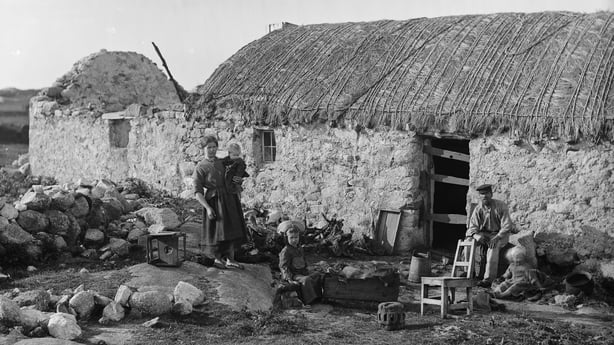
Falling down into a townland, a parish, a plot of nine acres. Three widows letting, subletting, never owning. Lives as lost as their unmarried names. The records of the Omagh District Asylum noted: "Mary Quinn escaped from laundry on the evening of 15 December but was not missed till bedtime… she escaped again on the 24th, but was brought back in an hour…"
*
I gaze at plot 10 that is not a cemetery; it is a mark on a map where three widows leased and sublet their lives. A walk away from the Female National School. Three fields from the Corn Mill. Suddenly that empty house in Dromore in County Tyrone in Ireland where a woman writes in mourning for the lost life of her daughter-in-law, her widowed son, his derelict children in Liverpool—suddenly that house seems crowded with disappearances and short-term rent. To her son in Liverpool my ancestor Mary Quinn wrote: "Frank is hired out . . . The melancholy is upon him. Don’t mention it if you write back."
*
In 1943 Jean Guéhenno wrote in his secret Resistance diary: "Renan said there was no use demanding freedom all the time. Just begin, he said, by thinking freely."
*
In a military witness statement Frank Thornton remembered: "We boarded the ‘St. Paul’ at Princes Landing Stage on that day and carried O’Donovan’s remains right along the Dock Road, the journey being over two miles. I think it can safely be claimed that by this method O’Donovan Rossa’s body had landed in Ireland when we took him on our Irish shoulders at Prince’s Landing Stage.
*
File notes on children to be deported from a care home in Liverpool to work on farms in French-speaking Canada:
Father: "a demobilized soldier."
Father: "supposed to be in County Down Ireland."
Questions on form to be ticked by care home:
Does it have good teeth?
Is it moral?
Is it baptized?
Sometimes we hear a little of the children’s thoughts in words scrawled in letters "home" to the priests who had deported them:
"I think I have a good chance of having a place of my own some day and showing the world what Liverpudlians can do."
WALKING
On Brook Street Philip said:
He’d been refused asylum and he’d been living on the streets
I was typing away trying to get him access to accommodation.
"Look at this picture. This was me."
Small phone; little grainy picture.
"This was the first day I arrived."
It was just him, smiling the best smile ever
a blanket of snow behind him.
"This was the first day I arrived. I had never seen snow."
I’m looking at him
holding this picture:
his face then and the way he is now.
The journey.
It doesn’t end when you get to the White Cliffs of Dover.
Not only are you suffering from the persecution
you’ve escaped from,
you are having to negotiate this opaque system
that feels like it’s structured to
beat you down into the dust…
There is that survivors’ guilt . . .
one of the boats had sunk.
"I’ve lost all my friends."
On 8th December 1849 in Brownlow Hill Workhouse a visiting journalist saw Mary Percy, newly arrived from Ireland, scream over and over:
What shall I do without my tongue?
4
1968: CIVIL RIGHTS MARCH, DERRY & FRENCH
SOCIAL REVOLUTION
The Hunger Strikes left her grandmother without speech; when she began to talk it took a priest from Africa to understand that what she was not saying, she was not saying in Irish.
*
Ghosts. We did not visit our dead. No rituals of grave decoration. The dead went on living with us. Their lives, their sayings, the names passed down through generations whose love for one another is so intense it makes breathing almost impossible. The Irish woman who lived in the house was my mother’s grandmother. "Me Nin" told a fairy-tale closer to Tyrone than Liverpool; shrouded in a blanket her refrain rested in the same opening and closing of stories that De Valera’s folk archive failed to collect in 1937. Those who had left were gone to the Free State; those from the now North were disappeared forever.
*
"Could you be pregnant?" She answered a sentence where the words "immaculate" and "conception" fell and broke.
My story is broken twice by ghosts.
*
Catherine reading the part of Susan in Virginia Woolf’s The Waves as the sun left the chapel in Cambridge said to Emma:
"Then like a cracked bowl the fixity of my morning broke, and putting down the bags of flour I thought, Life stands round me like a glass round the imprisoned reed."
*
Where are you now?
Are you working?
So what are you doing?
Are you on your own?
Her questions were always the same. "Where are you?" My mother was so confused the last time we spoke by the vagueness of my answers—all of which were spoken to an impossible truth—that she asked: "But where are you right at this minute so I can picture exactly where you are?"
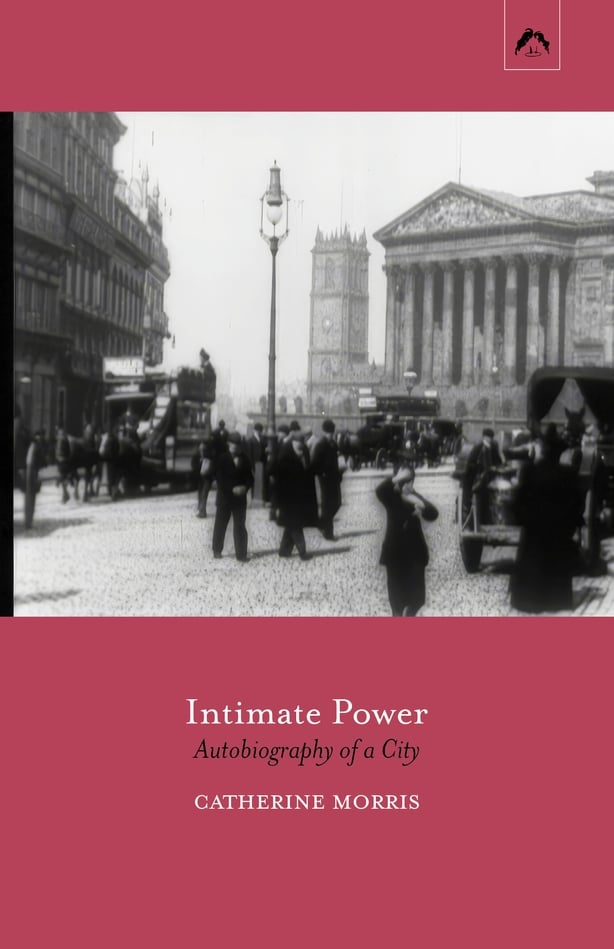
Intimate Power: Autobiography of a City is published by Spring Publications - find out more here
About The Author: Catherine Morris is a writer, curator and educationalist based in Dublin.
