



I've been thinking again lately about the visibility and invisibility of Irish art and Irish visual artists abroad – that is outside Ireland, or thar lear as the lexicon in my mind prefers to consider it.
Thar lear is a phrase in Irish/as gaeilge that acknowledges in a vague yet specific way the island nature of this place: that anywhere not here is over there, somewhere across the water, past our shores. Lear is an old Irish word for sea. Thar means beyond or over, and it's a word that is as much physical gesture and psychological concept as it is geographical. Thar lear can mean beyond as in extra, above and beyond, or passed as in past or beyond death (or life), and also something more as in another or further space: something or somewhere other than here, now. It's an acknowledgement that, in our most embodied understanding of our place in the world, there is here and there is other than or more than, or beyond here: overseas, over there, thar lear.
Watch: Irish artist Richard Mosse's The Enclave at the 55th Venice Biennale in 2013
One of the most persistent questions I’ve been asked as an Irish art critic thirty years now in the game is whether any Irish artists are famous outside Ireland? Are any painters, any sculptors, well known? Proper famous, they mean, like so many of our writers, musicians and actors are? Is any of our art history well known beyond these shores, in that other, extra, further, more than place, thar lear?

It's a question that shimmered into focus just before Christmas when British art historian, author of The Story of Art Without Men and host of the Great Women Artists podcast Katy Hessel responded to Irish singer CMAT’s call 'What about Irish art?’ Acknowledging her own lack of present expertise, she ceded a Substack post to the musician. ‘6 Irish women artists to know’ highlighted the work of Mary Swanzy (1882–1978), Mainie Jellett (1897–1944), Margaret Clarke (1882–1961), Una Watters (1918–1965), Dorothy Cross (b.1956) and Genieve Figgis (b.1972), who had featured on the GWA podcast in 2020. Hessel added a provocation of her own at the end: ‘Some more fantastic Irish artists: Aideen Barry, Alice Maher, Rachel Fallon, Diana Copperwhite… Who are yours?’
When (Louis) le Brocquy died in 2012, I was unable to find an international art critic working in mainstream media who had been aware of his work.
Patricia Hurl, Camille Souter and Daphne Wright were added in the comments. Irish painter Allyson Keehan expanded, ‘Just to add a few more to the list - Niamh O Malley, Isabel Nolan, Sharon Murphy, Ailbhe Ni Bhriain, Aleana Egan, Sonia Shiel, Emma Roche, Sheila Rennick, Geraldine O Neill, Aileen Murphy... all making an impact internationally.’ All of which brought me back to that persistent question: how much do they know about our art thar lear?
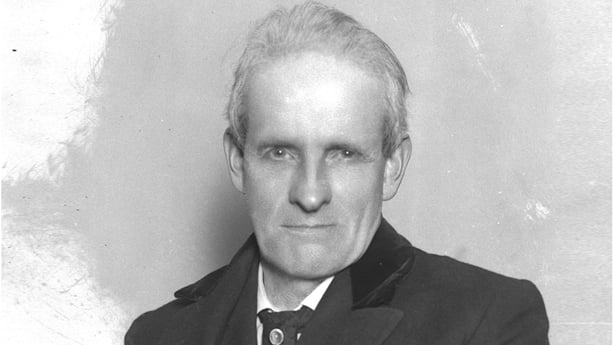
as 'the best-known Irish painter of the 20th century'
An internet search will give you Jack B Yeats, Paul Henry and John Lavery, perhaps Norah McGuinness, William Orpen, Roderic O'Conor, Louis le Brocquy, Francis Bacon if we can claim him, and contemporary names like London-raised Irish-American painter Sean Scully, Irish street-artist Maser and Dublin-born Glasgow-based video artist Duncan Campbell, who won the Turner prize in 2014. But (my asker will ask), where are the Picassos, the Van Goghs, the Frida Kahlos, the Tracy Emins? When le Brocquy died in 2012, I was unable to find an international art critic working in mainstream media who had been aware of his work.
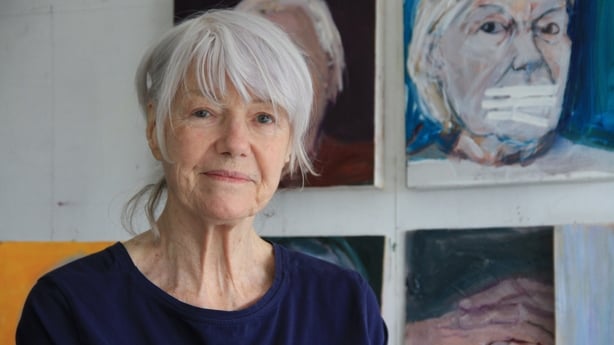
Cross, Fallon and Wright were included by British critic, writer and curator Hettie Judah in the UK iterations of her 2025/26 Hayward Touring show 'Acts of Creation: On Art and Motherhood', and she swapped some artists out to include more from the island of Ireland in the exhibition’s recent run at Visual Carlow. Kathy Prendergast, Geraldine O’Neill, Patricia Hurl, Elizabeth Cope and Trish Morrissey were among them, but again there was a sense of the world outside Ireland only slowly waking up to the wealth of art being made here. In December, Judah posted about Alice Maher’s Cassandra’s Necklace (2012), seen at Richard Saltoun Gallery in London, commenting 'Maher is one of Ireland's great campaigning feminist artists… I’d love to see more of her work shown over here.'
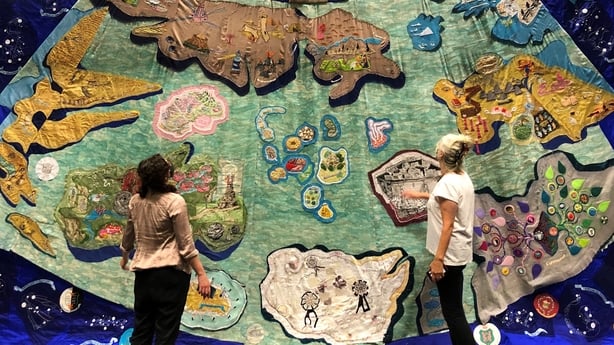
Maher and Fallon's epic textile work The Map (2021) toured to OFF-Biennále Budapest in 2025 and to the IAC in New York in 2024, where Hurl's major 2023 IMMA retrospective 'Irish Gothic' has just closed and Brian Maguire's ‘Portraits – The Failure of the State’ has just opened, running until June. Traditionally we may have fared better in, or at least looked to, America when seeking eyeballs for our big art names, but does any of this make Irish artists and Irish art more famous?
And so to the significant news that Irish artists Maher, Fallon and Alan Phelan are among 111 artists from all over the world selected by an international team (in honour of the late Koyo Kouoh) for the curated element of this year's Venice Biennale, where they will show alongside Marcel Duchamp (1887-1968) and Laurie Anderson, two names on the list the general public are most likely to recognise. (Anderson is set to play the National Concert Hall in Dublin in July.) Ireland first participated in the Venice Biennale in 1950, sending twelve works by Norah McGuinness (1901-1980) and Nano Reid (1900-1981) to the 25th iteration of the oldest and generally considered most prestigious art exhibition in the world. The last time we got significant international media attention for our Venice pavilion was when we sent Kilkenny-born photographer Richard Mosse in 2013. This year the Irish pavilion will be occupied by Isabel Nolan. Will any of this make any of them famous thar lear? Only time will tell.
The 61st Venice Biennale will run from 9 May to 22 November 2026 in Venice, Italy - find out more here
The views expressed here are those of the author and do not represent or reflect the views of RTÉ
