


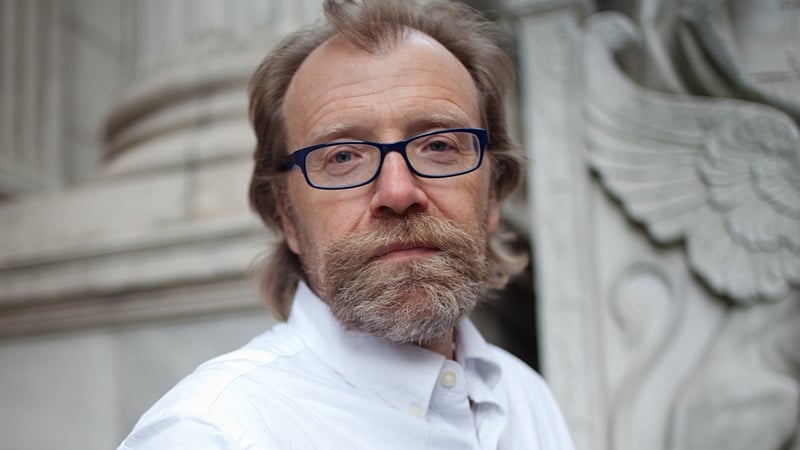

When news broke that George Saunders would be releasing a new novel this year, it rippled across book-loving communities like rumours of snowfall on a school morning.
Fans will understand the giddiness, stemming as it does from the sense that we're living in the same era as a literary legend - one that is as likely to write about farts as he is about living with the absurdity of grief.
Predominantly known for his short story collections, Saunders won the National Book Award in 2014 for Tenth of December, the Man Booker Prize in 2017 for his first novel Lincoln in the Bardo - soon to be adapted into both a stop-motion film and an opera at the Met in New York City - and both the MacArthur Genius Grant and the Guggenheim Fellowship in 2006.
Just last autumn, he won the National Book Foundation’s medal for Distinguished Contribution to American Letters.
We need your consent to load this rte-player contentWe use rte-player to manage extra content that can set cookies on your device and collect data about your activity. Please review their details and accept them to load the content.Manage Preferences
Listen: George Saunders talks to RTÉ Arena
Contrast this with his weekly Substack Story Club With George Saunders - wherein the professor of creative writing at Syracuse University writes warmly about his days, from touring schedules to class discussions, alongside teaching readers about short stories - and you land at a very unusual literary icon.
That divide between the profoundly lofty and the charmingly everyday is at the core of Saunders' new novel Vigil.
In it, an oil tycoon is visited on his death bed by first one spirit and then dozens, the first - Jill 'Doll' Blaine - sent to 'comfort’ him in his final hours and the rest urging him to recant on the decades he spent denying climate change and actively covering up scientific research into the harm of fossil fuels.
Holed up in his regal bed chamber, presided over by his loving wife and seeing nothing wrong with the life he’s led, K J Boone is visited by everyone from his parents and former colleagues, to an emphatic Frenchman and a lawyer from Rajasthan, who tells his story of dying in a climate crisis in bone-chilling detail. All are trying to get him to confess, to ask for forgiveness for his sins.
The plot, which is an impassioned exhortation on climate change and the corporate monoliths - human and systemic - that facilitated it, is undeniably political, but Saunders’ wisdom is to paint a portrait of our modern horrors by focusing on people, saving Vigil from being a mere 21st century parable.
Being a ghost story, it shares some of the same DNA as Bardo, such as how the spectres bear reminders of their former lives or deaths even in their ghostly state. But the form does away with the writing style of Saunders’ first novel, which takes its cues from screenplay writing or oral histories.
It’s not entirely like his short stories, either. With the length of a novel at his disposal, Saunders teases out the complex questions at Vigil’s heart that might have gone suggested in another story, inviting the reader to weigh up how we think about culpability and forgiveness, and how we judge the guilty, and if we should at all.
That said, Saunders’ mastery is here in force. He’s in his element once the ghosts arrive, jumping from character to character like a ventriloquist, inhabiting them in a far less invasive, but just as delightful, way. Few writers nail the specific absurd cadence of a true thought, or perfectly capture the petulance of teenage outrage or the beauty of a well-timed swear word or "golly, gosh", but Saunders does.
As is often the case, his humour is all the more uplifting because of the pain it’s threaded into.
Saunders’ comfort with the profoundly uncomfortable has become a trademark of his work. This novel leans into the thorny subject of death, legacy, repentance and self, huge themes that the author thumbs through with care and consideration. There seems to be an urgency to his explorations that might have something to do with him getting on (as spry a 67-year-old as he is).
In Joel Lovell’s introduction to Tenth of December, Saunders said, "If death is in the room, it’s pretty interesting. But I would also say that I’m interested in getting myself to believe that it’s going to happen to me".
"You cannot free him", Jill thinks at one stage about a particularly wayward figure, "But you might comfort him." Such could be the message that Saunders was writing to for this novel, thinking of his readers who are as lost and afraid and uncertain as he is.
Vigil is published by Bloomsbury
