



We present an extract from Saoirse, the new novel by Charleen Hurtubise.
In the wilds of Donegal, circa 1999, Saoirse is an artist living an outwardly idyllic life. Her tender husband Daithí and two beloved daughters are regular subjects for her work, and in them she has found the safe home that she has always longed for. She tends not to talk about her past, and those that love her have learned to accept that the full story is too painful for her to disclose. When her Dublin exhibition unexpectedly wins a prestigious award that invites a swarm of publicity, Saoirse is left panic stricken. The unanticipated recognition threatens to expose a decade's worth of buried memories and past crimes...
Early October, 1999
The front door is open and the full length of Daithí fills the frame. He leans against the doorjamb, soaking in the unexpected heat from the autumn sunshine. The mid- morning brightness splits the surface of the bay into shards of light below the house, dazzling Saoirse for a moment as she pulls the car between the gate piers, past the slate sign Daithí has fastened to the wall. Here, in their remote corner of Donegal, houses have no numbers, only names. Teach Cuan na Míolta Móra.
Eloise is slumped in her car seat; she has fallen asleep somewhere along the winding coast road. Saoirse can't bear to think of her youngest daughter’s face when the public health nurse cooed, tickled her thighs, and then surprised her with an injection in the arm. The child had jumped at the sting, her bottom lip quivering. Eyes, soft and dark as her father’s, filling with tears, looking at Saoirse as though she was the source of the betrayal, her own mother the cause of her now broken heart. She wept inconsolably as the nurse turned to her paperwork while Saoirse gathered the child in her arms, comforted her between sobs.
We need your consent to load this rte-player contentWe use rte-player to manage extra content that can set cookies on your device and collect data about your activity. Please review their details and accept them to load the content.Manage Preferences
Listen: Author Charleen Hurtubise talks to Miriam O'Callaghan
Saoirse pulls into a patch of shade at the end of the house, barely coming to a stop before reaching for her bag, rummaging for a sketchpad, a receipt – anything she might use to capture this moment, the light on Daithí’s face. Something about his position reminds her of the first time she sketched him in the garden at the Byrnes’ house. She fishes out a repurposed Altoids tin, prying open its lid, selecting a broken piece of charcoal – she finds an old bill in her bag, turns it over and blocks in the lines of his shoulders, his arms. It is not the first time she has considered painting a series using him as her sole subject, simply titling the exhibition Daithí. Add it to the growing canvases of her daughters playing at the sea, climbing the rocks, placing their tiny hands in the crevices of the walls surrounding the house.
Whichever her next series, it will be a happier collection than the one she is due to install in the Raymond Frank Gallery in Dublin next week. A van collected the canvases days ago. She was happy to see it move off down the road, her dark period as she knows it, as though it is all behind her now.
She will follow the paintings up to Dublin in a day or two. Daithí will drop her into Sligo town to catch the train. Fiona, the curator, no longer trying to hide her irritation, is insisting the paintings have a descriptive title at the very least. Gan anim – without name – will not suffice.
"They speak for themselves," Saoirse has argued, borrowing the curator’s own lingo. "You either connect with the work, or you don’t." But this exhibition is different from all the others that have come before. The smaller galleries allowed her what they saw as the eccentricities of the artist, leaving her to her own devices. She is aware of the scale and prestige of this upcoming exhibition – but what she hadn’t reckoned on was the scope of Fiona’s ambitions, her plans to not only curate the work but also to document Saoirse’s journey, to make a big deal of the trajectory that has brought her to this place most artists will only ever dream of reaching. Her resistance to this success, she fears, will bring its own suspicions.
Now Fiona has requested her sketchbooks to put on display, she will use them to write detailed descriptions for a catalogue in the absence of Saoirse’s cooperation.
"There are no sketchbooks," Saoirse has lied. But she does, in fact, have books full of drawings, graphic depictions, like untold confessions, events that happened just outside the frame. She keeps them locked in a secret place. When this is all over, and the exhibition is dismantled, Saoirse envisions herself burning the sketchbooks. The past can haunt someone else now, she thinks, and turns her hand back to this drawing of Daithí, back to the things in her new life which can be named.
Leah on the Rocks.
Daithí on the Threshold.
She breathes him in as she works.
Every happiness that is hers is right here, in this corner of the world. The slowness of the day, the blue sky rising tall above the house – a house Daithí has built for her and their two girls – Eloise, their baby, will sleep here, in the shade, windows open to the sea air. Her older sister,
Leah, builds a fairy castle on the rock beside the sea wall, draping seaweed for a bed; shells become the characters of her invented world. She stops now to wave to her mother pulling into the driveway.
Saoirse plans to go immediately to her studio; she will make larger sketches of this scene, of this man, and then she will turn to the canvas already drying on the easel – the girls barefoot amongst the rock pools. He will find her here – Mind your sister, he will say to Leah. He will come in and close the door, she won’t need much coaxing away from the easel where she is painting them into this corner of the world. The two of them, imposters in a country that reminds them, at many turns, they do not belong. But here – they are four now. They are one.
Daithí unfolds his body in the doorway, crosses his arms. And as he does it dawns on her – he is still home. He is home when he should long be at work, he should have Leah dropped at school by now – that was the plan while she took Eloise for her appointment. But here is Leah, in her uniform playing at the rock, here he is in the doorway, waiting for her return. She is unwinding the window, opening the door. A recognition passes through her. She feels the warmth leaving her body. He knows.
"What?" she asks. "What is it?" She tries to keep the panic from her voice. It puzzles her, then, when he smiles, in spite of this strange look in his eyes.
"Tell me!" she demands. She wants to rush to him, shake him, make him quickly say the thing she has dreaded hearing all these many years.
His voice is low, almost a whisper.
"Your man rang this morning."
She feels the blood draining from her face.
"I told him you weren’t home. He left a message." He comes across the gravel to her, takes her forearms in hands so large and comforting they could hardly belong to a human. It is then he sees the fear on her face.
"No, love. It’s all right. There’s nothing to worry about," he reassures her, caressing her, trying to unseat the panic. "It’s good news. Hey. Look at me." He takes her face in his hands. "You’ve won a prize. That’s it. That’s all."
Panic gives way to relief. She is rattled by her own sloppiness. If she is not careful, she will give herself away. She moves out of his grasp so he will not feel her shake, busying herself with lifting the groceries from the boot.
Daithí opens the door and unbuckles a still-sleeping Eloise, lifting her out of her car seat. She shift s and settles onto his shoulder, he smells the back of her neck, gives the folds of fat a soft kiss. He watches Saoirse, puzzled by her reaction.
"It’s good, babe," he says. "It’s all good."
"Okay," she says flatly. "You should get Leah to school."
"That’ll wait. She’s happy for you. Come inside," he says gently. "I’ll make a cup of tea. I’ve the details written down— "
"Give me a minute." Her Midwestern accent comes through in full force, the American accent is not something she can turn on or off. She finds, when she is happiest, she has the song of the language, fragments of someone who has lived in this part of the world forever. Now, she hears the syllables fall dead and flat, and fearful.
"I’ve to put these away." She nods toward the shopping bags, the handles cutting into her palm. She can’t afford any further attention brought to this exhibition. She turns to the sea, breathing, convincing her body it is not time to flee.
When she turns around, he is watching her, raising a question with the twist of a brow, a shake of his head. She knows he will ask questions later, but for now, for the children, he will play this out, and she will play along, too, feigning delight when he gives her the details of this latest prize she has won.
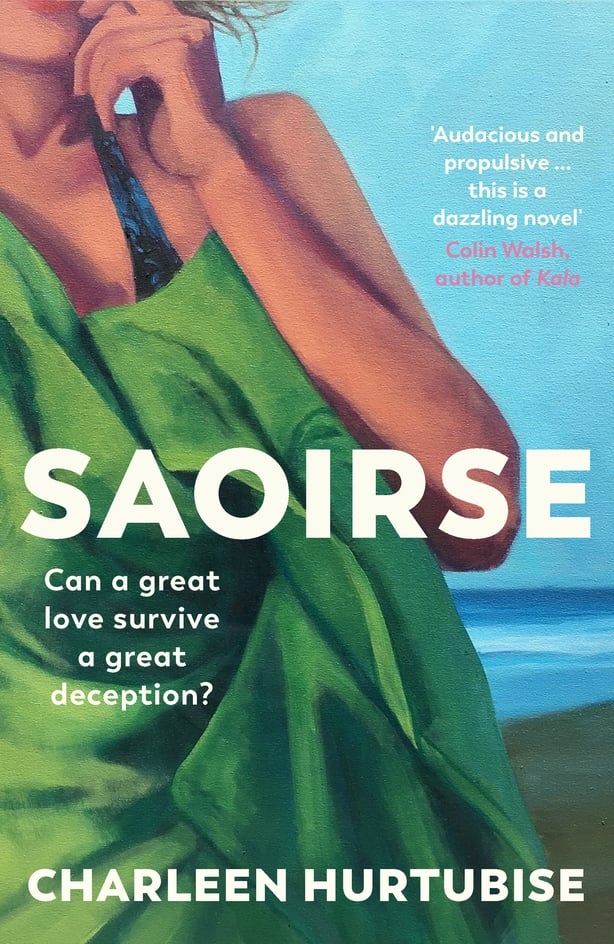
Saoirse is published by Eiru
