


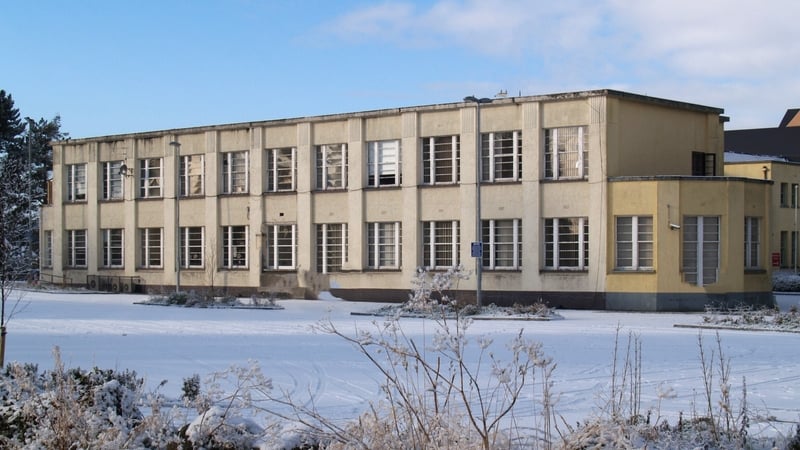

Within the Naas General Hospital complex is a time capsule of Ireland's healthcare provision during the 1930s. Its architect had embarked on a tour of more than sixty hospitals in mainland Europe before providing Kildare with one of the most modern hospitals for the treatment of infectious diseases.
In the early decades of the twentieth century, Ireland faced significant mortality from epidemics such as tuberculosis, typhus and scarlet fever. It was imperative to isolate patients from society to prevent the spread of these infectious diseases. However, older fever hospitals often facilitated the spread of illness due to cross-infection among patients. In response, the first Fianna Fáil government in 1932 undertook a massive programme of hospital building and reconstruction. The State's hospital programme was financed primarily by the Irish Hospitals Sweepstake - a form of national lottery - established under the Public Charitable Hospitals Act 1930.
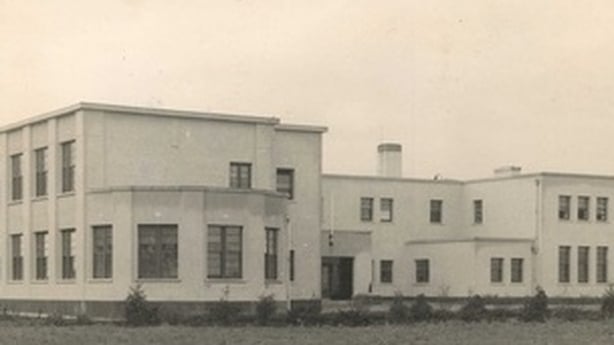
constructed of reinforced concrete and brick (Pic: Collen Construction)
In 1935, the medical advisers of the Department of Local Government condemned the existing fever hospital in Naas as unfit for purpose and requiring immediate replacement. The former workhouse, built in the first half of the nineteenth century under the Poor Relief (Ireland) Act 1838, was designed in the Tudor Revival style to accommodate 550 inmates. The architect for the new hospital was Vincent Kelly (1895–1975), who was appointed to oversee the hospitals programme and sent to study hospital buildings throughout Europe. In 1933, he embarked on an extensive tour to examine modern developments in the design, equipment and administration of hospitals. He inspected more than sixty hospitals over a period of almost three months.
This former fever hospital represents a unique period in Ireland's architectural heritage, marked by investment in health infrastructure on an unprecedented scale.
The new hospital in Naas was designed to minimise the risk of infection by providing for the segregation of patients suffering from different diseases, adequate bed spacing within wards, and increased numbers of medical staff. The design incorporated isolation rooms to facilitate observation where a diagnosis was unclear. The new hospital also provided a significant increase in capacity, accommodating thirty-eight patients, compared with a maximum of twenty-three in the old building. The building contract was awarded to Collen Construction.
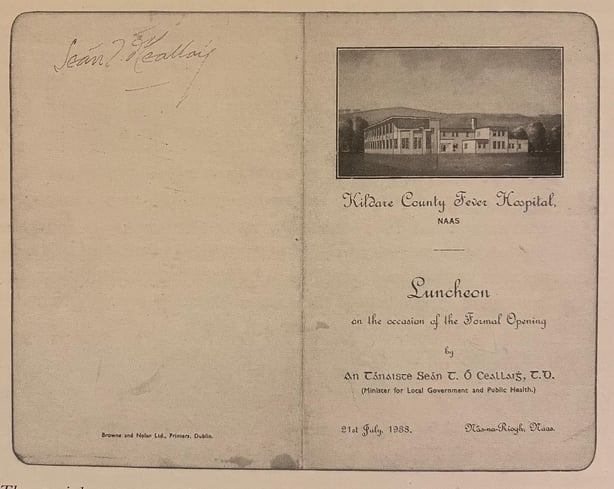
Fever Hospital on 21st July 1938, signed by An Tanaiste Sean T O Ceallaigh
Naas Fever Hospital is an eleven-bay, two-storey, flat-roofed building constructed of reinforced concrete and brick. Its stark geometric forms emphasise function and economy. As expected, all the wards and day rooms face southwards to maximise exposure to sunlight. Particularly striking are the single-storey canted pavilions, which boldly project and add variation to the elevation while providing terrace space for patients on the upper storey. The clean, well-lit and well-ventilated plain surfaces, devoid of decoration, testify to an architectural philosophy that placed the environment at the service of health. Seán T. O'Kelly, Tánaiste and Minister for Local Government, formally opened the new hospital, St Mary’s Fever Hospital, on 21 July 1938.
According to local historian Gerry McCarthy, the building ceased operating as a fever hospital in 1955–56 and was subsequently taken over by Kildare County Council for use as administrative offices. Today, the building serves as the local health office for the Health Service Executive and is listed on Kildare County Council’s Record of Protected Structures (RPS No. NS19-071).
This former fever hospital represents a unique period in Ireland’s architectural heritage, marked by investment in health infrastructure on an unprecedented scale. In less than a century, the architectural leap from the workhouse to the new fever hospital was astounding. A symbol of progress, the building embodies function, technology and aesthetics — all aimed at promoting the well-being and recuperation of patients.
Thanks to Gerry McCarthy and Collen Construction. Read more from the 100 Buildings series here.
