


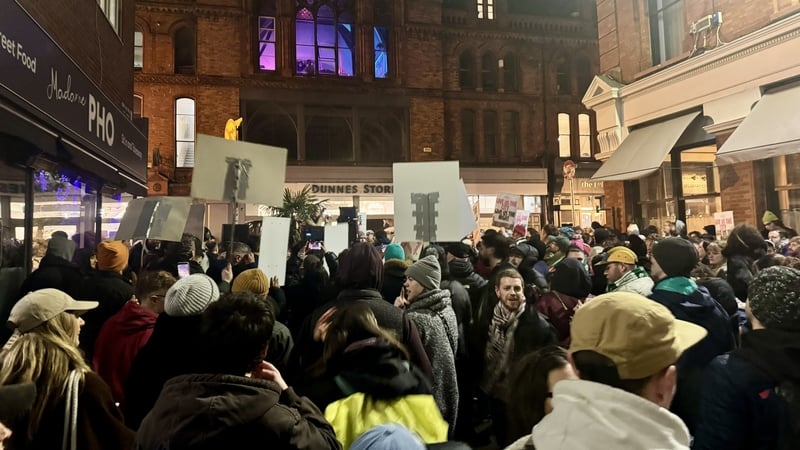

On Tuesday evening, a crowd gathered around DJs, decks and speakers. They wore hoodies, anoraks and baseball caps, smoked cigarettes and held beer bottles, moving to techno and house music. It could have been a tribute to Dublin's 1990s peripatetic rave scene. Instead, it was a street protest organised by People Before Profit, with ravers occupying Exchequer Street and carrying placards that read, "Take Back the City", "Fight Corporate Bullies", or the rather poetic, "The Hox is the Pox".
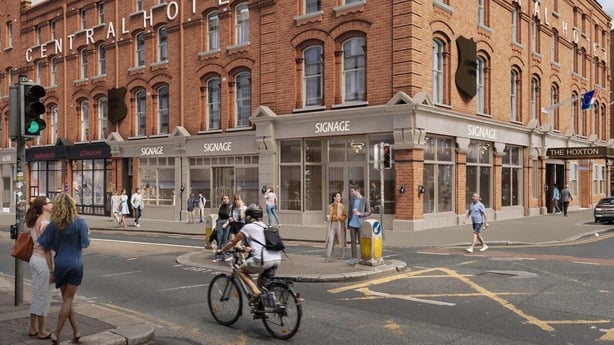
The protest's target was the carefully curated Hoxton Hotel. Located on the site of the former Central Hotel, Dublin’s newest import from London has, through a series of recent court injunctions against its neighbour Yamamori Izakaya, exposed an embarrassingly self-entitled mindset. Izakaya is emitting "late-night, low-frequency music noise and vibration", Trinity Hospitality (the Hoxton’s leaseholders) have complained to the High Court, while the new hotel simultaneously plans to establish its own nightclub in the basement.
Watch, via RTÉ News: Protest after Hoxton hotel seeks injunction against Yamamori Izakaya
Dublin's Hoxton Hotel opened in December 2025, but it is part of a property portfolio that has been expanding since 2006, when it launched in Shoreditch in east London, a stone’s throw from Hoxton Square. The area had been accumulating creative capital since the 1990s, a somewhat dilapidated spot inhabited and enlivened by artists and musicians. Here, a mischievous sense of sculptural experimentalism was matched by a soundtrack of drum and bass and acid jazz, as artists made new objects and sounds to fill the area’s large Victorian buildings and warehouses. The potential cachet of this was soon preyed upon by Jay Jopling, the famously bespectacled Etonian, son of Baron Jopling and shrewd YBA-flogging art dealer, swiftly building his own empire. When he expanded his contemporary art gallery from St James’s, near Buckingham Palace, the edgier east-end address became a credibility-building second site. Jopling’s White Cube Gallery opened its glass doors onto Hoxton Square in 2000 and, since then, commerce in the Hoxton area has advanced at the same rate it has expelled its artists. Commercial and residential rents are now affordable only to wealthy trust-funders, marketing executives and finance professionals, while the area’s hospitality merchants maintain the pretence of loyalty to the avant-garde.
Dublin's newest hotel builds on Hoxton’s paradox. Run by the Ennismore group, a "company rooted in culture and community", it has, over the past fourteen years, expanded Hoxton Hotels into multiple UK, US and European cities, each of unique cultural significance pre-existing the chain’s arrival. Key to the brand is accommodating luxury city breaks, strategically locating in areas dense with music, food, art and nightlife. Once installed, the interiors vary only slightly: velvety, upholstered opium dens scattered with wicker chairs, ceramic curios, low lighting, salon hangs and oversized succulents. Everything here indicates, somewhat formulaically, "we’re creative".
We need your consent to load this rte-player contentWe use rte-player to manage extra content that can set cookies on your device and collect data about your activity. Please review their details and accept them to load the content.Manage Preferences
Via Drivetime on RTÉ Radio 1: Hoxton Hotel says injunction 'not seeking to close' Yamamori Izakaya
While it is encouraging to see Dublin pinned for international visitors on the same art map as Brussels, Berlin and Rome (to name a few of the Hox’s recent openings), its arrival and ill-advised integration strategies come as the city’s own creative communities face existential threats: studio evacuations, closures of exhibition and rehearsal spaces, housing and student accommodation crises. The recuperation of artists’ spaces for urban gentrification is not a new phenomenon, nor are the daily pressures of housing and city planning in Dublin. Yet there is an acute set of contradictions for artists facing evictions from spaces like The Complex just as art-varnished multinationals such as The Hoxton arrive so neatly in their wake.
The creative claims of The Hoxton, and hotels like it, both complicate and disguise much deeper problems that the city ought to address for the careful custodianship of the arts.
Inside, The Hoxton has established a collection of art gathered by Carrie Neely, who runs the Belfast-based consultancy Art Loves. On social media, the physical exertions of this task have been condensed into enjoyable short videos. The Hoxton joins a small fleet of Irish hotels using art collections as part of their unique selling point. This includes the Dean Group, which has employed the London-based Jenn Ellis of APSARA Studio to develop a "global art programme", while its website reminds us of its prioritisation of art as "how we tune into the culture of our neighbourhoods". While lovely in principle, international visitors would genuinely struggle to find working artists or studios near these hotels’ upmarket city locations.
This is not to undermine the integrity of these collections, the financial lifeline they offer Irish artists at different stages of their careers, or the satisfaction artists may legitimately glean from seeing their work displayed among others in convivial semi-public spaces. I remember having breakfast with a sculptor friend in Shoreditch House some years ago, an early prototype for the art-collection hotel, which opened in the same area and around the same time as the Hoxton. She was then squatting in an old church because she could not afford rent or studio space; its draughty interiors had no shower or kitchen. Shoreditch House had acquired several of her beautiful works in exchange for hotel membership, access to its pool and a restaurant tab. She used the hospitality card frugally, to shower and occasionally have breakfast. I felt happy with her that morning, eating croissants and catching up, but looking back it was a bleak reflection on how the city had forced its artists to live while trading so aggressively on what they produced at its margins.
The creative claims of The Hoxton, and hotels like it, both complicate and disguise much deeper problems that the city ought to address for the careful custodianship of the arts. The lack of provision of the space necessary for art’s creation — all kinds of art — is a problem that will require the combined efforts of various government departments and solution-finders within creative disciplines to achieve meaningful legislative change. And this is possible. The culture minister, Patrick O’Donovan, hit international headlines last week when launching the Basic Income for the Arts scheme. "This is a gigantic step forward that other countries are not doing," he announced, quite rightly. It is time for the next step in preventing precarity. The green wave of cultural excellence that Ireland is showing the world comes from real artists needing real spaces to work, on the ground.
About The Author: Isobel Harbison is a writer and art historian from Dublin who lectures at Goldsmiths, University of London, and returns often.
The views expressed here are those of the author and do not represent or reflect the views of RTÉ.
