



Foul is fair and fair is foul in Una McKevitt's macabre comedy Fair Deal at the Peacock Theatre.
Having inherited "one of those council houses with the large gardens that everyone wants now" from her grandmother, and alongside it the care of her grand-uncle Terry, Fair Deal opens on what should be Keira Thornton's (Caroline Menton) final night in the Thornton family home before its sale is complete and Terry is transferred to a nursing home.
When Keira finally rids herself of a Tinder date from the night before - the physically and emotionally über-pumped Rio (Jack Weise) - all the ties that bind finally seem to loosen, long enough at least for the uptight tech worker to celebrate with a takeaway and her SRI-swilling thespian uncle Daragh, played in a choice comedic turn by Gareth Lombard. But as everyone comes to acknowledge that "fair f**ked off long ago," the best-laid plans are usurped by the abrupt arrival of Keira's high-flying celebrity interior designer mother, Sandra (Aislín McGuckian).
We need your consent to load this rte-player contentWe use rte-player to manage extra content that can set cookies on your device and collect data about your activity. Please review their details and accept them to load the content.Manage Preferences
Listen: Playwright Una McKevitt and director Conall Morrison talk Fair Deal on Arena
The quiet luxury of Sandra’s camel-hued wardrobe (fittingly designed by Joan O’Clery) betrays her overbearing, autocratic personality and shrinks in the wake of her shrill American twang, notions, and oversized sunnies. Squaring up to the crassly gilded golfing portrait of her deceased mother that looms large over the compact living space, the apple, it seems - despite Sandra’s best wishes - doesn’t fall far from the tree.
The success of Fair Deal lies in its farcical ability to offer the macabre as a night's relief from the world’s darkness.
This combative family dynamic, and Sandra’s intent on disrupting the sale of the house for personal sport, puts the audience on course for a domestic drama visually reinforced by Liam Doona’s "upwardly mobile" sitting-room set, replete with white porcelain dogs and red damask wallpaper reminiscent of the Old Vic pub in EastEnders. Indeed, Sandra’s monomaniacal compulsions swerve the evening into unexpected consequences worthy of the drumbeat of its iconic theme tune. This behaviour simultaneously hurls Fair Deal from family saga into not so much "bedroom farce," à la Alan Ayckbourn, as "bedsit farce". Madness and hilarity ensue in fitted peaks amongst avalanches of revelation and exposition.
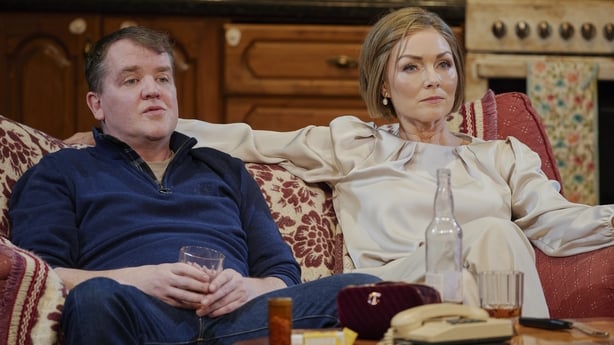
Despite its antics, under the solid marshalling of director Conall Morrison, Fair Deal is well paced. However, the transition between (or melding of) genres is troubled by the separate demands of drama and farce, and the arc between realistic and hyperbolic performances would benefit from greater trajectory.
Playwright McKevitt touches upon themes of care previously explored in her background in documentary theatre, and there are home truths that seep out amongst the mayhem, such as Keira’s concern for her grand-uncle in care: "I can’t help but think anyone could do anything to him in there," or her own misery as a tech industry worker: "I hate it but it meant I could buy my own house." Of course, the grappling over the house speaks to Ireland’s housing crisis, and the genre of farce lends itself to the farcical situation so many people find themselves enduring as a result of the belief, as Sandra puts it, that "exploiting an asset is a sane and normal thing to do."
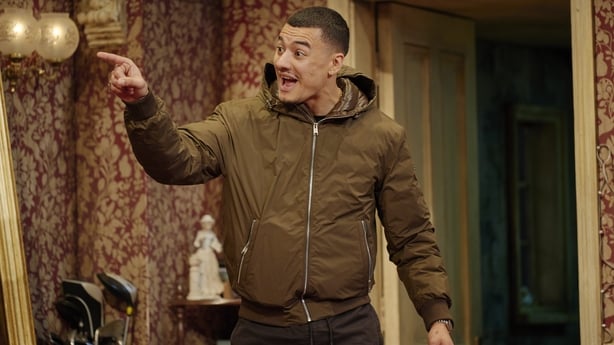
Fair Deal showcases McKevitt’s promise as a comedic writer, and Lombard opens up the tragi-comic expanses of Daragh - an actor who gets "small parts in big films and big parts in small films" as a result of being "one of the few actors of your age remaining in the country." The play, however, is at times overwritten, where every action meets a tightly bound reaction, even in situations where words should fail. While it is an Abbey Theatre commission, it might equally have been realised in film; and in an art form that needs rejuvenation, the question playwrights should keep central these days is "Why theatre?" That said, the success of Fair Deal lies in its farcical ability to offer the macabre as a night’s relief from the world’s darkness. That, in itself, is a fair enough deal.
Fair Deal is on the Peacock stage at the Abbey Theatre until March 28th
