


Artist Jesse Jones introduces Patient Labyrinth, a new artwork and exhibition from Junk Ensemble currently showing at Rua Red Galleries, Dublin.
Drawing from the Greek myth of Ariadne's thread and Mincéirí / Traveller folklore, the exhibition unfolds as a labyrinth within a labyrinth where the five elements mark the thresholds - each an echo, a path, a memory, a reminder.
What does it mean to world the world: in Patient Labyrinth we enter a world that has been worlded with instinct and intention, materials and magic, woven through the thread of folk memory, intergenerational stories, passed on like knots, reminding us of the pathways home and when to be lost.
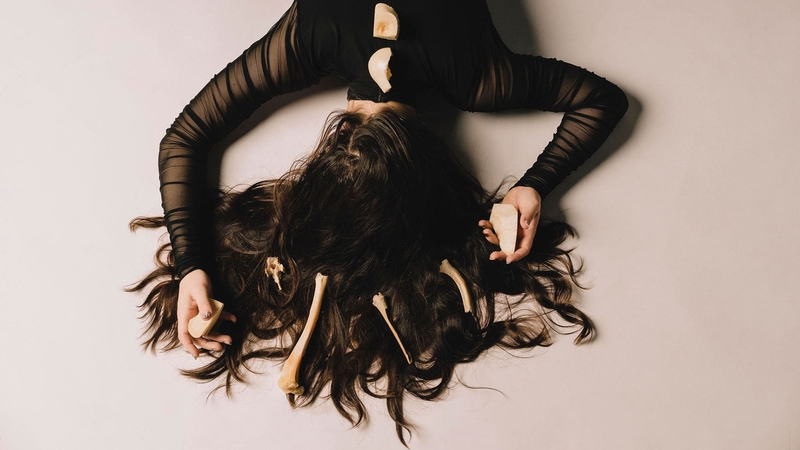
Patient Labyrinth is a spell and like any spell, materials matter. The bones of a sheep, boiled and stripped of their meat, are ritually cleansed in fragrant herbs infused with magic and meaning. When I encountered this ritual for the first time in the studio with (Junk Ensemble's) Jessica Kennedy and Megan Kennedy, I was struck by the metaphor it represented. This magical spell passed on by Oein DeBhairduin, a writer, activist and educator, formed a protection spell and spoke to the intention of the work, to strip back to the bone their practice of the body grounded in myth and movement and infuse it with instinct, conjuring, and enchantment.
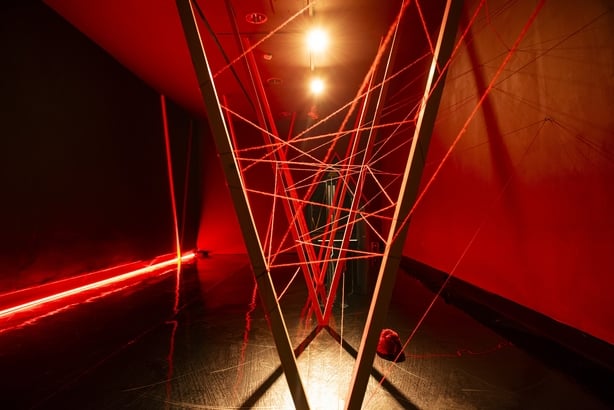
Patient Labyrinth's path is less defined; it is not a map. It refuses the plotting of clear trajectories for the body, fixed to time, but instead proposes the structure of labyrinthine wandering, beyond cognition of space to a place of intentionally getting lost. Losing one’s self is the antithesis of the current age, defined by fear of 'lostness’. Our reliance on Google mapping for simple tasks and navigation as we scroll through continuous streams of visual information means our algorithms create false rhythms in the body, allowing for a continuous process of forgetting what has come before. It is a maze in which being lost creates disengagement with our collective bodies as we are each allocated a zoom scrolled maze of our own individuation.
The soft fascination of Patient Labyrinth issues a reignition of the mesmeric qualities of the unknown, the pleasure of the body lost in darkness.
Patient Labyrinth instead proposes a phenomenology of lostness in resistance to this Mazeophobia. Mazeophobia; defined as the primal fear of being vulnerable and alone when in unfamiliar environments and where escape feels difficult. In more than one conversation with Jessica and Megan throughout my dramaturgical process, they insisted this would not be a maze but a labyrinth, a place for a soft fascination with the pleasure of being lost, heightening the sense of being a body in place and time. Yet in this lostness there is always the body.
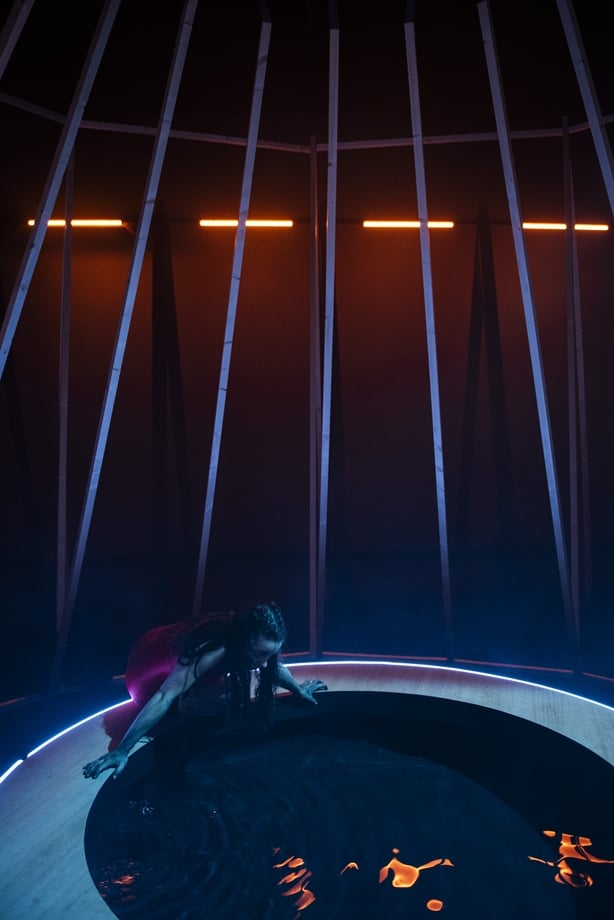
Scenes from a breathing labyrinth
Patient Labyrinth is both an architecture and a home, in particular a home to the body of performer Róisín Harten; whose activation pathway through the labyrinth reminds us of our own capacity to be untethered. From the first threshold: the spirit world, she ties her red threads through the hands and knuckles of audiences, echoing the red threads of Ariadne from Greek myth who gave Theseus a clew of yarn to enter the labyrinth and slay the minotaur. Patient Labyrinth is a warren of multiple minotaurs, made throughout the performance by Róisín from clay, an accumulative gesture folding between, object, relic, and ritual.
The clay minotaur’s companions are the cow’s knucklebones which were ritually blessed by Jessica and Megan, adapted from another ritual. These bones form an exterior spinal cord, we witness the body inside out, as Róisín crawls through the cavernous earthen floor. Clay, bones and flesh meet in this slow movement, dragging the body through the writhing darkness as an earthworm presses through its underworld.
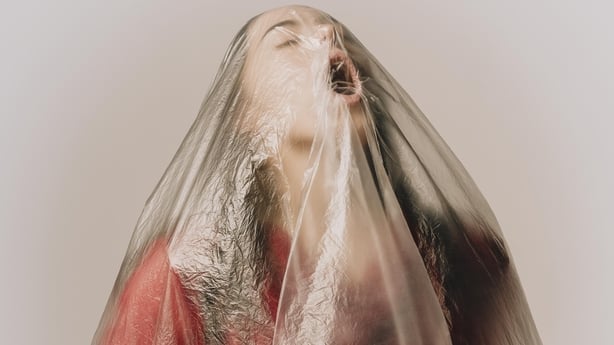
The labyrinth continues, echoing the veils between worlds - both seen and unseen – and there is an insistence on breath as a pneumatic force throughout. The quotidian simplicity of a plastic dust sheet is transformed into a saint’s reliquary of living flesh, undulating and rustling beneath the sheet until the rhythmic flow of the body becomes a watery pulsing serpent, a sea creature, a storm that dissolves the veil itself. In the patient labyrinth the body is never still, it is always in a propulsion between realms, gilded by intent through the elements; spirit, earth, air, to arrive at fire.
Patient Labyrinth is forged in the belief that materials and our ordering of them in the world is a form of enchantment, a push back against the maze of the rational, and a release into soft fascination. Soft fascination as defined by environmental psychologists Rachel and Stephen Kaplan, relies on all the senses to create a state of effortless and gentle attention that restores the mind and body. It is a core component of Attention Restoration Theory (ART), which posits that time spent in natural environments allows the mind to disengage from cognitive labour focused tasks and be guided into ambient stimuli, like the leaves rustling in the wind or patterns in clouds. Its key quality is patience, a patience to allow for cognitive fascination to build, and the maze of overstimulation to disappear.
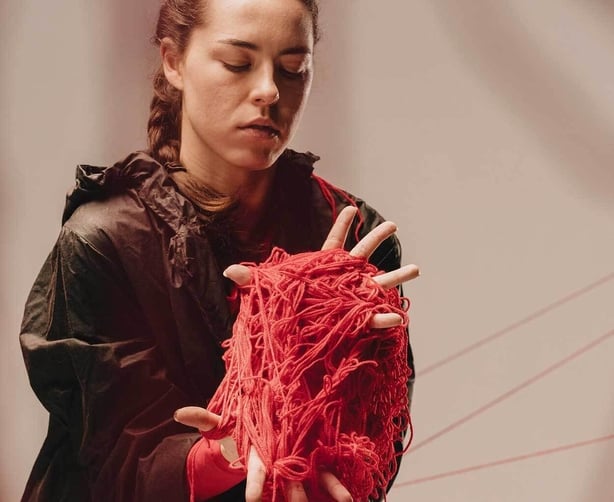
The soft fascination of Patient Labyrinth issues a reignition of the mesmeric qualities of the unknown, the pleasure of the body lost in darkness. A darkness that is not an absence of light but rather emerging from a continuous red thread. This red thread of artistic thinking, rooted in an embodied practice, believes in the body not only as a repository of archetypal myths mapped to histories of violence, but as a body with agency that is capable of remaking the world.
Mythologist Penelope Doob believes, "The labyrinth does not imprison; it instructs". The centre is not a point of resolution but a site of encounter with mystery itself. Like all mystery, the answer is always in the centre, and the centre heart of Patient Labyrinth waiting in stillness, is the well. These waters, expectant and whirling and drawn from the origin pool of the land, are pregnant with the possible blessings they might bestow; through protection and prophesy.
They remind us that water itself, as it exists everywhere, its oceans, rivers and streams and living in the deep interior of every cell of our body, can predict the emerging shape of anything that touches it. Inside us all, pulsing and flooding in this darkness, is the very thing that will bring us out of the unknown, towards the conjured speculation of worlds that are yet to be.
Patient Labrynth is at Rua Red, Dublin until February 14th, 2026 - find out more here
Images: Luca Truffarelli, Fionn McCann
