



It is coming up to that time of year when social media feeds are dominated by personal playlists: The Top Ten Artists I Have Listened to This Year. If you are streaming your music in Ireland, it is likely that Taylor Swift, Raye, or the number one singles from the fictional Korean pop bands in K-Pop Demon Hunters will feature somewhere in yours.
My personal soundtrack for 2025 was far less cooler.
My favourite songs of 2025 - which have been my favourite songs since childhood, really - were written by a musician born more than 100 years ago, a singer-songwriter whose ubiquity has been almost eclipsed by his success.
You may not have even heard of him, but you will most certainly know the lyrics to at least one of his songs. From Anything You Can Do? to White Christmas, Cheek to Cheek to Let's Face the Music and Dance, his ditties have been recorded and reinterpreted over more than a century by artists as diverse as Frank Sinatra, Bob Dylan and Cher, and by an animated mouse named Mike in Sing: The Musical. As the king of Tin Pan Alley in the 1910s and 20s, he contributed dozens of standards to that amorphous musical catalogue known as the Great American Songbook. He even wrote an unofficial national anthem for America, which is still widely performed at sporting events and political rallies today. Not bad for a Russian Jewish immigrant who left school at 8 and could barely read music. Take a bow Mr Irving Berlin.
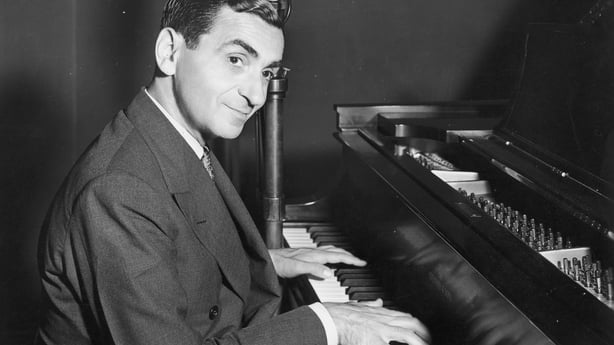
(Photo by FPG/Archive Photos/Getty Images)
Berlin wrote his first songs as a teenage newspaper boy, collecting tunes as he delivered rags across the Lower East Side of New York City, where his family settled after fleeing the Russian pogroms in the late 19th century. The sounds of the street were a critical part of Berlin’s musical education. Graduating to the role of singing waiter in Tin Pan Alley - the centre of the music publishing business in New York - Berlin developed a musical signature that was a hotchpotch of sidewalk styles, drawing on rags and ballads, polkas and waltzes for uptempo inspiration. Delivering meals on silver trays, he would improvise around popular standards, coining musical riffs that were as catchy as advertising jingles. Lunching publishers recognised his talent, and he was headhunted as a lyricist by one, where his songwriting talents were soon recognised.

The theatrical revue quickly became Berlin’s bread-and-butter. Inspired by the music halls of Paris, in particular Les Folies Bergeres, the theatrical revue was typically a mishmash of entertainments: dramatic sketches knit together by song and dance. Berlin's early ballad A Pretty Girl is Like a Melody became the anthem for The Ziegfeld's Follies at the New Amsterdam Theatre, the most famous of New York’s vaudeville houses, while his jaunty 1911 hit, Alexander’s Ragtime Band, sparked such international passion for the jagged, jazzy ragtime dance style - an affront to formal propriety of the ballrooms - that German newspapers called the song "a public menace."
If it seemed inevitable that someone would turn Top Hat into a live theatrical performance, it actually took almost a century for a stage adaptation to emerge.
When Berlin was drafted during World War One, however, he became a national hero in his role as an unofficial composer to the US Army. As part of his service, he wrote a military-themed revue, which included the patriotic God Bless America, although Oh! How I Hate to Get Up in the Morning is the more musically memorable tune, and remains a perfect pick-me-up on dark winter mornings.
We need your consent to load this Spotify contentWe use Spotify to manage extra content that can set cookies on your device and collect data about your activity. Please review their details and accept them to load the content.Manage Preferences
By the 1920s, Berlin was scoring whole revues himself. He even founded his own theatre in which they would play, and The Music Box Theatre remains a key Broadway institution, although it stages dramas rather than musicals these days (Neil Patrick Harris, no stranger to musical theatre, is currently starring there in Yazmin Reza’s Art). Berlin's hits from this fertile period included some of the 20th century’s greatest love songs, like Always (check out Patsy Cline’s definitive version) and What’ll I Do? (Chet Baker’s smooth sax-heavy recording is my favourite). It also included Puttin’ on the Ritz’, which was recorded shortly after its first publication by song-and-dance star Fred Astaire, who would become one of the great interpreters of Berlin’s work as the composer’s songs started to become immortalised in celluloid. One of the composer and dancer's most famous collaborations was their first filmic adventure Top Hat (1935), whose polka number, Cheek to Cheek, won Berlin his first Oscar nomination, and a number one spot on the singles chart, when it was recorded that year by the Boswell Sisters.
We need your consent to load this Spotify contentWe use Spotify to manage extra content that can set cookies on your device and collect data about your activity. Please review their details and accept them to load the content.Manage Preferences
Berlin finally won an Academy Award in 1943, for the title song in his seasonal fantasia White Christmas, which also starred the Top Hat duo of Astaire and Rogers, but it is Top Hat - a ridiculous romantic comedy driven by metatheatrical tricks, mistaken identities, and a soundtrack of syncopated rhythms perfect for tap dancing in tandem to - that remains the most beloved of Berlin’s works: a comforting classic that captures the decadence and frivolity of the interwar years perfectly.

If it seemed inevitable that someone would turn Top Hat into a live theatrical performance, it actually took almost a century for a stage adaptation to emerge. Premiering in 2011, the live production - which visits the Bord Gais Energy Theatre this January, in a new touring production directed and choreographed by Kathleen Marshall - uses Berlin’s original score as a starting point. In their neat adaptation, co-writers Matthew White and Howard Jacques absorb six other Berlin standards into the narrative action to solidify the story of star-crossed lovers, performer Jerry Travers and model Dale Tremont, whose compatibility as dance partners is continually complicated by confusion. In the second half, the song and dance comedy segues into straightforward farce, with sham weddings and behind-the-scenes skullduggery providing laugh out loud moments to accompany the restoration of harmony and a happy ever after.

One review for the premiere of Top Hat: The Musical provided a highly quotable summation of the stage confection: "great songs, daft book." But what might seem on the surface damning is actually an authentic response to the pleasure of Berlin’s work, whose melodies and musical moods are more memorable than any plot he spun out of them for the movies. The great American musical theatre composer, Alan Menken (The Little Mermaid, Beauty and the Beast), speaks of "music as a bed for lyrics to rest on." But with Berlin the opposite is true, and his greatest achievements were not lyric narratives, but the more throwaway pleasure of instantaneous entertainment, which Top Hat: The Musical maintains with oodles of goodhearted energy and visual flair.
There is a reason Berlin's work has lasted over the centuries and remains top of my playlist year on year. It may not be K-Pop cool, but it is cultural comfort food of the highest order.
Top Hat runs at the Bord Gáis Energy Theatre, Dublin from January 27th-31st 2026
