


As 2025 draws to its uneasy close, Dublin’s independent arts landscape has entered one of the most fragile periods in its recent history, writes Frank Wasser.
The Complex, among the city’s few remaining large-scale multidisciplinary arts centres, has been served with a notice to quit its premises in the north inner city, giving it until 14 January 2026 to vacate unless urgent state support materialises. Almost simultaneously, Ormond Art Studios—another longstanding workspace for artists—announced that it too would lose its home on Ormond Quay after a fifteen-year tenancy.
Taken together, the situation exposes a cultural emergency long in the making, one that artists, curators, and observers say speaks to a deep structural neglect of the arts in Ireland’s capital.
For almost two decades, The Complex has made a home in a converted warehouse on Arran Street East, transforming a once-derelict building near the old markets into a place where artists, performers, musicians and audiences collide. Its model has always been both practical and ambitious: studios, a gallery, a theatre, rehearsal rooms and performance areas all co-exist under one roof.
This is not an institution built on large budgets or detached administrative systems; it is a grassroots organisation shaped by the textures of the city around it. Artists have historically been able to develop new work there—often work that requires risk, experimentation, and time, conditions increasingly impossible to find elsewhere in Dublin.
The Complex now faces losing its home unless the government intervenes. Unlike many arts spaces that vanish silently due to rising rents or redevelopment, The Complex has mounted an active campaign to secure its future. Its director has described extended discussions with the former Minister for Finance Paschal Donohoe, including a proposal involving a co-purchase arrangement with a private developer. Under this plan, The Complex would retain its portion of the building while other parts would be redeveloped, creating a hybrid site that would protect cultural use while allowing for commercial investment. But these discussions did not culminate in a funding commitment before Donohoe left office, and the plan stalled.
It is difficult to reconcile the situation with Ireland's expanding global reputation for film, music and visual art.
Central to the survival of The Complex is a €6 million funding request lodged with the Department of Finance—identified as the final and critical piece of the financial structure needed to secure ownership of the site. Although Dublin City Council has indicated its willingness to help bridge part of the shortfall, the absence of a state commitment has left the project in limbo. As of this writing, the newly appointed Minister for Finance, Simon Harris, has not contacted The Complex, even several days after the eviction news became public. For many in the cultural sector, this silence has deepened fears that the fate of one of Dublin’s largest artist-led spaces is hanging by a thread.
Throughout the uncertainty, Complex director Vanessa Fielding has maintained a clear stance: "we are not closed." She has consistently underscored the scale of what is at risk—not only for the staff and studio artists, but for Dublin’s broader artistic ecology. The Complex was due to host elements of the 2026 Dublin International Film Festival, an event that contributes significantly to the city’s cultural standing. The loss of the venue would derail months of programming, disrupt commissions, and have a ripple effect across multiple disciplines. For many artists, the centre is not simply a workplace but a rare site where artistic, social, and civic life intersect.
The fragility of The Complex is part of a pattern that has intensified across Dublin in the last decade. Spaces such as Basic Space, Hangar, Block T and the Tivoli Theatre have all disappeared under pressure from rising property values and commercial redevelopment. Each closure chips away at the ecosystem that allowed earlier generations of artists to establish themselves. Losing both The Complex and Ormond Studios in the same season would be a devastating blow, effectively accelerating a cultural shrinking already well underway. Ormond Studios, which has operated on Ormond Quay for fifteen years, has confirmed that its lease has ended and that its members are now searching for a new home—though when they will ultimately be required to vacate has not yet been announced. Their circumstances mirror those of many small collectives across the city: long-term tenancy ends, skyrocketing rent prices block alternatives, and landlords show little interest in working with cultural organisations.
Artist Bill Harris, speaking on behalf of Ormond Studios, captured the starkness of the situation with precision: "What we have found so far with our move is that there really is no framework, process or guidance for artist organisations or studios during times of upheaval like this. The Irish approach towards property is one of financial production alone and that's something we have really felt with our current search. Land owners can comfortably keep their buildings empty rather than try to understand a way of working that doesn't fit into the regular 'office' ideas they are sold. While we have some new leads which we are very hopeful for, our experience so far has been one of skepticism and cynicism from those within the Dublin property scene after formally edging us for months."
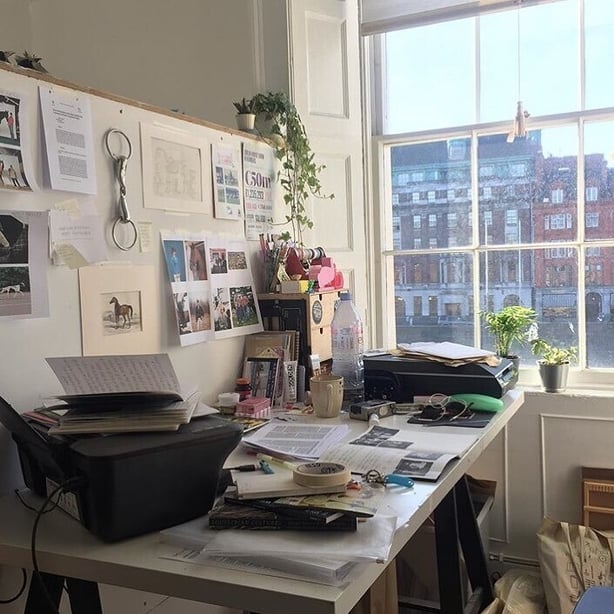
Artists who have studios at The Complex have echoed that sentiment. Ronan Ó Raghallaigh, who works from a studio in the building, emphasised the stakes involved: "We need balance in our capital city with support for grassroots culture and not just for hotels and big companies, and we need the government to support spaces where artists can work, meet, experiment and develop their practices. We are deservedly proud of our history of art and culture in Ireland, but we won’t have great artists if we don’t have spaces for them to practice. The complex is a multifaceted organisation with studios, gallery and multi purpose theatre space and it contributes so much to the city." His words point to a truth that policymakers frequently overlook: cultural production depends on physical space—affordable, stable, long-term space.
The importance of The Complex is reflected not only in its day-to-day function, but in the artists who have shown there. Among them is Sean Lynch, who represented Ireland at the 2015 Venice Biennale and later collaborated with Laura Ní Fháloibhín on an exhibition at The Complex that responded directly to the history and architecture of the building. Spaces capable of supporting such ambitious, site-specific work are increasingly rare, and Lynch’s involvement illustrates the cultural level at which The Complex operates.
Despite its track record, the building's landlord has chosen to sell, and The Complex now faces losing its home unless the government intervenes.
Mark O’Gorman, curator of The Complex’s gallery programme, articulated this role clearly: "Our programme has always been particularly ambitious. There isn’t going to be another place like this — a bridge-space where artists can take risks, experiment, and try things they can’t do elsewhere. Spaces like that are incredibly rare. What we do here brings people together across communities and generations, and in recent years we’ve begun to build international connections too. All of that is now at stake, and it’s hugely important."
Artist Sean Lynch, expressed the cultural stakes even more starkly: "Spaces like The Complex are a rarity internationally at this stage - community led, always asking more of the places and people it engages. It lifts everyone up. Society has achievements and high points and this is one of them. It’s a decision ahead about whether you want these kinds of possibilities in Ireland."
It is difficult to reconcile the situation with Ireland’s expanding global reputation for film, music and visual art. The Basic Income for the Arts was rightly heralded as a milestone, yet it is fundamentally undermined if artists have nowhere to produce work. A nation cannot celebrate its artistic achievements while allowing its cultural infrastructure to dissolve. Without stable, affordable spaces—studios, galleries, performance venues—the pipeline of future talent collapses.
Dr. Frank Wasser is an artist and writer based between London, Vienna and Dublin. He is a lecturer in Art and Critical Studies at Goldsmiths, University of Dublin.
The views expressed here are those of the author and do not represent or reflect the views of RTÉ
